
The Eiffel Tower Was Hated at First
How France's most iconic landmark was not only hated, but rejected by another city.


It's difficult to think of a more iconic building than the Eiffel Tower in Paris. It's an iconic landmark and is considered the second most recognisable building and landmark on the planet, only being beaten by the Statue of Liberty in New York. It's hard to imagine that what is today considered a symbol of Paris and romance was once hated. The Parisians would call it the "iron monster" and a "tragic giant lamppost," with writers and artists warning that building the tower would ruin the skyline and humiliate all the other monuments of Paris.
Why was it built?

The Eiffel Tower was designed by the French engineer and entrepreneur Gustave Eiffel, after whom the tower gets its name, to celebrate the 100th anniversary of the French Revolution in 1889. What's even more fascinating is that Gustave Eiffel also played a key role in designing the Statue of Liberty, meaning the two most iconic monuments in the world were both connected to the same person.
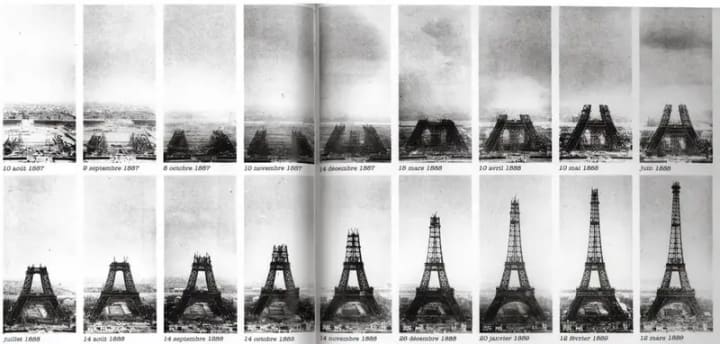
The Eiffel Tower was not meant to be a permanent part of the Paris skyline. It was meant to be a temporary structure and only had a 20-year permit before being scheduled for dismantling in 1909. What prevented its destruction was Gustave Eiffel's genius. Anticipating its fate, he deliberately promoted its use for various scientific experiments in meteorology and physics. By proving its value in science, he helped to overshadow the initial hatred it received.
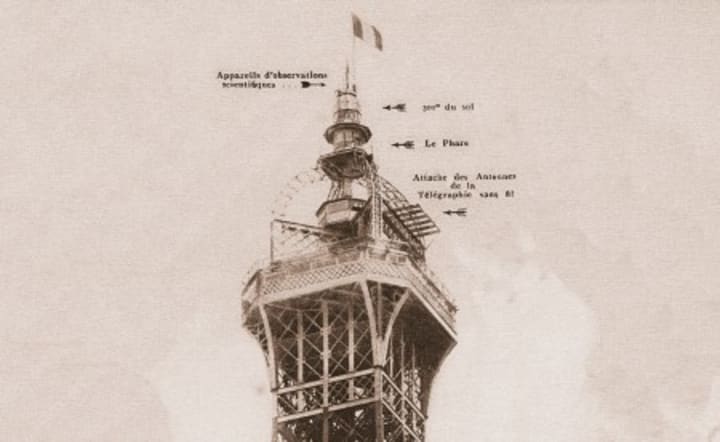
In 1903, Eiffel convinced the French Army officer Captain Gustave Ferrié to use the tower for wireless telegraphy experiments. Later, in 1909, a permanent radio station was established beneath the Champ de Mars, marking the tower’s importance as a strategic communications hub. This gave the Eiffel Tower a seventy-year extension before it was made a permanent part of Paris.
Why did people hate it?
The Eiffel Tower didn't have the easiest of starts. Almost instantly, there was pushback against its construction. Prominent writers, painters, and architects published an open letter called the "Protest of the Artists Against the Tower of Monsieur Eiffel," hoping to gather enough momentum to prevent the tower from being built.

They accused the tower of being useless and monstrous, warning that it would permanently disfigure Paris and cause other iconic landmarks such as Notre-Dame, the Louvre, and the Arc de Triomphe to lose their charm. Many were terrified of the idea that the tower would go against the romanticised charm of Paris.
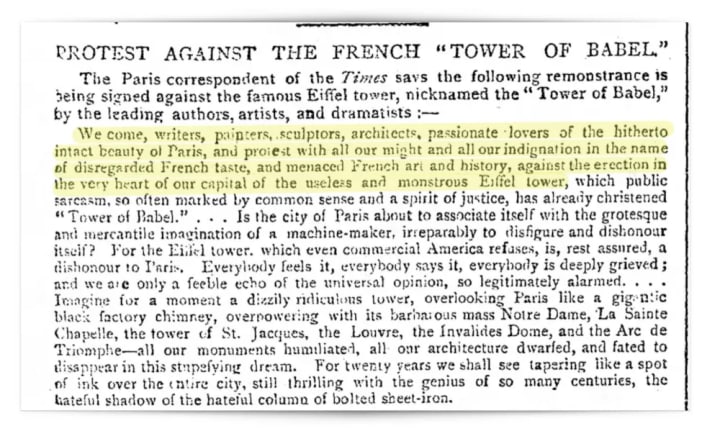
The movement against the tower included several well-known cultural figures of the time. Over time, it began to feel like the artistic world was prepared to wage war against the project, with newspapers adding fuel to the fire by calling it a "tragic lamppost" and "a towering, ridiculous structure that would dominate every view and ruin the city's harmonious skyline." It really did feel like the Eiffel Tower might in fact be lost to history.
From hated to loved
Despite the initial outrage the project received, around 1.9 million people visited the tower in the first year it opened. This amounted to around 12,000 visitors a day, with almost 30,000 visitors climbing the iconic 1,710 steps before the lift was even operational. Not only that, the fair that the tower was designed for was a huge success, bringing in more than 32 million visitors and turning a profit. Because of this, the tower was deemed a success.

Once the buzz of the fair faded, a problem arose. Due to the materials that were used to build the tower—which were prone to rusting—it required constant maintenance. This was costly and required specific paints to protect it from damage. For many, this was too troublesome, and some even suggested selling the tower for scrap metal to clear the skyline.

Luckily, as mentioned before, Gustave Eiffel managed to suggest the tower be used for various experiments. Not only that, during World War I, the tower’s radio station was used to intercept German communications and help coordinate French forces. This solidified its role as a strategic war asset and later won the hearts of both tourists and Parisians alike.
What do you think?
Can you imagine Paris without the Eiffel Tower? It's strange to think that something so iconic not only nearly didn't happen but was hated at first. It proves that if you are proud of what you do, fight for it and prove others wrong. It's easy for others to initially hate what you do; however, if you truly love it, who knows—maybe they will too. If we have learned anything from Gustave Eiffel, it’s that your next project, just like the Eiffel Tower, could cement itself in history as something truly iconic.
If you'd like to begin writing on Vocal, consider joining Vocal+
Not only do you earn more for the views your blogs get, you can pay out your earnings quicker, enable perks like audience pledges, keep more of your tips, and much more!
Join Vocal+ with the link below!
https://shopping-feedback.today/vocal-plus?via=DavesYourUncle
About the Creator
Dave's Your Uncle!
Food for Thought, and I'm Starving!
Keep reading
More stories from Dave's Your Uncle! and writers in FYI and other communities.
What Happened in Every Second of 2025
I think we can all agree that 2025 was an eventful year. Every day brought us closer to 2026, and despite being constantly bombarded with information, it is impossible to be aware of absolutely everything. In many ways, every second counted.
By Dave's Your Uncle!2 months ago in FYI
Author’s Advice
If you would’ve asked me 20 years ago did I know I’d become a writer and an author, I would’ve said “nope, ain’t happening”. As fate would have it I did become an author and I can honestly say I’m loving it so far. It really does feel good to be a writer. I’ve learned a lot on this journey and I feel like with even me being as new to this world as I am, there’s some wisdom I need to share with every other aspiring author.
By Joe Patterson2 days ago in Journal



Comments
There are no comments for this story
Be the first to respond and start the conversation.