
The Dark Mystery of Hart Island in the Time of Coronavirus
How many families have lost their loved ones to a Potter's field?

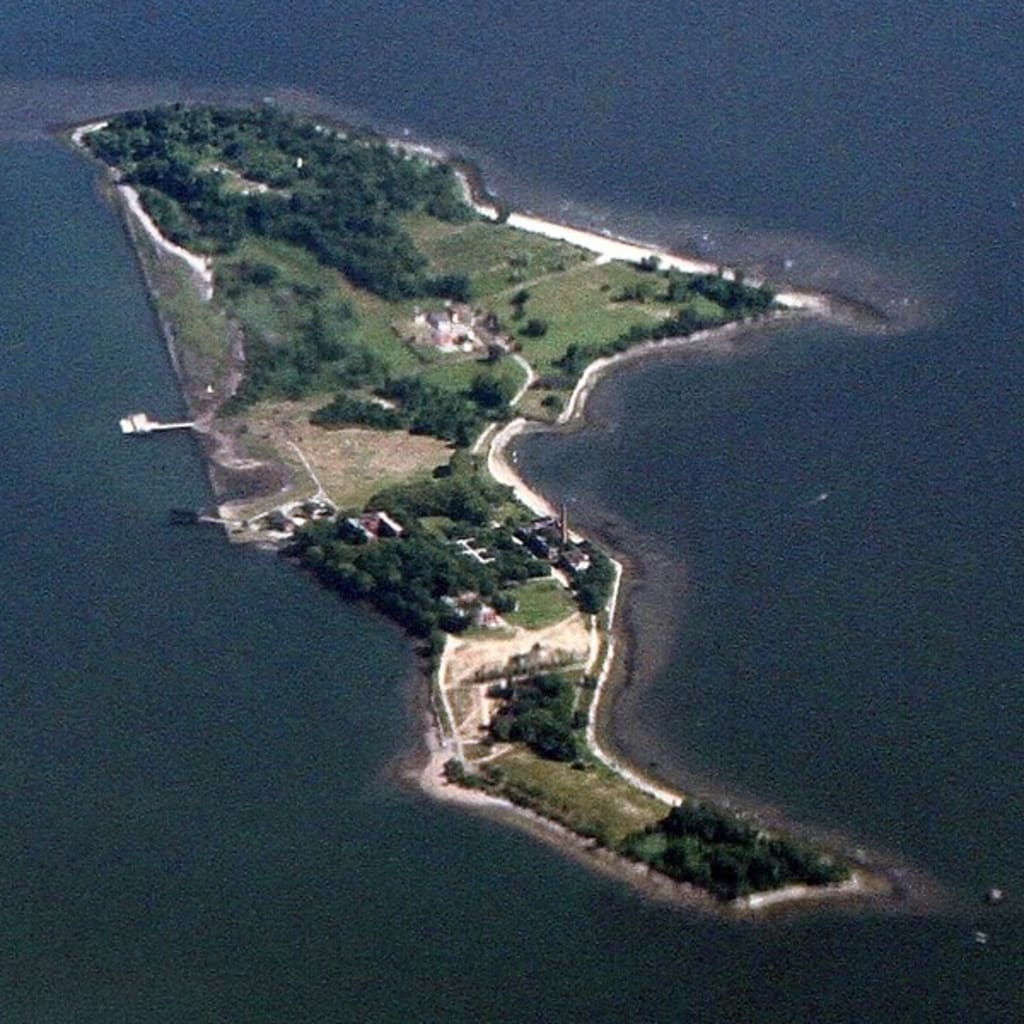
There is a small island off the coast of the Bronx in New York City that has long been a source of dark intrigue for those not allowed on its shores. For more than 150 years, Hart Island has been the site where hundreds of people have been interred for various reasons. Among the dead here, you will find soldiers, stillborn babies, homeless persons, prisoners, and AIDS patients. Now, there is a new addition to the masses who call this small island their final resting place—coronavirus victims.
Hart Island has been largely stigmatized over the years. Among other things, it has been the location of an asylum, a drug rehabilitation center, and even a location where those suffering from yellow fever or tuberculosis were housed in years past. Because of its image as a place where the mentally ill, diseased, addicted, and imprisoned are buried, it has largely been viewed as a dark and sinister place.
For years, most of the public was not even allowed to visit the island. This didn’t change until 2012 when New York City began allowing individuals to request permission from the Department of Corrections to visit the island to see where their loved ones are buried. Even then, the visits are conducted under escort, and families are merely allowed to look over the field of mass graves from a central point.
Because of the mystery surrounding the island for so many years, it has long been a subject of interest. More than one million people are buried here and that number continues to climb, thanks to a New York City law that prevents unidentified remains from being cremated.
In 2012, when Hurricane Sandy ravaged the city, skeletons could be seen exposed on the shoreline. Work to correct the shoreline couldn’t begin until 2019 due to certain delays. It is currently still in progress.
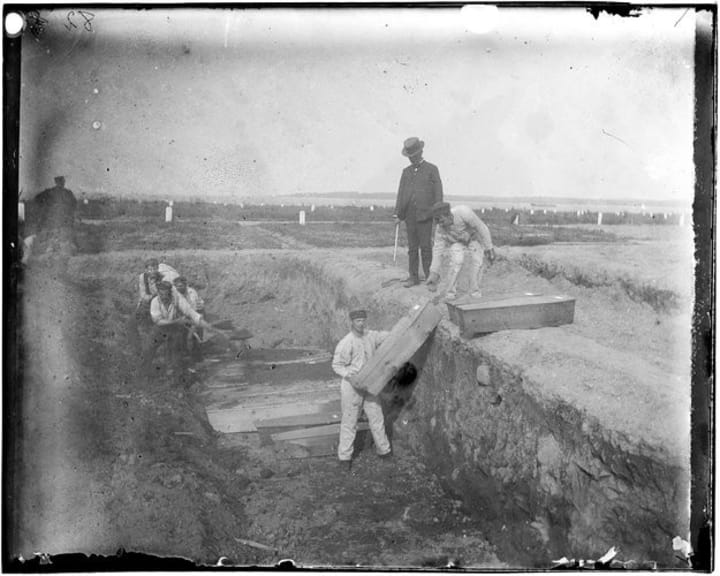
Due to the high number of deaths during the coronavirus pandemic, indigent New Yorkers without the family or means for a private burial had been added to the ranks of those who have come to rest here. Officials say that between 25 and 120 per week have been buried here, sometimes with multiple burials happening as often as every weekday. In the early days of the pandemic, burials were done by prisoners from Rikers Island, but an outcry from the public regarding the use of prisoners as cheap, expendable labor in a pandemic led to contractors being hired for the burials in April 2020.
While not all of those being buried here died from coronavirus, the increased numbers (almost five times normal) are mostly attributed to the infection. In previous pandemics, New York’s public parks were used to bury the dead, so residents will be relieved to know that Hart Island was an option instead of this. Still, some have expressed concern about whether they will be able to identify each of the deceased who are buried there, should a family come forward in search of their loved one later on.
The bodies buried in the mass graves of Hart Island reside in plain pine boxes. They are unembalmed and often buried with any personal effects in their possession at the time of their death. There are no individual grave markers for the mass grave, which usually contain around 150 coffins. Instead, each coffin is labeled with “unknown” and a grave number.
The issue some have with burials here is that they were done so quickly that the family didn’t have time to make arrangements. With the mass casualties from covid-19, the Chief Medical Examiner was forced to send anyone not claimed by family to Hart Island after fifteen days to make room in the overwhelmed morgues in the city.
When you’re talking about a person who was living on the streets or estranged from their family, the likelihood of finding the family and arrangement being made for them to retrieve their loved one in such a short amount of time is slim — leaving their loved one to be sent to a mass grave where they might remain forever.
Though bodies are disinterred from Hart Island for families who come to find their lost loved ones there, it is a long and expensive process to get the body moved to a private funeral home for reburial. The City of New York takes care of the disinterment, but it is up to the family to pay for the latter and many simply can’t afford it, especially during the financial crisis that has been a further burden in this major health crisis. Even in the best of times, the cost of moving a loved one is a deterrent for most families.
As late as the 1990s the record-keeping for graves on Hart Island wasn’t exactly stellar and also, the records that did exist weren’t available to the public. There are only two marked graves on the entire island, that of Mary Mallon (Typhoid Mary) and the first baby to die of AIDS in New York City. These days, records include each coffin’s location and a nonprofit organization called The Hart Island Project helps to catalog them further in an attempt to reunite families with their dead. A video posted on their site shows covid-19 burials in progress in April 2020.
With the pandemic on the downturn thanks to those who take precautions to prevent the spread and more people being vaccinated each day, the burials have already begun to subside — both because there are fewer victims and morgues can allow more time for bodies to be claimed by families, but it remains to be seen how many will have been claimed by a deadly virus and relegated to a Potter’s field forever.
About the Creator
A.W. Naves
Writer. Author. Alabamian.
Keep reading
More stories from A.W. Naves and writers in FYI and other communities.
The Unsolved Murder of Mary Cecilia Rogers
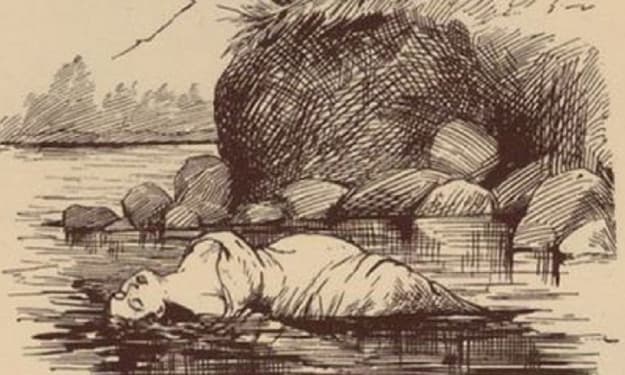
Mary Cecilia Rogers was known as a great beauty. She worked in a New York tobacco store where she turned the heads of many prominent men. When her body was found in the Hudson River on July 28, 1841, it was assumed that she had been the victim of gang violence. However, a witness claimed that she had been dumped there after a failed abortion attempt. A note written by her boyfriend before his suicide suggests that he might have been involved in her demise. After all of these years, her death continues to be unexplained.
By A.W. Naves4 years ago in FYI
Water wells the key of our future
The average lifespan of a water well ranges from 25 to 40 years if it has carbon steel piping. Other steel alloys can increase the well's durability; however, a crucial point is sustainability. This means that over the years, the well continues to provide a constant and sustainable flow of water. To achieve this, it largely depends on the underground aquifers not being overexploited and on the recharge rate being greater than or equal to the extraction volume. However, today most aquifers are overexploited due to the large amount of water extracted each year. Another important factor that will ensure the sustainability of water wells is the periodic maintenance that the user must perform to keep them free of sediment and at their full depth. This includes minimizing corrosion of the steel casing pipe, thus extending its lifespan. Continuous monitoring of static and dynamic water levels in the well is also crucial, as is annual water quality analysis to identify any potential partial or total aquifer contamination.
By Ximena Ramirez4 days ago in FYI


Comments
There are no comments for this story
Be the first to respond and start the conversation.