
Was Alexander the Great Murdered? 7 Shocking Theories on His 323 BC Death
The mysterious death of history's most legendary conqueror still baffles scientists, historians, and conspiracy theorists alike.

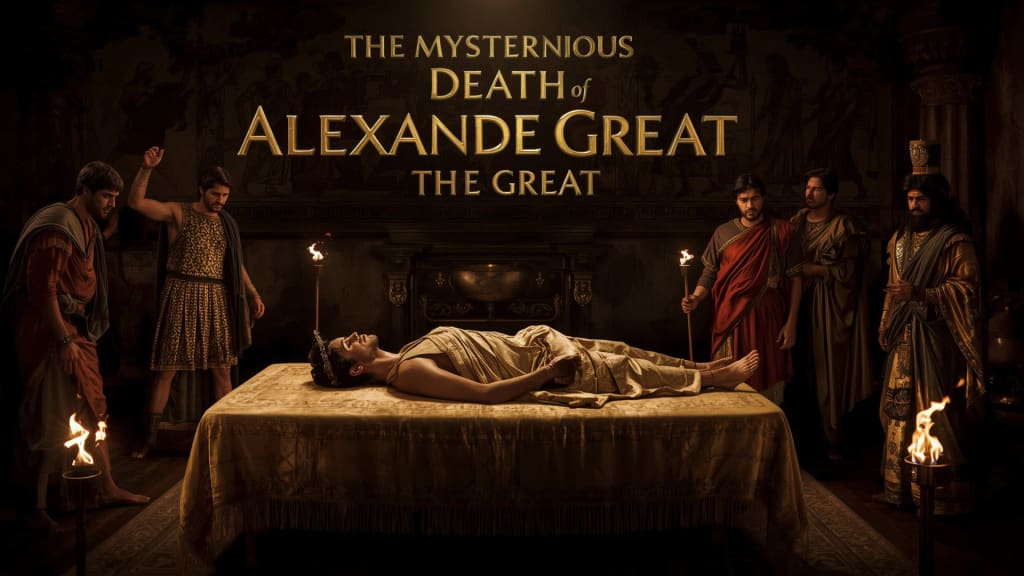
The Babylon Banquet: When a God Fell Ill
In June of 323 BC, Alexander the Great—king of Macedonia, conqueror of Persia, pharaoh
of Egypt, and self-proclaimed son of Zeus—died at the age of 32 in the ancient city of
Babylon. Just days before his death, he had celebrated one of his many victories with a
lavish banquet. The next morning, he awoke with a fever and soon found himself bedridden,
unable to speak or move. After 12 agonizing days, the greatest general the ancient world
had ever seen was dead.
But what truly killed him? More than 2,000 years later, the answer remains shrouded in
mystery.
The Unfading Corpse: A Sign from the Gods?
One of the strangest facts surrounding Alexander’s death was the state of his body.
According to historical sources like Plutarch and Diodorus, Alexander's body showed no
signs of decomposition for nearly a week after his death. His followers believed it was proof
of his divinity. However, modern scholars propose something else entirely: that Alexander
may not have been dead at all.
Some believe he had a rare neurological condition like Guillain-Barré Syndrome, which could
have left him paralyzed and unable to speak while still alive. Ancient doctors, lacking modern
tools, might have mistakenly declared him dead.
Poison Plot: Was It an Inside Job?
Poison has long been a favorite theory among those suspicious of Alexander's sudden
illness. It was whispered even during his lifetime that he had too many enemies close by.
The leading suspect? Antipater, the regent of Macedonia. His son Cassander would later
become king after eliminating Alexander's heirs. Some historians suggest they feared
Alexander’s growing favor toward Persian customs and wanted to restore Greek dominance.
If poison was used, it might have been hellebore, a plant known in antiquity for its
slow-acting, deadly effects. It would explain why Alexander remained sick for days rather
than dying immediately.
Typhoid Fever: The Most Likely Culprit?
Dr. David Oldach and his team of medical historians believe Alexander died of typhoid fever,
which was common in Babylon at the time. The symptoms match: high fever, abdominal
pain, and delirium.
Typhoid also causes gut perforation and sepsis, conditions that could last days before killing
the patient. This theory gains weight from records stating Alexander drank large amounts of
wine, had intense abdominal pain, and gradually lost consciousness.
West Nile Virus or Malaria?
Other modern scholars argue Alexander may have been struck down by malaria or the West
Nile Virus. Babylon was marshy and filled with mosquitoes—the perfect breeding ground for
disease.
In 2003, Dr. Paul Marr suggested Alexander may have caught the West Nile virus, which can
lead to paralysis, fever, and death. Like typhoid and Guillain-Barré, it would explain both the
neurological and physical symptoms described in ancient texts.
Guillain-Barré Syndrome: A Living Death
New Zealand pathologist Dr. Katherine Hall made headlines in 2018 when she proposed that
Alexander had Guillain-Barré Syndrome, a rare autoimmune disorder. It causes muscle
weakness, paralysis, and eventually shuts down the lungs and heart.
She suggests that Alexander was not dead when declared so, but trapped inside a
paralyzed body. This would also explain why his corpse did not decompose
immediately—because he was still alive for several days.
Alcohol, Pancreatitis & Sudden Collapse
Another theory suggests Alexander died from acute pancreatitis, triggered by excessive
alcohol consumption. He was known for heavy drinking and frequent feasts. One account
tells of him downing a massive bowl of wine, followed by a sharp cry and immediate pain.
Pancreatitis could cause a slow, excruciating death with fever, abdominal pain, and eventual
organ failure. It remains one of the more medically consistent explanations, though it's often
overlooked.
Power Vacuum: Who Benefited from His Death?
Regardless of the cause, Alexander’s death created a massive political vacuum. Within
days, his generals (the Diadochi) began dividing the empire. Wars broke out. His wife
Roxana and their son were eventually murdered. Cassander, the same man suspected in
the poisoning, seized power.
Whether by illness, poison, or divine fate, Alexander’s death marked the fall of an empire
built on charisma, conquest, and ambition.
The Mystery Endures: Another Chapter in Hidden History
The question remains: how does a man who conquered the known world die in silence,
without a clear cause?
Just as Genghis Khan’s tomb remains hidden and guarded by legend (see Episode 1: The
Secret Burial of Genghis Khan), Alexander’s death continues to captivate and confuse. It
may never be solved, but its echoes still shape how we view history, mortality, and power.
Curious about another buried mystery? Read Episode 1: The Secret Burial of Genghis Khan.
About the Creator
Keep reading
More stories from DRE Explains and writers in Humans and other communities.
The Secret Burial of Genghis Khan: History's Greatest Mystery Hidden in Mongolia
Genghis Khan’s Secret Burial: The Hidden Resting Place of a Conqueror A Final Wish Etched in Mountains In August 1227, near the end of his final campaign, Genghis Khan succumbed to complications from a hunting accident or fatal illness—accounts vary between malaria, typhus, or an infected woundyoutube.com+11thecollector.com+11terranoa.com+11en.wikipedia.org+1archaeology.org+1. Before his death, he is said to have uttered a simple command as he rested near Burkhan Khaldun in the Khentii Mountains: "Bury me here when I pass away"thecollector.com+7en.wikipedia.org+7multimedia.scmp.com+7.
By DRE Explains7 months ago in Humans
Why We Stare at Slow Drivers
Most drivers perform a strange ritual they never talk about. Someone ahead of them is moving so slowly it stretches patience to its thinnest thread. Once the gap opens and they can finally accelerate past, the same thing happens every time. They look. They turn their head just enough to catch a glimpse inside the other car. It feels automatic and unnecessary, but the body does it without taking a vote. The stare is not rudeness, and it is not about proving a point. It is part of a deeper behavioral process that starts the moment another driver interferes with your rhythm.
By Dr. Mozelle Martin | Ink Profiler6 days ago in Humans




Comments
There are no comments for this story
Be the first to respond and start the conversation.