

So says Nikola Tesla.
“We shall be able to communicate with one another instantly, irrespective of distance. Not only this, but through television and telephony we shall see and hear one another as perfectly as though we were face to face, despite intervening distances of thousands of miles; and the instruments through which we shall be able to do this will be amazingly simple compared with our present telephone. A man will be able to carry one in his vest pocket.”
This little known prediction of smartphones and digital communications was published January 30, 1926, some 95 years ago, in Colliers Magazine. Nikola Tesla, the genius engineer scientist who gave us Alternating Current as a superior alternative to Edison’s Direct Current, also predicted the Smartphone. The only thing he may have missed is the diminishing number of vests available in which to carry the smartphone. A back pocket in a pair of jeans is more likely in today's fashion.
Edison, whose Direct Current solution to lighting cities was imperiled by Tesla's Alternating Current solution which was technologically superior, fought mightily to protect his product. This led to another little known fact. The development of the electric chair.
Edison, a genius in his own right, in his efforts to prove DC superior to AC, declared AC to be dangerous, and to prove how dangerous, Edison held demonstrations for reporters where stray dogs and cats were placed on metal sheets and electrocuted using 1,000 volts of AC. Then to show America how dangerous AC was to people, Edison built an electric chair. The beneficiary, well, make that victim, of Edison’s competitiveness, was William Kemmler, a resident of Auburn Prison.
It took two tries to electrocute Kemmler, but Edison made his point, “Is this what your wife should be cooking with?” his campaign asked.
It took Edison twenty years or so to acknowledge the superiority of AC, and produced inventions of his own that relied on AC. In the meantime, in a major display of AC lighting cities, Westinghouse, who had backed Tesla early on, supplied AC electricity to light up the Chicago World’s Fair in 1893. President Grover Cleveland pushed the button that lit up nearly 100,000 incandescent lamps lighting the fair. It heralded the nullification of the need for daylight, gas lamps, or candles to light the darkness and extend the day.
Nikola Tesla also designed the first hydro electric power plant which with Westinghouse was installed at Niagara Falls, New York. Visitors may see a statue of him there donated by Yugoslavia in 1976. A testament to an increasing awareness of Tesla and his contributions.
Edison's laboratory and home, next door to Henry Ford's estate, can be visited in Ft. Myers, Florida, or you can visit his museum in Edison, NJ, or his and Ford’s museum in Greenfield Village, Dearborn, Michigan. All worth a visit.
So we have many reasons to thank Nicola Tesla for his contributions to our well being. Turn on a light, make a call on your smartphone, use any electrical appliance, Tesla’s fingerprints linger.
And while we may wince at the thought of Edison’s electric chair, he still reigns as one of America’s foremost inventors whom we should thank everytime we hear a phonograph or see a movie. One of his wind-up cylinder portable phonographs is proudly displayed in my home.
For anyone whose interest is piqued, there is no shortage of material available on either Tesla or Edison. An internet search leads to a plethora of resources as does a library search. There is more than enough material to engage a curious mind for hours on end.
About the Creator
Cleve Taylor
Published author of three books: Ricky Pardue US Marshal, A Collection of Cleve's Short Stories and Poems, and Johnny Duwell and the Silver Coins, all available in paperback and e-books on Amazon. Over 160 Vocal.media stories and poems.
Keep reading
More stories from Cleve Taylor and writers in FYI and other communities.
Quick, Call 911
Call 911-The Emergence of EMS Call 911. In minutes an ambulance staffed with trained Emergency Medical Technicians (EMTs) arrives at your door, checks your medical status, stabilizes you, puts you on a trolley, loads you into a well equipped ambulance and transports you to the nearest appropriate emergency room where emergency physicians and nurses attend your needs and possibly save your life, all the while communicating electronically as needed between the dispatcher, the ambulance and the hospital. Routine stuff now. But it was not always so. Here is a short history of how that happened through the eyes of one who was there.
By Cleve Taylor 5 years ago in FYI
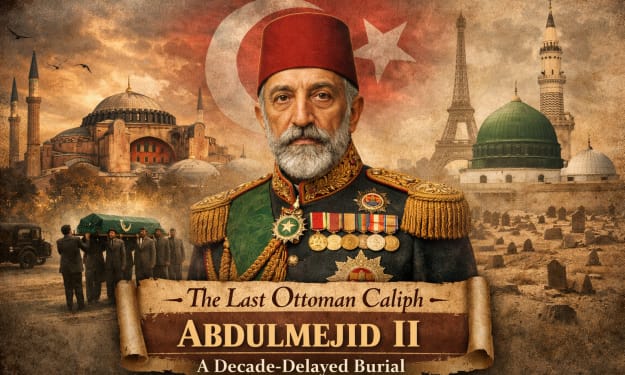
The Last Ottoman Caliph: Abdulmejid II and the Burial That Happened a Decade After His Death
The fall of the Ottoman Empire in the early twentieth century marked the end of one of the longest-lasting and most influential Muslim empires in history. With it came the abolition of the Caliphate—an institution that had symbolized the political and spiritual leadership of the Muslim world for centuries. The last person to hold that title was Abdulmejid II, the final Ottoman Caliph, whose life ended in exile. Yet what makes his story even more remarkable is that his burial took place nearly ten years after his death, following efforts supported by the Governor-General of Pakistan.
By Irshad Abbasi about 2 hours ago in FYI



Comments
There are no comments for this story
Be the first to respond and start the conversation.