
Taiwan Flexes HIMARS Power in War Drills Aimed at Countering China
In a bold display of defensive readiness, Taiwan integrates U.S.-supplied HIMARS into high-stakes military exercises simulating a full-scale invasion.
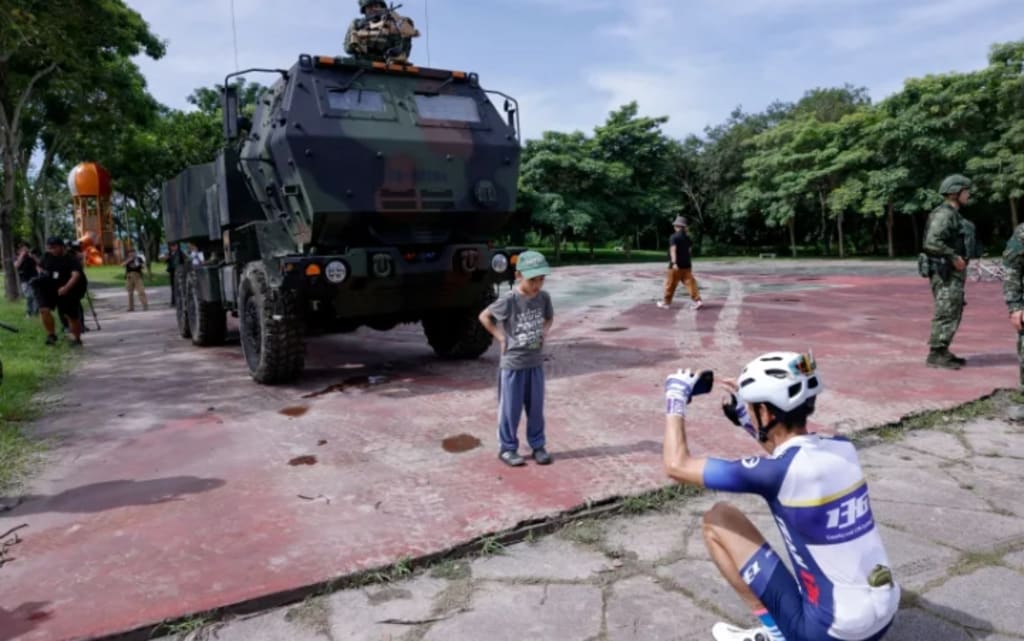
Taiwan has showcased its most advanced missile systems in a large-scale military exercise designed to strengthen its defenses against growing threats from China. Among the most notable developments in this year’s drills is the active deployment of High Mobility Artillery Rocket Systems (HIMARS), a long-range precision strike system supplied by the United States.
The military exercise, known as Han Kuang, is Taiwan’s largest annual defense drill and serves as a key indicator of the island's combat readiness. The latest iteration features a range of scenarios including simulated invasions, surprise attacks, and counterstrikes, aimed at preparing the country for the worst-case military confrontations.
Over the course of ten days, Taiwan's military forces are engaging in intensive training that includes live-fire artillery, amphibious landing simulations, urban warfare practice, and cyber defense. The fourth day of the exercise drew particular attention as HIMARS vehicles were seen actively maneuvering through the streets of Taichung, a major city along Taiwan's central western coastline.
Military officials emphasized the strategic value of HIMARS, especially its ability to deliver rapid, high-precision strikes at distances of up to 300 kilometers. This range allows Taiwanese forces to potentially target military installations across the Taiwan Strait, particularly in China's southeastern Fujian province. The missiles are not only fast and powerful, but also mobile—mounted on armored trucks that can quickly relocate after firing, making them difficult targets for enemy retaliation.
A senior spokesperson for Taiwan's military highlighted the importance of maintaining the secrecy and positioning of these systems, noting that HIMARS must be hidden from aerial surveillance, satellite imagery, and potential enemy agents operating within Taiwan’s territory. The element of surprise and concealment, military planners say, is crucial for maintaining the tactical advantage in any conflict.
The unveiling of HIMARS in such a high-profile setting sends a powerful message to both domestic and international audiences. It reflects Taiwan’s determination to bolster its self-defense capabilities in the face of growing Chinese pressure. Over recent years, the Chinese military has significantly intensified its activities around the island, conducting large-scale naval and aerial patrols, often breaching the island’s air defense identification zone (ADIZ).
China maintains that Taiwan is a breakaway province that must be reunified with the mainland, by force if necessary. In response to Taiwan’s increasing military preparations and its deepening security ties with the United States, Beijing has issued repeated warnings and condemned the drills as provocative. Chinese officials described Taiwan’s military exercises as "self-deceptive" and accused the island's leadership of creating unnecessary tensions.
Despite these criticisms, Taiwan’s government continues to stress the defensive nature of its military build-up. The latest drills are framed as a necessary precaution to ensure the island’s survival in the event of an invasion. Taiwan’s leadership has also pointed out that these exercises are conducted in accordance with international laws and within the nation’s territorial boundaries.
The deployment of HIMARS marks a significant upgrade in Taiwan’s military arsenal. Last year, the island received the first batch of 11 HIMARS units out of an expected 29. These rocket systems were field-tested in May and are now being fully integrated into Taiwan’s military strategy.
The use of such advanced weaponry in unscripted drills has been praised by analysts who note the importance of realism in military training. According to senior defense officials, this year's Han Kuang drills are intentionally designed without predetermined outcomes. Instead, they are structured around a dynamic flow of simulated enemy attacks, infiltration scenarios, and response tactics that aim to simulate actual battlefield conditions as closely as possible.
The broader strategic context of Taiwan’s military posture is shaped by its increasingly close cooperation with the United States. Though Washington has maintained a policy of "strategic ambiguity" regarding direct intervention in a Taiwan-China conflict, American law requires it to provide Taiwan with the means to defend itself. Over the years, the U.S. has supplied a range of defensive systems, including air defense missiles, drones, tanks, and radar equipment. The addition of HIMARS marks a turning point in the level of firepower available to Taiwan's military.
However, questions remain about the extent of U.S. support in the event of an all-out war. While Taiwan continues to receive arms and political backing from Washington, actual military intervention remains uncertain. This uncertainty underlines the urgency of Taiwan's own defense preparations, as the island cannot rely solely on external support.
Observers have noted that Taiwan’s strategy is increasingly focused on asymmetric warfare. Instead of matching China’s vast military power weapon-for-weapon, Taiwan aims to deploy mobile, lethal, and resilient systems that can outlast and outmaneuver a much larger force. The HIMARS units, with their agility, precision, and destructive capability, are a centerpiece of this evolving doctrine.
Beyond the immediate military implications, these drills carry symbolic weight. They are meant to reassure Taiwan's population that the government is prepared to defend the country’s sovereignty. At the same time, they serve as a message to the international community—especially key partners like Japan, Australia, and European nations—that Taiwan remains steadfast in its commitment to democracy and self-determination, even under pressure.
In parallel with the military exercises, Taiwan continues to invest in cyber defense, satellite communication, and drone technology. Modern conflict, officials warn, is no longer limited to the physical battlefield. Electronic warfare, psychological operations, and economic sabotage are also tools that a hostile power could employ.
With tensions in the Taiwan Strait remaining high, Taiwan’s multi-dimensional defense efforts—bolstered by sophisticated U.S.-made systems like HIMARS—are expected to continue evolving. While no one desires conflict, the reality of modern geopolitics requires constant vigilance and readiness.
Taiwan's defense leadership maintains that its ultimate goal is to preserve peace and stability in the region. But to achieve that, they say, the island must remain strong, prepared, and resolute in the face of any threat.
About the Creator
Keep reading
More stories from Ikram Ullah and writers in FYI and other communities.
The Power of Misinformation: A Cautionary Tale
*The Power of Misinformation: A Cautionary Tale* In today's digital age, misinformation can spread like wildfire, often with devastating consequences. A recent story circulating on social media highlights the importance of fact-checking and critical thinking. The story, which claims to be about a father who brutally injured his two-year-old son and then set his car on fire, is a perfect example of how misinformation can spread and cause harm.
By Ikram Ullah6 months ago in FYI



Comments
There are no comments for this story
Be the first to respond and start the conversation.