Science
Science
How long can humans live in a closed ecosystem?
1. FIND THE FIRST TERRARIUM The world's oldest enclosed terrarium by David Latimer, the Terrarium is a miniature self-sustaining ecosystem also known as a basin or landscape. It's usually a moisture-resistant plant that's planted inside a large closed glass vessel. In 1960, David Latimer, an electromagnetic engineer in Southeast England, washed a 38-litre glass bottle, which was used to store sulfuric acid, he poured the mixture into a jar, planted a few spider grasses in it, watered it and then closed the jar. Latimer put the jar under the stairs in the house where there was indirect sunlight from time to time, and he turned the jar to make the leaves grow evenly. Since then, this closed ecosystem has beenined and developed strongly without interference, the only time the vessel was opened in 1972. David just needs some water. So exactly how a terrarium works and why it can sustain itself for decades, you could say explosive or exaggerated, but in essence it's a terrarium that can be seen as a tiny Earth but without humans and animals, in fact it has all three important cycles of life: the water cycle, the oxygen cycle and the nutrition cycle. The water is absorbed by the roots of the plant and then released from the leaves, condensed in the wall of the vessel and flowing back into the soil, the plant photosynthesizes and releases oxygen, and then uses it to breathe and to release CO2, while the bacteria in the ground use Oxygen to break down the leaf and release CO2 to the plant for fotosynthesis. The boy is covered, and the Earth is isolated by a space vacuum with limited resources, only the sunlight is almost infinite and it's free, so now you can see how similar these two things are. Because all resources are recycled and preserved, so in theory, a perfectly optimized terrarium can sustain itself for a very long time. However, balancing conditions such as light, humidity, temperature, plant type, microorganism, and pot size is not easy. In fact, Mr. David Latimer's reservoir is one of the best closed ecosystems on the planet. On average, reservoirs only sustain themselves for a few months to a few years before being damaged due to a lack of necessary degradants and cycles that are not completed effectively, and if nothing changes, Mr David Latimers reserver can continue to grow for decades while its owners die of old age and poor health.
By Nguyen Duy2 years ago in FYI
Innovations and Implications
The future of technology promises to revolutionize every aspect of human life, driving changes in healthcare, transportation, communication, and beyond. As we stand on the cusp of a new era, several key trends and innovations are poised to shape our world in profound ways.
By Alohan I Rowland2 years ago in FYI
From Impalement to Inspiration: How I, Vlad the Impaler, Became an Unlikely Cardiologist. Content Warning. AI-Generated.
I suppose you might think me an odd choice to pen a tale about the circulatory system, especially considering my historical penchant for, shall we say, less delicate interactions with human anatomy. But here I am, Vlad the Impaler, breaking from tradition and dabbling in the gentle art of educational writing. You might even say I had some assistance from those marvels of modern sorcery known as AI models, who helped transform my gruesome narratives into more palatable fare for the masses.
By ScienceStyled2 years ago in FYI
Understanding the Internet: A Journey from Devices to Submarine Cables
The internet is a ubiquitous part of modern life, but many people don't know how it actually works. From sending a simple email to streaming videos, the internet relies on a complex network of technologies and physical infrastructures. This article will demystify the journey of data across the internet, exploring how it travels from our devices through routers, across vast distances, and ultimately reaches its destination.
By Karabo Tsotetsi2 years ago in FYI
An Invisible Riff: My Pre-CRISPR Capers and the Adventurous Missteps. AI-Generated.
It all began with a botched experiment and an unusual alliance. If you’re wondering why I, the Invisible Man, have taken up the quill—or, more likely, the keystrokes—to pen a narrative about gene editing, let’s just say I might have had some help from a few advanced AI models. It’s quite the tale, my curious readers, and one that involves more chaos and comedy than my usual exploits.
By ScienceStyled2 years ago in FYI
How should I Factory Reset Airtel 4G Hotspot Router ?
Are you experiencing connectivity issues, slow internet speeds, or other problems with your Airtel 4G Hotspot Router? Sometimes, a simple reboot or resetting the router's settings may not be enough to resolve the issue. In such cases, performing a "Factory Reset Airtel 4G Hotspot Router" can be an effective solution.
By Jack Richards2 years ago in FYI
Robin Hood's Accidental Quantum Quest
You might find it odd, but as I sit here, feather in cap and quill in hand, I confess that a troupe of AI jesters may have had a hand—or algorithm—in helping this merry outlaw craft this curious prelude. But rest assured, every word carries the spirit of Robin Hood, albeit with a quantum twist.
By ScienceStyled2 years ago in FYI
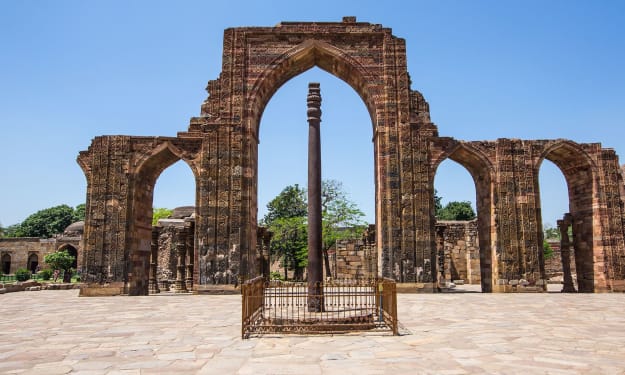
The mystery of the 1,600-year-old stainless steel exposed iron pillar
Delhi Iron Pillar is one of the famous ancient monuments of India. Delhi is an iron pillar cast in the 5th century, erected by King Kumara Gupta I of the Gupta dynasty, who ruled north India in the period 320-540.
By Culture Discovery2 years ago in FYI