
ST OLAVE’S CHURCH – LONDON
St Olave’s is one of only a few churches from the Middle Ages that survived the Great Fire of London in 1666.

St Olave’s Church is one of the smallest churches in the city of London, and is one of only a tiny number of churches from the Middle Ages that survived the Great Fire of London in 1666.
Having certainly started its existence as a small wooden structure. St Olave’s Church was reconstructed in stone in the 13th century and rebuilt again in the 1450s. As with nearly all ancient churches, many modifications and additions were made over the following years.
The church was first recorded in the 13th century, a stone building replacing the earlier construction. By the 9th century, London was a prosperous trading city, and its prosperity attracted the attention of Danish Vikings.
It is devoted to the patron saint King Olaf II of Norway, who fought together with the Anglo-Saxon King, Ethelred the Unready. At the Battle of London Bridge in 1014, against the Danes.
As London developed into a centre of trade in the 15th and 16th centuries, the church thrived. Many traders chose to be buried there, and their vibrantly coloured memorials are a high point of any visit to the church. As the church was next door to the residence of Queen Elizabeth I’s spymaster, Francis Walsingham, many of her other spies are said to have worshipped there and at least two others are buried in the church.
It began with the Battle of London Bridge, or so the story goes. This legendary battle between an Anglo-Norwegian force and the Danish navy of Sweyn Forkbeard, the father of King Canute. Norway’s Olaf II sided with England’s Ethelred the Unready because they were fellow Christians, while the wicked Danes were still inclined to paganism.
London Bridge is said to have been pulled down during the conflict. The event may be the source of the nursery rhyme London Bridge is Falling Down.
The churchyard is swollen above the surrounding ground level by a massive number of bodies buried within. Today, the gardeners are constantly unearthing human bones.
Samuel Pepys was buried in a vault along with his wife beneath the nave. Within living memory, when the Victorian font was removed, a hole was exposed that led to a chamber with a passage that led to a hidden chapel where a tunnel was dug to reach the Pepys vault.
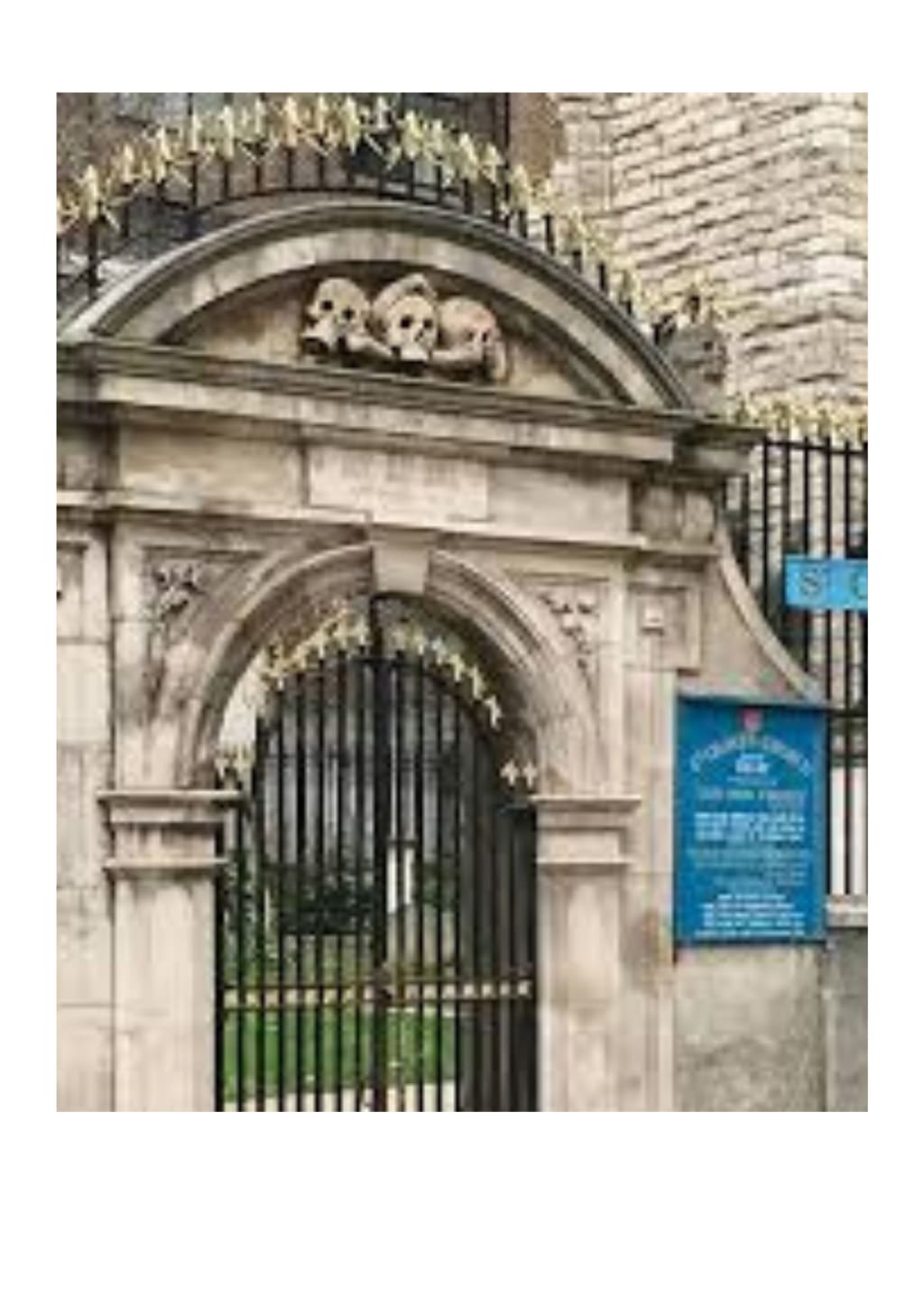
When a new churchyard gateway was constructed in 1658. It’s decorated in such a macabre way that later Charles Dickens coined it ‘St Ghastly Grim.’ In 1666, flames from the Great Fire of London came within a few yards of St Olave’s before the wind changed its direction. The church may have been saved by the diligence of its most famous worshipper, Samuel Pepys. He made sure that neighbouring structures were torn down before the fire spread to the church.
St. Olave’s was severely damaged in World War II. In the 1940 bombing, many windows were blown out and lost. The church took a major hit again the year after. Ernest Glanfield, the architect in charge of the 1951 rebuilding, found enough of the foundations remained and its medieval arrangement could be reinstated. The current building is an amalgamation of this rebuilding and the surviving medieval foundations.
The window shows Queen Elizabeth I on the east side of the building, which is a nod to the thanksgiving service she held at the church in 1554 to commemorate her release from the Tower of London. The churchyard can be entered through Seething Lane, where a ghoulish gateway. Crowned with skulls greets you. There’s also a Latin phrase, ’Christus Vivere Mors mihi lucrum’ — ‘Christ lives, Death is my reward’. Constructed in 1658, before the plague ravaged London again, and almost seems a sort of warning.
About the Creator
Paul Asling
I share a special love for London, both new and old. I began writing fiction at 40, with most of my books and stories set in London.
MY WRITING WILL MAKE YOU LAUGH, CRY, AND HAVE YOU GRIPPED THROUGHOUT.
paulaslingauthor.com
Keep reading
More stories from Paul Asling and writers in FYI and other communities.
THE OTHER GREAT FIRE OF LONDON
The Tooley Street fire has been described as the worst London fire since the Great Fire of London. The fire began on Saturday, 22nd June 1861, at Cotton’s Wharf, where many warehouses were situated. At 5 p.m. workers in the warehouse along the river by London Bridge, near Tooley Street, were preparing for the Sunday shutdown. Almost everyone had left for the Sunday shutdown when a fire began.
By Paul Asling4 years ago in FYI


Comments
There are no comments for this story
Be the first to respond and start the conversation.