


Whenever black history is taught in schools we only cover certain topics or even people such as Harriet Tubman, Martin Luther King Jr, and Rosa Parks because they are considered safe to teach about. Slavery is rarely taught and it usually goes straight to the civil rights movement of the 60’s. Black history is more than that because every aspect of American history has been touched and built up on by a black person. Lets go hang with some forgotten heroes.

Jack Johnson was one of the toughest boxers who ever lived. In nearly a half century of boxing he was only knocked out three times.
Arthur John Johnson, the son of a former slave, was born in 1878 in Galveston, Tx. He first got into boxing as a sparring partner, and then in "battle royal" fights where a number of young black men fought for the entertainment of whites with the last one standing collecting the prize. In 1897, Jack Johnson knocked out Jim Rocks in his first professional fight. Unfortunately boxing was illegal in Texas so he was forced to leave the state in 1901. After knocking out Bob Fitzsimmons, a white former champion, in 1906 he clearly became a contender for the world championship but no one wanted to give him the shot at the title. Finally, heavyweight champion Tommy Burns, a lackluster Canadian boxer, agreed to a fight. On Christmas Day in 1908, Johnson, with a taunt behind every punch, gave him a thrashing that ended with a technical knockout in the 14th round.Johnson, becoming the first black heavyweight champion, ostentatiously paraded his wealth and exploited his fame. He infuriated whites who felt Johnson was acting above his station. Turn of the century American society presented numerous obstacles to African Americans. Historian Lawrence Levine says, "Johnson ruptured role after role set aside for Negroes in American society." Many would not acknowledge Johnson as the world champion and a movement began to recruit various "Great White Hopes" to take back the title. Stanley Ketchel, one contender, knocked Johnson down in the twelfth -- before being knocked out with one punch.Boxing's race crisis brought former heavyweight champion Jim Jeffries out of retirement trying to recapture the crown from Johnson but he went down in the 15th round. Deadly riots followed the fight,which caused a banning of it’s film. In a move to keep Johnson off the big screen all together, all fight films were banned. The search for the white man who could depose the black champion continued. Johnson's success in the ring was a matter of great pride for African Americans but some, mostly middle class, blacks found his behavior outside the ring a source of embarrassment. Activist and intellectual W.E.B. du Bois saw Johnson's relations with white women as unnecessarily alienating acts. Historian Jeffrey Sammons says, "in many ways, Johnson represented the 'bad nigger' that whites were so willing to parade as an example of why blacks must be kept in “their place”. In 1913, when Johnson was charged with violating the Mann Act and later convicted by an all-white jury, he escaped and fled to Canada, and then to Europe. He continued to box, defending his title twice. He lost the championship to Jess Willard in 1915 in a fight in Cuba. The 37-year-old champion tired and was knocked out in the 26th round. Rumors suggest that Johnson threw the fight as a concession to authorities in a bid to return home.Returning to the United States in 1920, he turned himself in and was incarcerated in the Federal prison at Leavenworth, Kansas for eight months. He boxed a few more times after his release, but retired in 1928. He would appear in several exhibition matches, including one to raise money for the war effort in 1945.Johnson's post-boxing career was a cobbled-together string of jobs. He ran a restaurant, appeared in movies, fought bulls and wrestlers, wrote two memoirs, appeared with a flea circus, patented a wrench and gave lectures before dying in a car accident in 1946. His flamboyant style and interracial relationships left a huge shadow over the next black boxing champion, Joe Louis and was rebuffed when he offered to work as Louis' trainer.
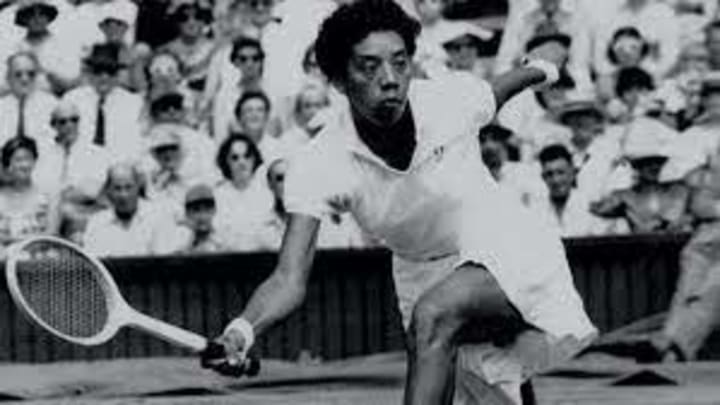
Althea Gibson, a sharecropper’s daughter, entered the world of sports when segregation severely limited opportunities for African Americans. Eventually becoming the first black athlete to cross the color line of international tennis and golf.
Althea Gibson was born on August 25, 1927, on a cotton farm near Silver, South Carolina. In 1930, the family moved to Harlem where Gibson’s younger siblings were born. While growing up in Harlem, Gibson played paddle tennis on a section of 143rd Street that was barricaded during the day so neighborhood children could participate in organized sports under the supervision of the Police Athletic League. Gibson became proficient in paddle tennis, and by 1939, at the age of twelve, she won the New York City,NY women’s paddle tennis championship. The following year, a group of Gibson’s neighbors helped finance her junior membership at the Cosmopolitan Tennis Club in Harlem. In 1941, Gibson entered and won her first tournament, the American Tennis Association’s New York State Championship. She later won the ATA national championship in the girls’ division in 1944 and 1945. After losing the women’s championship final in 1946, she won the first of ten straight titles beginning in 1947. Gibson’s success drew the attention of Dr. Walter Johnson, a physician from Lynchburg, Va, who was active in the national black tennis community. He mentored and helped her gain important competitions with the United States Tennis Association (USTA). Also in 1946, she moved to Wilmington, North Carolina, under the sponsorship of another physician and tennis activist, Hubert A. Eaton[21] and enrolled at the racially segregated Williston Industrial High School.In 1949, she became the first black woman and the second black athlete (after Reginald Weir) to play in the USTA’s National Indoor Championship. Later that year, she earned a full athletic scholarship to Florida A&M University and also becoming a member of the Beta Alpha chapter of Alpha Kappa Alpha sorority. In 1950, Gibson became the first black player to compete in the United States National Championships (now the U.S. Open) at Forest Hills, NY. Although she lost narrowly to Louise Brough, the reigning Wimbledon champion, the following year she won her first international title, the Caribbean Championship in Jamaica in 1951. After graduating from Florida A&M, Gibson taught physical education at Lincoln University in Jefferson City, Missouri, but she continued her tennis competitions. In 1955, the U.S. State Department sent her on a goodwill tour of Asia. When the tour was over, she remained abroad, winning sixteen of eighteen tournaments in Europe and Asia.In 1956, Gibson became the first African American to win the French Open. Later she won the Wimbledon doubles title with Briton Angela Buxton, the Italian National Championship in Rome, and the Asian championship in Ceylon. In July 1957, she won Wimbledon, considered at the time the world championship of tennis, and received the trophy personally from Queen Elizabeth. She won the doubles championship as well, and when she returned to New York City,becoming only the second black athlete, after Jesse Owens, to receive a ticker tape parade. At season's end she broke yet another barrier as the first Black player on the US Wightman Cup team, which defeated Great Britain 6–1. In 1958, Gibson successfully defended her Wimbledon and US National singles titles, and won her third straight Wimbledon doubles championship, with a third different partner. She was the number-one-ranked woman in the world and in the United States in both 1957 and 1958, and was named Female Athlete of the Year by the Associated Press in both years,garnering over 80% of the votes in 1958. She also became the first Black woman to appear on the covers of Sports Illustrated and Time. In late 1958,Gibson retired from amateur tennis at the age of thirty-one, after having won fifty-six national and international singles and doubles titles including eleven Grand Slam championships. "The truth, to put it bluntly, is that my finances were in heartbreaking shape", she wrote. "Being the Queen of Tennis is all well and good, but you can't eat a crown. Nor can you send the Internal Revenue Service a throne clipped to their tax forms. The landlord and grocer and tax collector are funny that way: they like cold cash ... I reign over an empty bank account, and I'm not going to fill it by playing amateur tennis. In 1959, she signed to play a series of exhibition matches against Fageros before Harlem Globetrotter basketball games. When the tour ended, she won the singles and doubles titles at the Pepsi Cola World Pro Tennis Championships in Cleveland, but received only $500 in prize money. Althea also pursued her long-held aspirations in the entertainment industry. A talented vocalist and saxophonist—and runner-up in the Apollo Theater's amateur talent contest in 1943—she made her professional singing debut at W. C. Handy's 84th-birthday tribute at the Waldorf Astoria Hotel in 1957. An executive from Dot Records was impressed with her performance, and signed her to record an album of popular standards. Althea Gibson Sings was released in 1959, and Gibson performed two of its songs on The Ed Sullivan Show in May and July of that year, but sales were disappointing.She also appeared as a celebrity guest on the TV panel show What's My Line? and was cast as a slave woman in The Horse Soldiers (1959), which was notable for her refusal to speak in the stereotypic "Negro" dialect mandated by the script. She also worked as a sports commentator, appeared in print and television advertisements for various products, and increased her involvement in social issues and community activities. In 1960 her first memoir, I Always Wanted to Be Somebody, written with sportswriter Ed Fitzgerald, was published. In 1964 , thirty-seven year old Gibson became the first black woman to join the Ladies Professional Golf Association (LPGA) tour. While she broke course records during individual rounds in several tournaments, Gibson’s highest ranking was twenty-seventh in 1966, and her best tournament finish was a tie for second place at the 1970 Buick Open.In a second memoir, So Much to Live For,(1968) she articulated her disappointments, including unfulfilled aspirations, the paucity of endorsements and other professional opportunities, and the many obstacles of all sorts that were thrown in her path over the years. In the early 1970s, Gibson began directing women's sports and recreation for the Essex County Parks Commission in New Jersey. In 1972 she began running Pepsi Cola's national mobile tennis project, which brought portable nets and other equipment to underprivileged areas in major cities. She ran multiple clinics and tennis outreach programs over the next three decades, and coached numerous rising competitors, including Leslie Allen and Zina Garrison. "She pushed me as if I were a pro, not a junior", wrote Garrison in her 2001 memoir. "I owe the opportunity I received to her."Although she was one of the LPGA's top 50 money winners for five years, and won a car at a Dinah Shore tournament, her lifetime golf earnings never exceeded $25,000. She made financial ends meet with various sponsorship deals and the support of her husband, William Darben, brother of best friend and fellow tennis player Rosemary Darben, whom she married in 1965 (and divorced in 1976). In 1976 she was appointed New Jersey's athletic commissioner, the first woman in the country to hold such a role, but resigned after one year due to lack of autonomy, budgetary oversight, and adequate funding. "I don't wish to be a figurehead", she said. Also in 1976 Gibson made it to the finals of the ABC television program Superstars, finishing first in basketball shooting and bowling, and runner-up in softball throwing.In 1977 she challenged Essex County State Sen. Frank J. Dodd in the Democratic primary for his seat and came in second behind him but ahead of Assemblyman Eldridge Hawkins. Gibson went on to manage the Department of Recreation in East Orange, New Jersey. She also served on the State Athletic Control Board and became supervisor of the Governor's Council on Physical Fitness and Sports. She retired from professional golf at the end of the 1978 season. With the advent of the Open Era she began entering major tennis tournaments again; but was unable to compete against younger players. In 1983 she married Sydney Llewellyn, her coach during her peak tennis years which also ended in divorce, after five years; and no children.She also attempted a golf comeback, in 1987 at age 60, but was unable to regain her tour card. In the late 1980s Gibson suffered two cerebral hemorrhages and in 1992, a stroke. Ongoing medical expenses depleted her financial resources, leaving her unable to afford her rent or medication. Though she reached out to multiple tennis organizations requesting help, none responded but former doubles partner Angela Buxton made Gibson's plight known to the tennis community, and raised nearly $1 million in donations from around the world.Gibson became the first African American woman named Athlete of the Year by the Associated Press. She was inducted into the South Carolina, Florida, and New Jersey Sports Halls of Fame, the International Women’s Sports Halls of Fame, and the International Tennis Hall of Fame. She is also among Sports Illustrated’s Top 100 Greatest Female Athletes from 1900-2000.
In early 2003 Gibson survived a heart attack, but on September 28,she died at the age of seventy-six from complications following respiratory and bladder infections. Her body was interred in the Rosedale Cemetery near her first husband, Will Darben in East Orange, New Jersey.

James Thomas "Cool Papa" Bell was an American center fielder in Negro league baseball from 1922 to 1946. He was elected to the Baseball Hall of Fame in 1974 and was ranked 66th on a list of the greatest baseball players published by The Sporting News in 1999 and was nominated for the Major League Baseball All-Century Team.
. Bell was born on May 17, 1903 in Starkville, Mississippi to Jonas Bell and Mary Nichols.The 1910 U.S. Census shows him as the fourth of seven children living with his widowed mother, Mary in Sessums Township, just outside Starkville. His brother Fred Bell also played baseball. As a teenager, Bell worked at the creamery at Mississippi Agricultural & Mechanical College, now Mississippi State University, and at the school's agricultural experiment station. At the age of 17, he moved to St. Louis to live with older brothers and attend high school. However,Bell spent most of his time playing baseball in the neighborhood.He signed as a knuckleball pitcher with the Compton Hill Cubs, a black semipro baseball team, until the team broke up in August 1921. He played with Compton Hill on Sundays and holidays while he worked for a packing company during the week. For 1922, Bell moved to the East St. Louis Cubs, a semipro team that paid him $20 weekly to pitch on Sundays.Bell joined the St. Louis Stars of the Negro National League (NNL) as a pitcher in 1922. At first, Bell made only occasional appearances in the outfield. Before becoming an outfielder, Bell batted right-handed and threw left-handed. His transition to the outfield was aided by learning to bat as a switch hitter. When he batted left-handed, his base running speed was even more trouble for opponents because he was a couple of steps closer to first base. By 1924, at the urging of manager Bill Gatewood, Bell began working on his defensive skills and appearing more in the outfield.Bell earned his nickname in his first Negro league season; he was referred to as "Cool" after striking out standout player Oscar Charleston and added "Papa" to the nickname because it sounded better but some sources say that it was Gatewood who first gave Bell his nickname. Bell ultimately made a permanent move to center field and stopped pitching. However, Bell's speed allowed him to play very shallow in the outfield and to still catch balls that were hit behind him. Pitchers tried to avoid issuing walks to Bell, because he was often able to steal both second base and third base, scoring a run on the next play. Bell could also sometimes score a run if he was on first base and the batter got a base hit. Bell described the style of play on the occasions when the Negro league players faced white teams in exhibitions: "We played a different kind of baseball than the white teams. We played tricky baseball. We did things they didn't expect. We'd bunt and run in the first inning. Then when they would come in for a bunt we'd hit away. We always crossed them up. We'd run the bases hard and make the fielders throw too quick and make wild throws. We'd fake a steal home and rattle the pitcher into a balk."Bell led the Stars to league titles in 1928, 1930, and 1931. While with the Stars, he played alongside close friend and shortstop Willie Wells and first baseman Mule Suttles. He moved to the Detroit Wolves of the East-West League when the NNL disbanded. The Wolves were owned by former Negro league star Cumberland Posey and they jumped to a first-place lead with a 29–13 win-loss record before the league disbanded. Bell bounced to the Kansas City Monarchs and the Mexican winter leagues until finding a home with the Pittsburgh Crawfords in the reorganized NNL. In Pittsburgh, he played with Ted Page and Jimmie Crutchfield to form what is considered by many to have been the best outfield in the Negro leagues. On the 1936 Crawfords team, Bell was one of six players who were subsequently inducted into the Baseball Hall of Fame.Bell left the Crawfords in 1937 when owner Gus Greenlee defaulted on player salaries. Bell, Satchel Paige and other Crawfords players went to the Dominican Republic to play on a team assembled by dictator Rafael Trujillo. Outside of Negro league players, the club featured Puerto Rican star Petrucho Cepeda, father of future Major League Baseball (MLB) Hall of Famer Orlando Cepeda. They were led by Cuban manager Lázaro Salazar, who was later elected to the Cuban Baseball Hall of Fame.While playing for Trujillo, the team members began to fear that losing might threaten their lives. Ultimately, the team won the league championship, finishing ahead of two other clubs by four games or less. The second-place team featured several Negro league players, Cuban star Luis Tiant, Sr. and manager Martin Dihigo, a future Hall of Famer. Trujillo was disappointed that a $30,000 team of Americans had barely beaten the competition, so his league was disbanded the next year and no organized baseball was played in the Dominican Republic for 12 years. Bell went to the Mexican League, which was integrated, between 1938 and 1941. He spent the first two seasons with the team in Tampico, hitting for batting averages of .356 and .354. He split the 1940 season between teams in Torreón and Veracruz. In that season, Bell became the first Mexican League player to win the Triple Crown, leading the league with a .437 batting average, 12 home runs, and 79 runs batted in. He finished that year with 167 hits and eight of his home runs were inside-the-park home runs. Veracruz won the pennant that year. He spent his last Mexican League season in Monterrey. His career Mexican League batting average was .367.Bell came back to the United States in 1942 to play for the Chicago American Giants of the Negro American League. He joined the Homestead Grays in the NNL in 1943. The Grays won league championships in Bell's first two seasons. In an attempt at a third consecutive title in 1945, the Grays lost in the league's World Series. The 43-year-old hit .396 for the 1946 Grays. Bell became a player-manager for Negro league farm teams until 1950. He finished his Negro league career with a .341 batting average; he hit .391 in exhibitions against MLB players. Bell was a part-time scout for the St. Louis Browns from 1951 to 1954, when the team moved to Baltimore. Though statistics were not meticulously maintained for most of Bell's career, it is clear that he was known as one of the best players in Negro league baseball. As Paige noted in his autobiography, Maybe I'll Pitch Forever, "If schools had known Cool Papa was around and if Cool Papa had known reading real good, he'd have made the best track man you ever saw.” Anecdotes about Bell's speed are still widely circulated; some are not easily believable, while others are thought to be true. Paige liked to say that Bell was so fast he could turn off the light and be under the covers before the room got dark. Legend also holds that Bell hit a ball up the middle of the field and that he was struck by the ball as he slid into second base.In Ken Burns' Baseball, Bell was described as being so fast that he once scored from first on a sacrifice bunt. In an exhibition game against white all-stars, Bell is said to have broken for second on a bunt and run with Paige at the plate. By the time the ball reached Paige, Bell was almost to second and seeing the third baseman had broken towards home to field the bunt, rounded the bag. The catcher, Roy Partee of the Boston Red Sox, ran to third to cover the bag and an anticipated return throw from first. To his surprise, Bell rounded third and brushed by him on the way home; pitcher Murry Dickson of the St. Louis Cardinals had not thought to cover home with the catcher moving up the line, and Bell scored standing up. Bell once circled the bases in 13.1 seconds on a soggy field in Chicago; he claimed that he had done it in as few as 12 seconds in dry conditions. Ted Page commented that Bell was "an even better man off the field than he was on it. He was honest. He was kind. He had a clean liver. In fact, in all of the years I've known him, I've never seen him smoke, take a drink or even say one cuss word." After Bell's playing and managing days were over, Bell lived in an old red-brick apartment in St. Louis.He worked as a scout for the St. Louis Browns for four years,then serving as a security officer and custodian at St. Louis City Hall until 1970. He was inducted into the Baseball Hall of Fame in 1974. His Hall of Fame plaque highlights the fact that Bell's contemporaries regarded him as the fastest runner on the base paths. He was the fifth Negro league player inducted into the Hall of Fame. Negro league players Satchel Paige, Josh Gibson, Monte Irvin and Buck Leonard were also inducted between 1971 and 1973. Bell suffered a heart attack and he died at Saint Louis University Hospital on March 7, 1991; with his wife Clara preceding him a few weeks earlier. In his honor, Dickson Street, was renamed James "Cool Papa" Bell Avenue. He was also inducted into the St. Louis Walk of Fame. Cool Papa Bell Drive is the road leading into the Mississippi Sports Hall of Fame and Museum in Jackson, of which he is a member. The St. Louis Cardinals have recognized Bell's contributions by erecting a bronze statue of him outside Busch Stadium along with other Hall of Fame St. Louis baseball stars, including Stan Musial, Lou Brock and Bob Gibson.References to Bell appeared in Hanging Curve by Troy Soos, and the 1994 movie Cobb, in which Ty Cobb, played by Tommy Lee Jones, is chided for being a lesser player than Bell. His character makes a brief appearance in the 2009 feature film The Perfect Game, encouraging and aiding the 1957 Little League World Series champion team from Monterrey, Mexico; the role is played by Lou Gossett Jr. He was named to the Washington Nationals Ring of Honor for his "significant contribution to the game of baseball in Washington, D.C" as part of the Homestead Grays on August 10, 2010. On May 13, 2021, Mississippi State University unveiled the Cool Papa Bell Plaza and mural honoring Bell's life and accomplishments at famed Dudy Noble Field. Sculptor Gareth Curtiss was commissioned by Starkville, MS to create a statue in his honor. The statue will be in Starkville's Cornerstone Park.
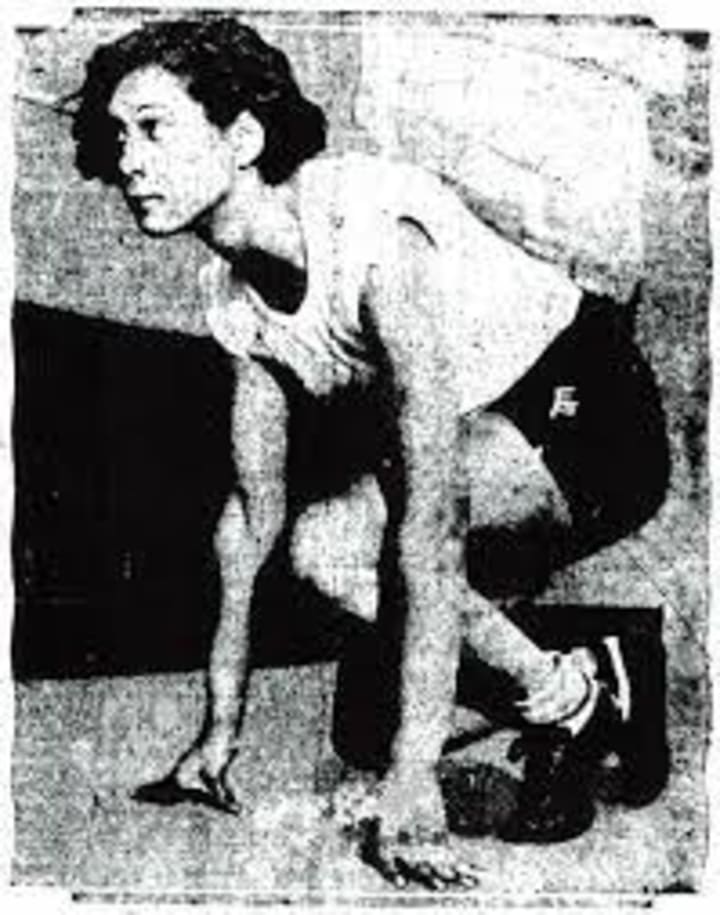
Tidye Pickett was an American track and field athlete. She represented the United States in the 80-meter hurdles at the 1936 Summer Olympics in Berlin, becoming the first African-American woman to compete in the Olympic Games. In 2016, the 1936 Olympic journey of the eighteen Black American athletes, including interviews with Pickett's family, was documented in the film Olympic Pride, American Prejudice.
She was born in Chicago, Illinois, on November 3, 1914. She lived with her parents, Sarah Pickett, a factory clerk, and Louis Pickett, a foundry foreman and an older brother,Charlie, in the Englewood community. In the 1929 Chicago American/Central AAU huge meet involving 1,100 girls in age groups starting at 11-12 years, Pickett running for Carter in the 13-14 years group, took second in the 50 yard dash. During 1931-1934, Tidye Pickett was a student at Englewood High School, an integrated institution that was about one-third black when she attended. She followed her sports interests outside the school—which were track, tennis, and basketball—in the city’s great park and playground organizations and in the African American church-sponsored leagues. She probably found the level of competition in high school not challenging enough for someone who had considerable experience in park district programs. From the playground competitions, she soon graduated to other track meets sponsored by athletic clubs, church organizations, and YMCAs. At a meet at an armory, she met University of Chicago track star John Brooks, who would become her trainer and mentor. Pickett also had a notable career in basketball competing as a star player on some of the top African American women's teams in the city. In March, at the annual Illinois National Guard meet, Pickett again astounded the Chicago track world when she beat out two top veteran runners, Mary Terwilliger and Annette Rogers, in the 60-yard. At the 1932 United States Olympic Trials Pickett competed in the 100-meter dash, winning her heat and placing third in her semi-final; she qualified for the final, where she placed sixth. Pickett was named to the American Olympic team as part of the eight-woman 4 × 100 meter relay pool; she and Louise Stokes, who was also part of the relay pool, were the first African-American women to be selected for the Olympic Games, but both were left out of the final four-woman relay lineup that ran at the Olympics because of racial discrimination during their Olympic trip. Pickett continued her running career; in 1934 she ran the opening leg on a Chicago Park District team that set an unofficial world record of 48.6 in the 4 × 110 yard relay. In 1935 Pickett continued her stellar performances, first with three outstanding indoor meets, the Central AAU annual indoor in Chicago, and two indoor meets in Hamilton and Toronto, Canada. In Chicago, Pickett won the 100 meters, took the 80-meters, and captured the broad jump. At Hamilton and Toronto, the Chicago Park District team won both meets. Pickett teamed up with Annette Rogers, Doris Anderson, and Mary Terwilliger, to set a world’s record in the 440-yard relay twice, first in Hamilton at 52.2 seconds and then in Toronto at 51.8 seconds. Pickett’s individual achievements included winning the 50-yard at both Hamilton and Toronto. At the 1936 United States Olympic Trials she competed in the 80-meter hurdles, placing second and qualifying for the Olympics in Berlin.At the Olympics, Pickett survived the heats but went out in the semi-finals, falling at the second hurdle and injuring herself, she was the first African-American woman, as well as the first Illinois State University athlete, to compete in the Olympic Games. Pickett’s track career was over after the 1936 Olympics, although she participated in a few meets. she resumed her basketball playing in 1939, joining the Bivins All Stars.Pickett married Gail Russell Eldredge in October of 1939. He was thirteen years older than Pickett and worked as a janitor in the Chicago Public Schools system. In the 1940-41 season, the team under new sponsorship adopted the name “Co-eds” or “Chicago Co-eds,” but within weeks adopted the name “Chocolate Co-eds.” Being a novelty team, the Co-eds would joke around that do silly and entertaining tricks with the basketball. They claimed to have the “tallest lady in the world” and the ‘fastest girl runner in the world,” meaning Tidye Pickett. Sometimes at half-time Pickett would do a sprint demonstration.The 1940 census had Pickett and her husband living in a residence along with two children of her husband from a previous relationship.Pickett was listed as having completed three years of college, and of having earned 480 dollars for 26 weeks of work for the previous year. She was not listed as being employed anywhere, and the amount of income probably reflected some or much of her basketball earnings.Pickett ended her basketball career after the 1940-41 season, ending her competitive sports career and her identity as a sports figure. She settled down and had her first child from the Eldredge marriage in August of 1942. Sometime in the 1940s, Pickett returned to school to get a degree in teaching and graduated from Pestalozzi Froebel Teachers College. In her personal life she ended her marriage with Gail Eldredge, and while teaching in school married one of her fellow teaching colleagues, Frank Phillips, and raised three daughters. In 1956, Pickett earned an MS degree in Education from Northern Illinois University. Then in September of 1957, Pickett joined the teaching staff at the Cottage Grove Elementary School in East Chicago Heights (later Ford Heights), a small impoverished African American community in the south suburbs. After one year of teaching at Cottage Grove, she moved to Woodlawn School in the same district to serve as principal. She served as principal of Woodlawn School for 23 years until her retirement in 1980; when she retired, the school was renamed after the Tidye A. Pickett School. ickett’s legacy has been remembered in various awards and recognitions she received over the years. In 1973, Illinois State University (formerly Illinois State Normal University), inducted Picket into the school’s Athletic Hall of Fame. In August 1984, the United States hosted the Olympic Games at Los Angeles, returning to the city of the 1932 Olympics, and the Chicago Tribune and the Chicago Sun-Times used the occasion to write a human-interest story on Tidye Pickett. The papers obtained Pickett’s views on both the 1932 and 1936 Olympics, in which she recounted the bigotry of the 1932 Games and the disappointing injury of the 1936 Games. The Sun-Times story captured the gist, however, when it reported that she was rooting for the USA while watching the 1984 Olympics, but that in 1932 it was “hard for her to feel so patriotic.”After some years of failing health, Tidye died in Chicago Heights, Illinois, on November 17, 1986 at the age of 72.
About the Creator
Kia T Cooper-Erbst
Writer, poet, author. submissive. Mom of three wonderful human beings. These are the first things that come to mind when I think of myself besides being the obvious.... which is daughter, wife,etc.
Keep reading
More stories from Kia T Cooper-Erbst and writers in FYI and other communities.
black clergy and politicians
Whenever black history is taught in schools we only cover certain topics or even people such as Harriet Tubman, Martin Luther King Jr, and Rosa Parks because they are considered safe to teach about. Slavery is rarely taught and it usually goes straight to the civil rights movement of the 60’s. Black history is more than that because every aspect of American history has been touched and built up on by a black person. . Let me introduce to you several people.
By Kia T Cooper-Erbst4 years ago in FYI
Bomb Scare
It was 2027, and the world never thought it would happen. A missle hit the United States, but it wasn't where they had anticipated. A little town in the northeast was hit by a missile strike, they didn't know why, and they didn't know exactly where it hit, but they did know it was a coastal community, somewhere between Maine and Delaware.
By Gregory Payton5 days ago in Fiction


Comments
There are no comments for this story
Be the first to respond and start the conversation.