
South China Sea Dispute Explained
Have you ever wondered what is South China Sea Dispute? Here are some answers for you.
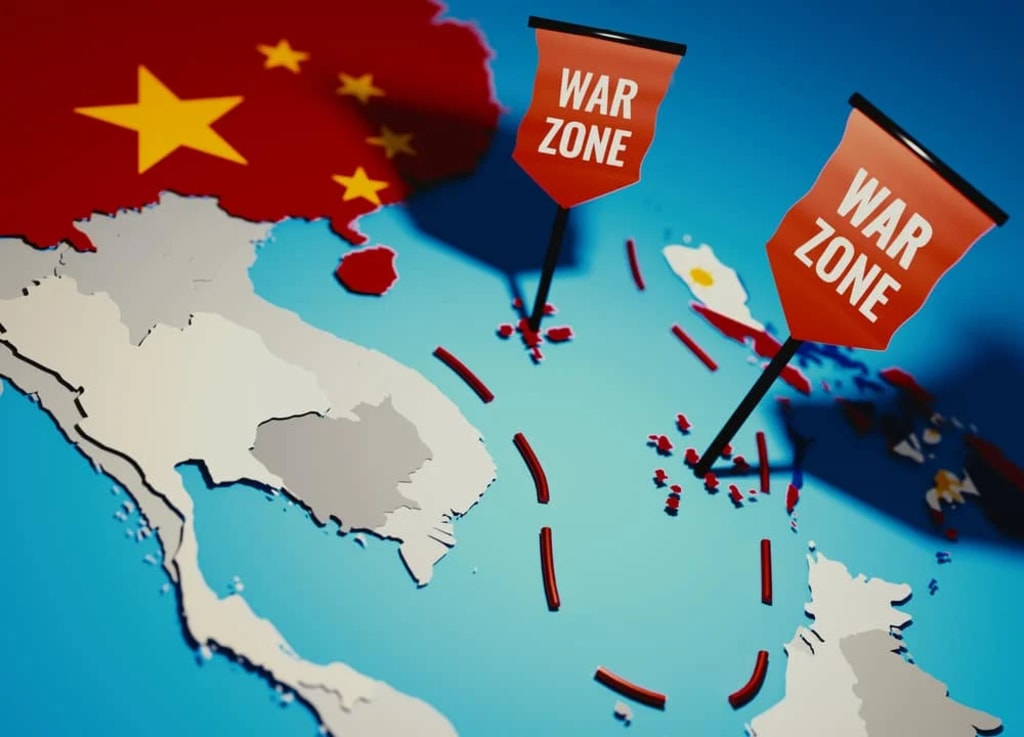
Territorial disputes in the South China Sea have persisted for centuries, but tensions have escalated in recent years, primarily due to China's extensive claims that encompass both land parcels and adjacent waters. This has caused dissatisfaction among competing claimants such as Vietnam, the Philippines, Taiwan, Malaysia, and Brunei. These countries have staked their own claims on islands and various zones within the sea, including the Paracels and the Spratlys.
To support its expansive claims, China has engaged in island-building activities and increased naval patrols in the region. The United States, while officially claiming neutrality in territorial disputes, has conducted military operations near the disputed islands, citing "freedom of navigation." Japan, despite having no direct stake in the South China Sea, has provided support to claimants like Vietnam and the Philippines by supplying them with ships and military equipment. Concerns have arisen that this area could become a potential flashpoint with significant global consequences.
Several factors contribute to countries' interest in these waters. Firstly, the South China Sea serves as a crucial shipping route, with the United Nations Conference on Trade and Development estimating that over 21% of global trade, amounting to $3.37 trillion, passed through these waters in 2016. Additionally, the region is home to valuable fishing grounds that sustain the livelihoods of millions of people. More than half of the world's fishing vessels operate in this area. Furthermore, although largely uninhabited, the Paracels and the Spratlys may contain untapped natural resources. Due to limited exploration, estimates of the area's mineral wealth are largely extrapolated from neighboring regions.
China's claims in the South China Sea are based on its "nine-dash line," which encompasses the largest portion of territory in the area. This demarcation, consisting of nine dashes, extends hundreds of miles south and east from China's southernmost province of Hainan. China argues that its historical rights to the area date back centuries when the Paracel and Spratly island chains were considered integral parts of the Chinese nation. Taiwan also asserts the same claims as China.
Critics argue that China's claims lack specificity, as the nine-dash line depicted on Chinese maps does not include coordinates and it remains unclear whether China claims only the land territory within the line or the entire maritime space as well. Vietnam strongly disputes China's historical account, asserting that China had never claimed sovereignty over the islands before the 1940s. Vietnam maintains that it has actively ruled over both the Paracels and the Spratlys since the 17th century, backed by historical documents. The Philippines, another major claimant, bases its claim on geographical proximity to the Spratly Islands. Both the Philippines and China lay claim to the Scarborough Shoal, situated around 100 miles from the Philippines and 500 miles from China (known as Huangyan Island in China).
Malaysia and Brunei also assert their claims in the South China Sea, arguing that the disputed territories fall within their economic exclusion zones defined by the United Nations Convention on the Law of the Sea (UNCLOS). Brunei does not claim any of the disputed islands but Malaysia claims a small number of islands in the Spratlys.
Efforts to reach a resolution have been complex. China prefers bilateral negotiations with the other claimants, but many argue that its size and influence give it an unfair advantage. Some countries propose that China should negotiate with the Association of Southeast Asian Nations (ASEAN), a regional grouping comprising ten member states. However, China opposes this approach, and ASEAN itself is divided on how to address the dispute. The Philippines has pursued international arbitration instead, announcing in 2013 its intention to take China to an arbitration tribunal under UNCLOS to challenge its claims. In July 2016, the tribunal ruled in favor of the Philippines, stating that China had violated its sovereign rights. China boycotted the proceedings and rejected the ruling, asserting that it would not be bound by it.
About the Creator
I Preached an Entire Sermon Based on Only One Word
As an itinerant preacher, I was invited to preach at a church for its Missionary Sunday. I chose to preach on a practical subject in keeping with the occasion. Even though the sermon was geared toward missionaries, it was appropriate for everyone who heard it.
By Margaret Minnicks5 days ago in FYI



Comments
There are no comments for this story
Be the first to respond and start the conversation.