
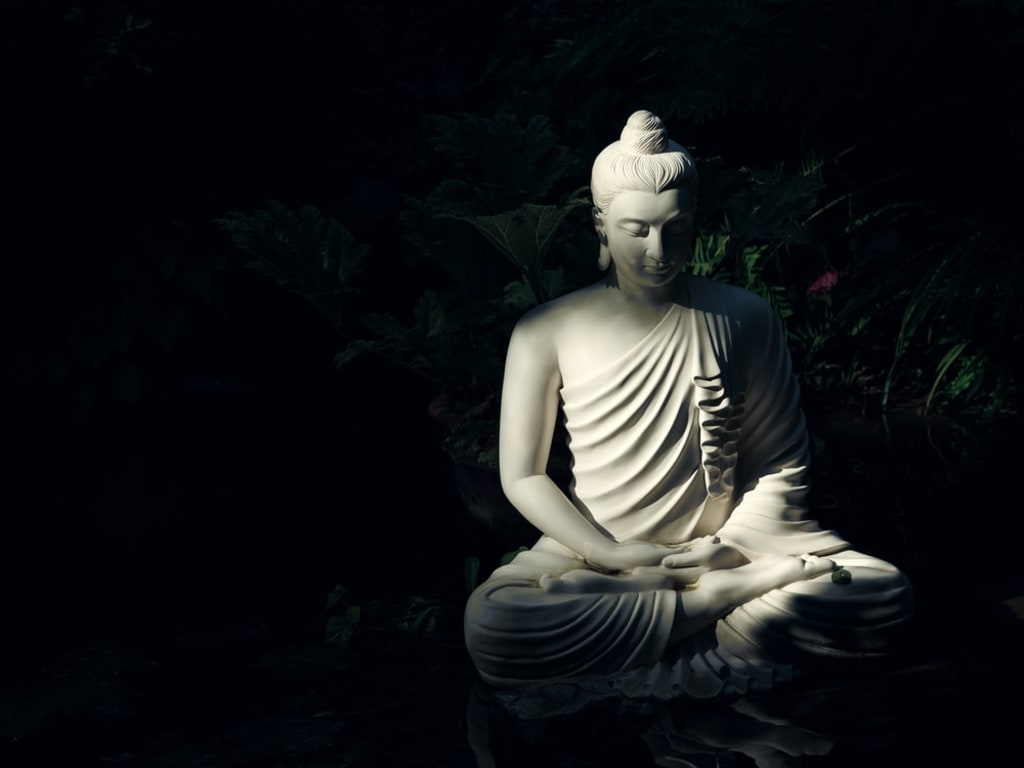
The term “Historical Buddha” (Sakyamuni Buddha) refers to the Buddha Siddhattha Gotama, the founder of Buddhism, who was born in North India some 2,500 years ago (around 600 BC) and whose authentic teaching has lived on to this day, mainly through Theravada Buddhism. The exact place of his birth is considered to be the Lumbini Garden, which is located today right on the southern border of Nepal. Gotama’s father was Suddhodana, a local king or lord (rāja) of the Sakya tribe, which had its own autonomous state within the Kingdom of Kosala, and Siddharttha Gotama was considered a prince of Sakya. When Gotama was born, a wise ascetic of high intellectual achievements named Asita predicted that he would eventually become a Buddha. On the fifth day after the birth of prince Gotama, he was named Siddhattha, meaning “the one whose purpose has been attained”. His family name was Gotama.
According to the ancient custom, Suddhodana invited Brahmanical priests to the palace for the naming ceremony. Among them were eight distinguished priests. After examining the characteristics of the child, seven of them raised two fingers and gave a double interpretation, saying that if he continued to live among the people and consented to rule, he would become a world monarch, but if he renounced it and turned to asceticism, he would become a Buddha. But the younger one, Kondañña, who surpassed the others in knowledge, raised only one finger and firmly declared that Siddhattha would certainly renounce the world and become a Buddha.
When he heard this, Suddhodana tried in every way to keep his son in the palace, in a secure and luxurious world, wishing that his son would succeed him. He even constructed three palaces for him, one for each of the three seasons, where Siddhattha was brought up in luxury; he wore the most beautiful and expensive clothes, used the best perfumes, his servants held a white umbrella over his head day and night, so that the cold and the heat, the dust and the dewdrops would not get to him, he was entertained by musicians, none of whom were men, he only ate the best food and for the most part, he did not leave the palace. (AN Sukhumālasutta).
At the age of 16, he married a young noblewoman named Yasodhara, who gave him a son named Rahula.
Until the age of 29, everything was going smoothly and King Suddhodana was careful not to cause his son any misery.
The Buddhist scriptures describe four incidents that awakened Siddhattha and thus he came to know the four evils – birth, old age, sickness and death – from which all people suffer; but he also felt the desire to find a solution. Eventually, he renounced his princely position and embarked on a spiritual search to find out how to overcome the aforementioned human evils.
He snuck out of the mansion at night, exchanged his beautiful silk clothes for the simple orange tunic of a holy man and cut off his beautiful black hair. Then, having nothing with him but a bowl for begging in order to be offered food, he began his great search. For six years, he lived ascetically, meditating and fasting. Eventually, he stopped fasting because he thought it was extreme and by discovering his own method of meditation, he achieved enlightenment under the Bodhi Tree.
At the age of 16, he married a young noblewoman named Yasodhara, who gave him a son named Rahula.
Until the age of 29, everything was going smoothly and King Suddhodana was careful not to cause his son any misery.
The Buddhist scriptures describe four incidents that awakened Siddhattha and thus he came to know the four evils – birth, old age, sickness and death – from which all people suffer; but he also felt the desire to find a solution. Eventually, he renounced his princely position and embarked on a spiritual search to find out how to overcome the aforementioned human evils.
He snuck out of the mansion at night, exchanged his beautiful silk clothes for the simple orange tunic of a holy man and cut off his beautiful black hair. Then, having nothing with him but a bowl for begging in order to be offered food, he began his great search. For six years, he lived ascetically, meditating and fasting. Eventually, he stopped fasting because he thought it was extreme and by discovering his own method of meditation, he achieved enlightenment under the Bodhi Tree.
About the Creator
A Failed Artist, A Disillusioned Poet, An Underpaid Game Show Host
I took my son and niece to Gori, a small town in Georgia where Joseph Stalin was born. They talked me into visiting the Stalin's Museum, the largest in the post-Soviet space. I had resisted going there because I just can't stand the monster and know enough about him, or so I thought.
By Lana V Lynx20 days ago in FYI
On National Cheese Lover’s Day, Don’t Feel Bleu—Celebrate the Curds That Bind Us
January 20th rolls around every year with a simple but powerful message: don’t feel bleu, throw a feta, and absolutely act capriciously if cheese is involved. National Cheese Lover’s Day is the perfect excuse to lean into one of humanity’s oldest and most beloved foods. Whether you’re reaching for cheddar, asiago, fontina, or something that smells questionable but tastes incredible, this is a gouda day to celebrate it all.
By Lawrence Lease6 days ago in FYI
Affection and Healing for Yourself
During the night of the last quarter moon, I gathered my ritual supplies. I carefully handled the chunk of black tourmaline that would protect me from your overall negative and narcissistic energy. I carefully walked the house with my stick of selenite in hand, asking the universe to cleanse our working space.
By Alisha Wilkins ✒️🦋🖋️6 days ago in Fiction


Comments
There are no comments for this story
Be the first to respond and start the conversation.