
Saturn's Moon Mysterious Beam
NASA Have Detected a Mysterious Beam
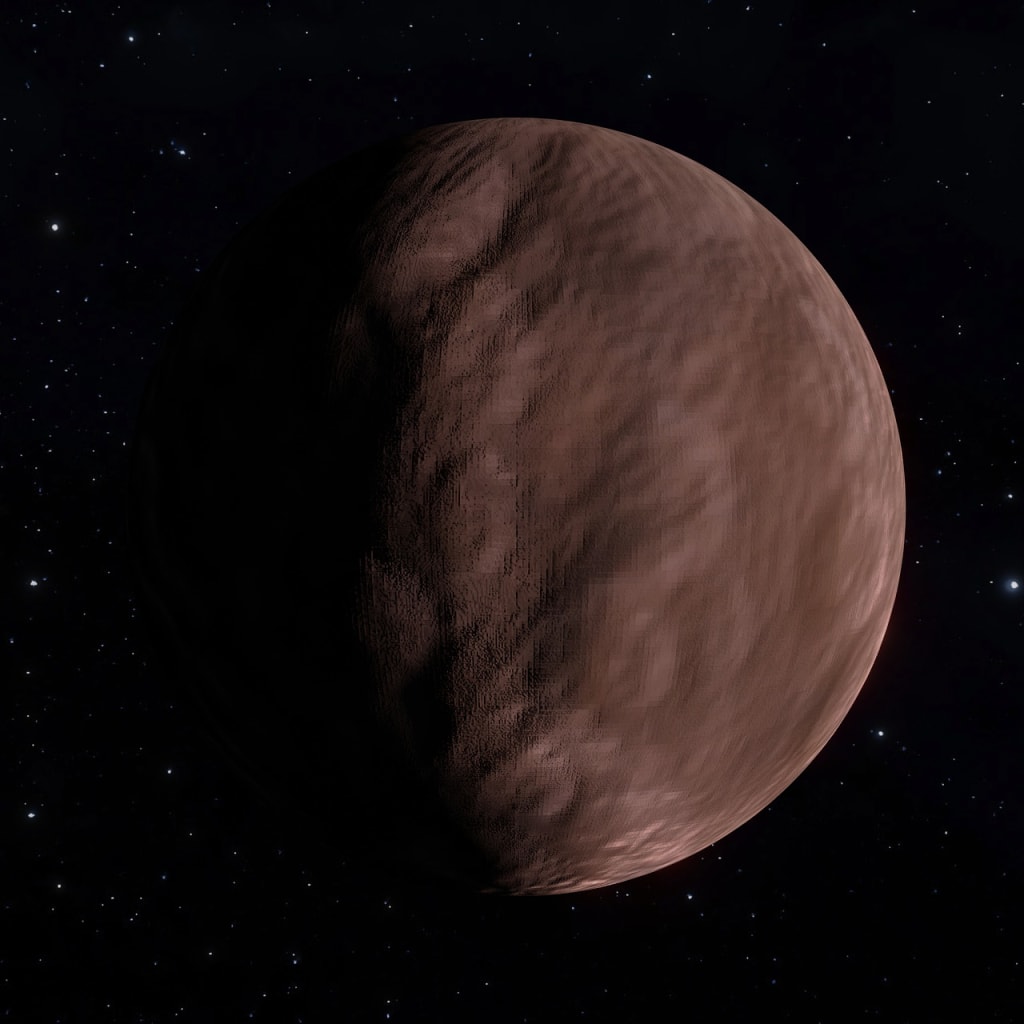
Recall your childhood days when you first encountered the concept of static electricity. Picture yourself taking a blown-up balloon, rubbing it against your hair for a few seconds, and witnessing the charge from static electricity pulling your hair straight out. Now, imagine applying this concept to objects scattered throughout the vast cosmos.
For many years, the only celestial body known to exhibit its own form of static electricity was our very own Moon. In the vacuum of space, charged dust particles played a significant role in creating an environment filled with static. However, while it was conjectured that other celestial bodies, like the Moon, might possess such properties, no concrete evidence was gathered by NASA or other space agencies within our purview of research.
That was until a serendipitous space probe mission made a remarkable discovery in 2005, near Saturn, suggesting the presence of a similar form of static electricity on Saturn's moon, Hyperion. To delve deeper into Hyperion, its unique characteristics, and its intriguing particle beam shooting into space, let's embark on a comprehensive exploration.
In October 1997, a collaborative team of engineers, sponsored by NASA, the European Space Agency (ESA), and the Italian Space Agency (ISA), initiated the Cassini space research mission from Cape Canaveral, Florida. The mission's objective was to send a robotic spacecraft to Saturn to study the planet and its various moons in intricate detail. Nearly six years after its launch, following flybys of other celestial objects in our solar system, Cassini reached the Saturnian system. This marked the commencement of regular data transmission from Cassini to Earth, a process that continued for 14 years.
However, it was just two years into the mission that something unusual caught the attention of astronomers. On September 26, 2005, the Cassini probe encountered technical issues. Several instruments on board began to malfunction, but there were no signs of the probe making contact with any other celestial objects. Fortunately, meticulous investigation revealed that the Cassini Plasma Spectrometer (CAPS) readings had indicated an intriguing phenomenon. The probe had magnetically connected to Hyperion's surface for a brief period leading up to the technical difficulties. This magnetic connection allowed electrons and ions to escape from Hyperion's surface and travel in the direction of Cassini, ultimately latching onto the robotic probe. What was truly perplexing was that this particle beam attack occurred when Cassini was a substantial 1,200 miles away from Hyperion's surface, making the 200-volt electric shock all the more mystifying. Despite this incident, Cassini continued its mission, remaining one of the most successful space probes in the history of our solar system's exploration.
This seemingly isolated occurrence in September 2005 kept nagging at the minds of astronomers and researchers. No other particle beam attacks occurred within the Saturnian system, either before or after the incident, including a direct visit by Cassini's lander vehicle, Huygens, to Saturn's moon, Titan.
To unravel the mystery behind this unusual event, we must first examine the peculiar nature of Hyperion, also known as Saturn VII. Hyperion was first discovered in 1848 by a trio of astronomers: William Cranch Bond, his son George Phillips Bond, and William Lassell. Its name, derived from Greek mythology, pays homage to Hyperion, a pre-Olympian Titan known for his observation. Strikingly, the Roman equivalent of Hyperion is Saturn himself.
Hyperion, unlike typical spherical moons in our solar system, stands out due to its non-ellipsoidal shape, signifying an absence of gravitational equilibrium and a unique pressure gradient. This irregular shape has led researchers to believe that Hyperion might be one of the largest non-spherical objects in our solar system. It ranks second in size, smaller only than Neptune's moon Proteus. The peculiarities don't end there.
One of the most notable features of Hyperion is the presence of a massive, 75-mile-diameter crater that extends six miles deep. This crater's origin is closely linked to the proposed theory concerning the moon's creation. It's believed that Hyperion is the remnant of a much larger asymmetrical body that collided with an unidentified celestial object billions of years ago. If this theory holds true, Hyperion would be the remaining fragment of a once-620-mile-wide object, reduced to its present form. The fate of the other fragments from this collision remains unknown. Clues to this collision can also be found in the isotopic abundances on Titan, Saturn's largest moon, suggesting that volatiles from the impact might be present on Titan.
Hyperion's composition adds to its enigma. Despite its considerable size, the moon has a relatively low density, primarily due to its mostly water ice composition. The rocky portion is smaller than initially thought. This moon was once considered a conglomerate of dust and space rubble. However, recent findings revealed a thin layer of undefined dark material on its surface, contradicting the dust theory.
One of the most striking aspects of Hyperion is its rugged surface, adorned with numerous deep craters, each characterized by sharp edges. It is often described as resembling a sponge due to the multitude of craters and the moon's highly porous and compressed surface. In fact, Hyperion's gravity is so weak that most matter ejected from its surface never returns, leading to an accumulation of debris on its porous exterior.
All these peculiar characteristics bring us back to the central mystery: the particle beam discovered by Cassini in 2005. The answer, somewhat surprisingly, harks back to the notion of static electricity. Hyperion does not function as an alien spacecraft firing lasers at passing space probes, nor does it host toxic thunderclouds with interstellar lightning. Instead, the moon houses a particle beam that emanates static electricity due to Saturn's magnetic field's volatility.
Saturn's magnetic field, encompassed by its magnetosphere, extends its influence over Saturn's moons, including Hyperion. Ultraviolet sunlight from the sun entering the magnetosphere interacts with the moon's surface, causing charged electrons and ions to continually rain down on Hyperion. These charged particles act much like rubbing a balloon on your hair or sweater. With sufficient charge, static electricity manifests itself in the form of a particle beam.
In essence, Hyperion and Earth's Moon exhibit static electricity through similar processes. Now, with the knowledge that Hyperion and its family of objects may possess such static properties, astronomers and researchers can explore other moons in Saturn's system, as well as in the Jovian system, to better understand the potential electric charges present. Investigating these particle beams can help mitigate risks for future missions, ensuring that static electricity does not interfere with their success. By delving into the mysteries of Hyperion and its fellow static-filled celestial bodies, we are but one step closer to comprehending the vast universe and its enigmatic phenomena.
About the Creator
Ananymus Kelly
meticulous
Keep reading
More stories from Ananymus Kelly and writers in FYI and other communities.
Unveiling the Enigma of Mysterious Underwater Sounds
Our planet is home to an enormous, largely unexplored realm - the world's oceans. A staggering 95% of these vast aquatic expanses remains unseen by human eyes, leaving us with an intriguing question: what secrets could be concealed within these uncharted waters? Many experts contend that, given the ocean's immense size, it wouldn't be surprising if some sizeable and enigmatic creatures still elude discovery. When people contemplate the uncharted depths of the deep sea, thoughts often veer towards the possibility of mythical and fearsome sea creatures. While this notion is nothing short of enthralling, it also carries an air of terror.
By Ananymus Kelly2 years ago in FYI
Wild Card Weekend Recap: What Happens Now?
I think I figured out why I love Wild Card Weekend so much. It's because it's the first playoff anything of the calendar year. The NFL season starts in the fall, and once upon a time, the champion was crowned either on or slightly before New Year's. The evolution of the NFL schedule has resulted in the playoffs starting just into the New Year, and currently, the final week of the season falls on the first weekend of the New Year, with Wild Card Weekend coming a week after that. So yes, chronologically, the NFL's Wild Card Weekend serves as the first playoff anything of the calendar year.
By Clyde E. Dawkins6 days ago in Unbalanced



Comments
There are no comments for this story
Be the first to respond and start the conversation.