
Samuel Pepys
"I know not how to abstain from reading"


He was an administrator of the Navy of England and a Member of Parliament and he lived during Charles II and James II reigns. His diary gives us a deep insight into what life was like in the 17 Century and during the Great Fire of London and the Plague. Samuel Pepys' private diary goes into detail about the years from 1660 to 1669.
Samuel was born in 1633, in Salisbury Court, Fleet Street, London. He was the son of John Pepys, a tailor, and his mother was Margaret, who was the daughter of a Whitechapel butcher. Samuel was the 5th of 11 children, but because child mortality was high, he was soon the oldest survivor. Whilst still very young, Samuel was sent to live with nurse Goody Lawrence at Kingsland and in 1644, he attended Huntingdon Grammar School and then St.Paul’s School, London. In 1649, Samuel Pepys attended the execution of King Charles I. He took his Bachelor of Arts degree in 1654.
As was the norm back then, Samuel entered the household of one of his father’s cousins, Sir Edward Montagu (who was later dubbed the 1st Earl of Sandwich). In December, 1655, Samuel married Elizabeth Marchant de Saint-Michel, who was the daughter of a French Huguenot refugee and who was penniless but a beautiful 15 year old. In his diary, Samuel recorded these humble beginnings, when his wife “used to make coal fires and wash my foul clothes with her own hand for me, poor wretch! In our little room at Lord Sandwich’s; for which I ought forever to love and admire her, and do.” It certainly sounded like the young couple were in love! Samuel went through a serious abdominal operation in 1658 (remember what a dangerous time this was where medicine was concerned), and afterwards, he celebrated the success of the operation (and the fact that he was still alive!) every year with a dinner: “This being my solemn feast for my cutting of the stone.” Samuel moved to Axe Yard (near Downing Street today) where he worked as a teller in the Exchequer under George Downing.
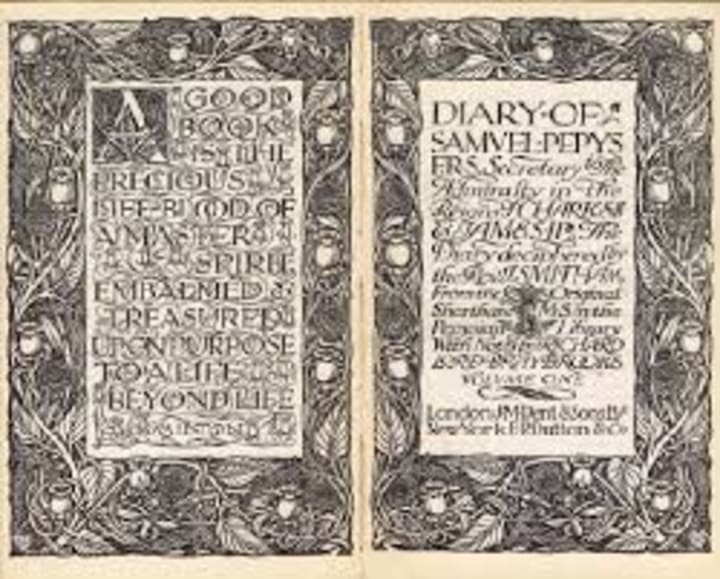
Samuel started his diary on 1st January, 1660, and recorded his daily life for almost 10 years. The ‘diary’ has more than a million words in it and is regarded as Britain’s most celebrated diary because of Samuel’s own frankness. He recorded with great accuracy events of daily life and major events of the 17th Century, as well as about the ‘contemporary court’ and theatre, his affairs with certain actresses, his own household, and political and social things that happened.

Working his way up the ladder, Samuel became a Justice of the Peace and wrote “so to the office, where I do begin to be exact in my duty there and exacting my privileges and shall continue to do so.” Samuel went into Naval administration, learning as much as he could even about shipbuilding. His devotion to duty was soon realized during the Second Dutch War (1665-1667) when he ‘remained at his post’ during the Plague and the Great Fire of London, actively saving the Navy office. All of this caught the attention of the King and his brother James and Samuel was appointed Secretary to the new commission of Admiralty, now becoming the administrative head of the Navy.
Samuel Pepys' diaries provide details of everyday life of an upper-middle-class man during the 17th Century. He wrote his diaries in shorthand and sometimes he used a ‘code’ of various Spanish, French and Italian words. Samuel wanted future generations to read his diaries --- he included them in his library and made sure that his library survived his death. The diaries go from the politics of the day to very personal details between himself and his wife. He stopped writing because of bad eyesight and, although Samuel lived for another 34 years, he never wrote again in his diary.
Samuel Pepys died in 1703. His wife had died some years before and they had no children, so Samuel left his ‘estate’ to his unmarried nephew, John Jackson. Samuel was buried in St.Olave’s Church, Hart Street, London, next to his wife.
Here are some interesting extracts from Samuel Pepys diaries:
Sunday 2nd September, 1666.
“About seven rose again to dress myself, and there looked out at the window, and saw the fire not so much as it was and further off. By and by Jane comes and tells me that she hears that above 300 houses have been burned down to-night by the fire we saw, and that it is now burning down all Fish Street, by London Bridge. --- The Lieutenant of the Tower, who tells me that it begun this morning in the King’s baker’s house in Pudding-Lane, and that it hath burned St.Magnus’s Church and most part of Fish Street already.”
Tuesday 4th September, 1666.
“I after supper walked into the darke down to Tower-Streete, and there saw it all on fire --- which was very near us; and the fire with extraordinary vehemence. Now begins the practice of blowing up of houses in Tower-Streete, those next the Tower, which at first did frighten people more than anything, but it stopped the fire where it was done.”
Pepys first-hand account of the Great Fire of London.
7th June, 1665.
“This day, much against my will, I did in Drury Lane see two or three houses marked with a red cross up on the doors, and ‘Lord have mercy upon us’ writ there --- which was a sad sight to me, being the first of that king that to my remembrance I ever saw.”
20th July, 1665.
“But Lord! To see how the plague spreads.”
London was facing an epidemic --- the Plague.
16th October, 1665.
“But Lord! How empty the streets are and melancholy, so many poor sick people in the streets full of sores; --- And they tell me that, in Westminster, there is never a physician and but one apothecary left, all being dead.”
Again, Pepys first hand account but of the Plague this time.
Thursday 7th January, 1668 / 1669
“Up, and to the office, where busy all the morning, and then at noon home to dinner, and thence my wife and I to the King’s Playhouse, and there saw “The Island Princesse,” the first time I ever saw it --- we sat in an upper box, and the jade Nell come and sat in the next box; a bold merry 'xxxx', who lay laughing there upon people; and with a comrade of hers of the Duke’s house, that come in to see the play. Thence home and to the office to do some business, and so home to supper and to bed.”

Pepys did have some ‘normal’ days!
About the Creator
Ruth Elizabeth Stiff
I love all things Earthy and Self-Help
History is one of my favourite subjects and I love to write short fiction
Research is so interesting for me too
Keep reading
More stories from Ruth Elizabeth Stiff and writers in FYI and other communities.
"2B Or Not 2B"
When I was working in a stationery shop, readjusting the pen and pencil section, a colleague suddenly said to me: “To be or not to be, that is the question.” Now as I was sorting through the pencils, I thought she said: “2B or not 2B” and honestly did not put the two together. “What?” I said (in my complete ignorance). “I’m quoting Shakespeare” she said, and went on to quote the whole stanza, and this became a long-standing joke, even with the customers.
By Ruth Elizabeth Stiff5 years ago in FYI
A Failed Artist, A Disillusioned Poet, An Underpaid Game Show Host
I took my son and niece to Gori, a small town in Georgia where Joseph Stalin was born. They talked me into visiting the Stalin's Museum, the largest in the post-Soviet space. I had resisted going there because I just can't stand the monster and know enough about him, or so I thought.
By Lana V Lynx7 days ago in FYI
We Shall Never Surrender: The Speech That Turned Britain’s Darkest Hour Into Defiance
There are speeches that explain history, and then there are speeches that intervene in it. On June 4, 1940, Winston Churchill delivered one of the most consequential addresses ever spoken inside the House of Commons. Britain had just pulled off the miracle of Dunkirk—an evacuation that saved more than 330,000 Allied troops from annihilation. But make no mistake: this was not a victory. France was collapsing. Nazi Germany looked unstoppable. Invasion felt inevitable.
By Lawrence Leasea day ago in FYI



Comments
There are no comments for this story
Be the first to respond and start the conversation.