
"2B Or Not 2B"
"All the world's a stage, and all the men and women merely players. They have their exits and their entrances."
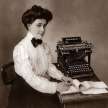

When I was working in a stationery shop, readjusting the pen and pencil section, a colleague suddenly said to me: “To be or not to be, that is the question.” Now as I was sorting through the pencils, I thought she said: “2B or not 2B” and honestly did not put the two together. “What?” I said (in my complete ignorance). “I’m quoting Shakespeare” she said, and went on to quote the whole stanza, and this became a long-standing joke, even with the customers.
Shakespeare --- some-one I studied in Secondary School and with whom I passed my ‘O’ level English, and whom I did not even think about again until the above incident when I was working. Yet, it brought back some great memories because I really enjoyed English at School, and studying “Twelfth Night” only added to that fun. We know this very famous name, “William Shakespeare”, and even a few words from one of his 39 dramatic works. Who was this man whose plays we still see today, performed in theatres throughout London --- hundreds of years after his death?

Born in 1564 in Stratford-upon-Avon, William was the eldest son of John and Mary Shakespeare. His father was a prosperous glover and local dignitary, and his mother was the daughter of a wealthy farmer. Although there is no record about William’s education, he possibly went to King’s New School where he would have studied Latin and Greek and may have been brought up as a Catholic.
When he was 18 years of age, William married (the 26 years of age) Anne Hathaway. The marriage licence was issued in 1582 and it appears that the wedding was rushed. Their daughter, Susanna, was born 6 months later (now we know why the wedding was rushed). The couple also had twins, a son and daughter in 1585, but the son died when he was 11 years of age.
William seemed to ‘disappear’ between 1858 and 1592, scholars calling this time “Shakespeare’s lost years.” Finally, William is mentioned in 1592 as part of the London theatre scene. Between the years of 1590 and 1613, William wrote 37 plays. His 17 comedies include “The Merchant of Venice” and “Much Ado About Nothing.” Among William’s 10 history plays are “Henry V” and “Richard III.” The most famous of his tragedies are “Hamlet”, “Othello”, “King Lear” and “Macbeth.” William also wrote 4 poems, and the famous collection of sonnets (which was first published in 1609).
When several of his plays were put on the London stage in 1592, some thought that William was trying to reach above his rank and the playwright Robert Greene called William “an upstart Crow.” However, after 1594, William’s plays were performed by the “Lord Chamberlain’s Men” and they soon became the leading playing company in London. When Elizabeth I died in 1603, the new King James I awarded the company with a Royal Patent, and they changed their name to the “King’s Men.”
A partnership within the company built their own theatre in 1599, on the South bank of the River Thames --- The Globe --- which is still in use today in 2021! In 1608, the same partnership took over the Blackfriers indoor theatre. Records of William’s property purchases and investments of the time, indicate that William was now a wealthy man. He bought the second-largest house in Stratford, New Place, and in 1605, William invested in a share of the parish tithes in Stratford. When “Henry VI, Part 1” played at the Rose theatre in 1592, the box office takings were £3 16s. 8d. --- the highest recorded for the season.
The plague from September 1592 to June 1594 closed the London playhouses. During this time, William published 2 epic poems, “Venus and Adonis” and “The Rape of Lucrece.”
William’s name had now become a selling point and began to appear on the title pages, William acting in his own plays as well as other plays. William retired in 1613 and died in 1616 at the age of 52 --- we don’t know how or why he died. He left behind his wife and 2 daughters. In his will, William gave the bulk of his estate to Susanne (his eldest daughter). His wife was probably entitled to one-third of his estate automatically. Shakespeare was buried in the Chancel of the Holy Trinity Church --- 2 days after he died.

A brilliant man who wrote brilliant plays in his short life and today, we can still enjoy his works! So --- is it “2B or not 2B”? Or “To be, or not to be, that is the question: Whether ’tis nobler in the mind to suffer the slings and arrows of outrageous fortune, Or to take arms against a sea of troubles And by opposing end them.” (The quote is actually from Hamlet!)
About the Creator
Ruth Elizabeth Stiff
I love all things Earthy and Self-Help
History is one of my favourite subjects and I love to write short fiction
Research is so interesting for me too
Keep reading
More stories from Ruth Elizabeth Stiff and writers in FYI and other communities.
Women in the Forbidden City
The Forbidden City is one of the most popular tourist attractions we have on earth today. It always fascinates me that at one time in history, this “City” was home to thousands of people. So, what was life like for the “Women” who lived in The forbidden City?
By Ruth Elizabeth Stiff5 years ago in FYI
The Psychology of Unboxing: Why Thailand is Obsessed with Mystery Boxes
There is a specific kind of dopamine rush that comes from opening a package when you don’t know exactly what is inside. In Thailand, a nation famously obsessed with social trends and digital shopping, this psychological thrill has transformed into a massive economic engine. The "subscription box"—once a niche Western concept—has evolved into a mainstream retail habit, reshaping how Thais discover everything from skincare to gourmet snacks.
By Sam walterabout 8 hours ago in FYI


Comments
There are no comments for this story
Be the first to respond and start the conversation.