
Professor Ahmed: Over 75% of APMD Platform Budget Dedicated to Implementation Phase
In the final phase, from 2026 to 2028, the platform will focus on assessment and scaling up. Lessons from the operational phase will guide refinements, enabling the platform to adapt to emerging opportunities and challenges while expanding its impact.
The African Union Inter-African Bureau for Animal Resources (AU-IBAR), with funding from the Bill & Melinda Gates Foundation, has invested $5.28 million in the development and implementation of the African Pastoral Management and Development (APMD) Platform.
The four-year initiative, launched in Nairobi, Kenya last week, aims to address the challenges faced by pastoral communities across Africa by fostering private sector collaboration and integrating policy advocacy, market enhancement, and advanced data systems.
Extensive groundwork has since assessed livestock populations, economic contributions, growth potential, and stability across 32 countries. Kenya and Nigeria were named "Lighthouse Countries" for their strategic importance, while Ethiopia, Somalia, Tanzania, and seven others were marked for targeted outreach.
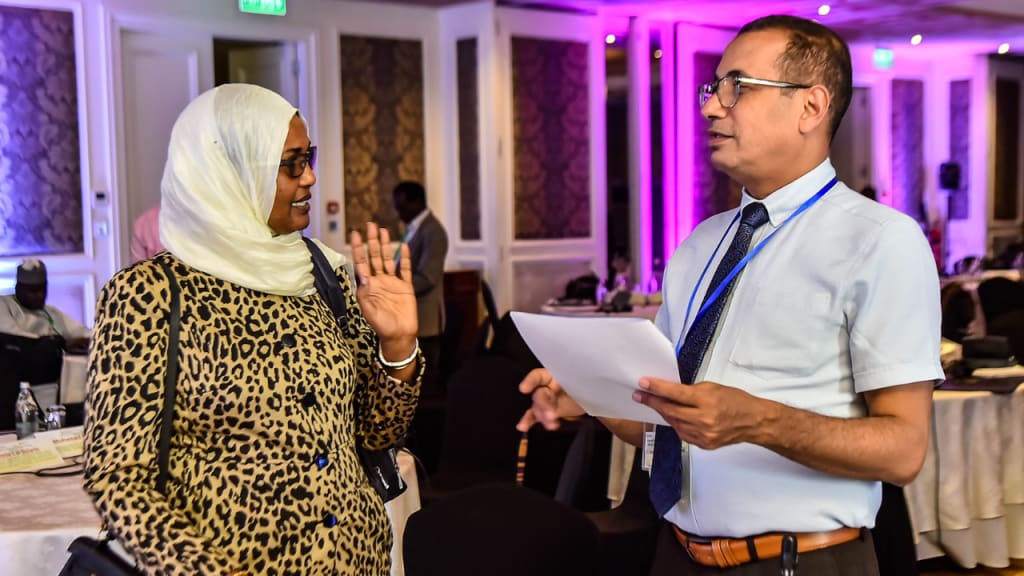
Speaking at the platform's launch, Professor Ahmed Elbeltagy, the project's head, presented a comprehensive strategic roadmap for the APMD platform, covering key milestones and initiatives from 2024 to 2028.
“The inception phase began in 2024, focusing on identifying strategic priorities, forming technical working groups, and designing intervention plans,” Elbeltagy said. “This phase also engaged key stakeholders and implementers to collect valid views for the platform’s success.”
The second phase, scheduled for 2025 and 2026, will see the full-scale launch and operation of the platform. A secretariat will be established, and priority actions executed to realize the platform’s objectives.
In the final phase, from 2026 to 2028, the platform will focus on assessment and scaling up. Lessons from the operational phase will guide refinements, enabling the platform to adapt to emerging opportunities and challenges while expanding its impact.
Notably, $3.98 million—more than 75% of the total budget—has been allocated to implementation and operational costs. This substantial allocation, Professor Ahmed said, underscores the platform’s focus on delivering tangible outcomes to pastoral communities across Africa. Governance expenses, including technical and steering committees, account for $458,550, ensuring strong oversight and coordination.
Administrative and overhead costs are set at $343,297, while $60,000 is earmarked for knowledge management to facilitate the sharing of best practices. Additionally, $89,000 will fund interim and final evaluations to measure the platform’s effectiveness. AU-IBAR itself contributed $353,016 to the initiative.
The AU-IBAR director, Dr. Huyam Salih, noted that the APMD platform will align with key African Union strategies, including Agenda 2063, the Comprehensive Africa Agriculture Development Programme (CAADP), the Policy Framework for Pastoralism in Africa, and the Livestock Development Strategy for Africa (LiDeSA).
“It aims to drive economic inclusion, job creation, sustainable livestock practices, and rural resilience while enhancing value chains, promoting cross-border trade, and safeguarding the rights of pastoral communities,” she said.
AU-IBAR is a specialized technical office of the Department of Rural Economy and Agriculture (DREA) of the African Union Commission (AUC). Its mandate is to support and coordinate the utilization of livestock, fisheries, and wildlife as resources for human wellbeing and economic development in the Member States of the African Union (AU).
For over four decades, AU-IBAR has led continent-wide efforts to eradicate rinderpest through various projects. These include Joint Project Number 15 on Rinderpest (1962-1975), the Pan-African Rinderpest Campaign (1986-1998), and the African Wildlife Veterinary Project (1998-2000).
Other notable initiatives are the Pan-African Programme for the Control of Epizootics (1999-2007), the Pastoral Livelihoods Programmes (2000-2006), and the Community Animal Health and Participatory Epidemiology Project (2000-2004).
Additionally, AU-IBAR implemented the Regional Project for Poultry and Milk Production in East Africa (1999-2005), the Farming in Tsetse-Controlled Areas Project (1999-2004), and the Regional Programme on Ticks and Tick-borne Diseases, among others.
About the Creator
Suleiman Mbatiah
A Journalist
Keep reading
More stories from Suleiman Mbatiah and writers in FYI and other communities.
Nigerian Minister Applauds APMD Platform as a Game-Changer in Africa's Livestock Revolution
The African Pastoral Market Development (APMD) Platform, an ambitious initiative to transform Africa's pastoral and livestock markets, was officially launched this week at the Villa Rosa Kempinski Hotel in Nairobi, Kenya.
By Suleiman Mbatiah12 months ago in FYI
How to Time Travel: 5 Methods According to Science
For a long time, the idea of traveling through time was tucked away in the "fiction" section of the library, right next to wizards and space monsters. But in recent years, the conversation has shifted. With mysterious "time traveler" photos popping up on the internet and physicists like Stephen Hawking weighing in, we have to ask: Is time travel actually possible?
By Areeba Umair6 days ago in FYI
Do You have a Support Network?
Life is harder when you’re on your own. Human beings are social creatures, and we usually feel better when we have support from a strong social network around us. For most people, it’s our families that hold us together like glue.
By Elizabeth Woodsabout 22 hours ago in Psyche


Comments
There are no comments for this story
Be the first to respond and start the conversation.