
Not So "Happily Ever After" for the Beauty and the Beast
The true story that inspired the tale

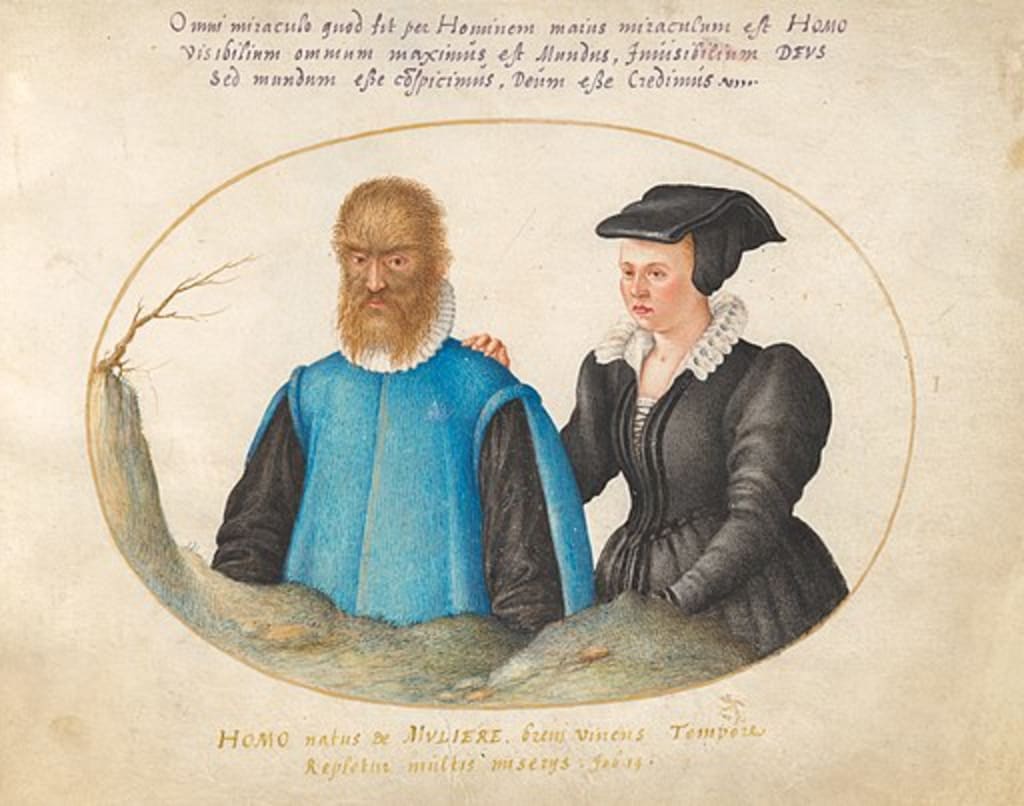
They were called "freaks", "monkeys", and "wild people" for centuries... They were not considered fully human, they were abused in circuses and displayed as curiosities. And the first known person through this was Petrus Gonsalvus - "The Canarian Werewolf" in the Court of Henry II of France.
Hypertrichosis is a rare condition that causes abnormal bodily hair growth. It can affect the body or just certain areas. While mostly hereditary, thus present since birth, it can also be acquired due to certain diseases or medications.
The condition is so rare, that the first ever recorded case of a "wild" person was that of Pedro Gonsales, or Petrus Gonsalvus, in the 16th century.
A Royal Gift
One thing known about Pedro as a child is that he was born around 1537 in Tenerife and was of the Guanche (the indigenous Berber tribe that inhabited the Canary Islands before Spanish occupation) descent.
When Pedro was about ten years old, Margaret de Parma, the regent of the Netherlands, sent the boy to France as a gift to King Henry II. there are only recorded rumors that Pedro's father was already showing him off for money, and sold his son to royals.
Petrus became the royal "monkey" and was disregarded as human at first. However, Henry II took an interest in the boy as he noticed his intelligence and fast learning skills.
This is when the king renamed Pedro "Petrus Gonsalvus". However, Pedro preferred to use his birth name when signing papers, so let's continue calling him Pedro as well.
The king assigned royal tutors such as Piere Danes (professor of the Greek language and later the bishop of Lavaur), Jacques Amyot (one of the most renowned translators of the Renaissance period), and Robert Estienne (lexicographer and royal printer for Hebrew, Latin, and Greek texts) to teach the boy.
Henry also entrusted his Lord of the Bedchamber to look after the kid while in Court and sent Pedro to reside with a wealthy Parisian family.
From Sauvage du Roi to Professor
Sauvage du Roi - King's Savage... This "name" followed Pedro throughout his life, and it was given to the young man upon his return to the Royal Court.
It was because Henry II proudly bragged to everybody about how he successfully transformed the little "savage" into a young gentleman. In his early twenties, Pedro became somewhat of a domestic servant responsible for serving the royal family during their meals.
What happened to the young man after Henry's death in 1559 has been much of a mystery until recently. Only a few years ago, new documents referring to Pedro and his life were found in French archives.
They tell the sad story of the man who had every opportunity to become famous for his intelligence... Yet he was bound to be forever remembered for his looks.
After Henry's son Charles became the new king under the regency of his mother, Pedro was appointed to become his official storyteller. This meant Pedro would read books aloud to the king in private.
The young man also received a yearly royal pension that allowed him to study law at the University of Poitiers - the second biggest in the country at the time, after Sorbonne.
Later in life, Pedro would even become a professor at the University of Sorbonne in Paris.
But before that, he got married.
Queen's Cruel Joke
After Henry's demise, Queen Catherine de Medicis became Pedro's guardian and protector. However, her plans for the young man differed from what her late husband had envisioned.
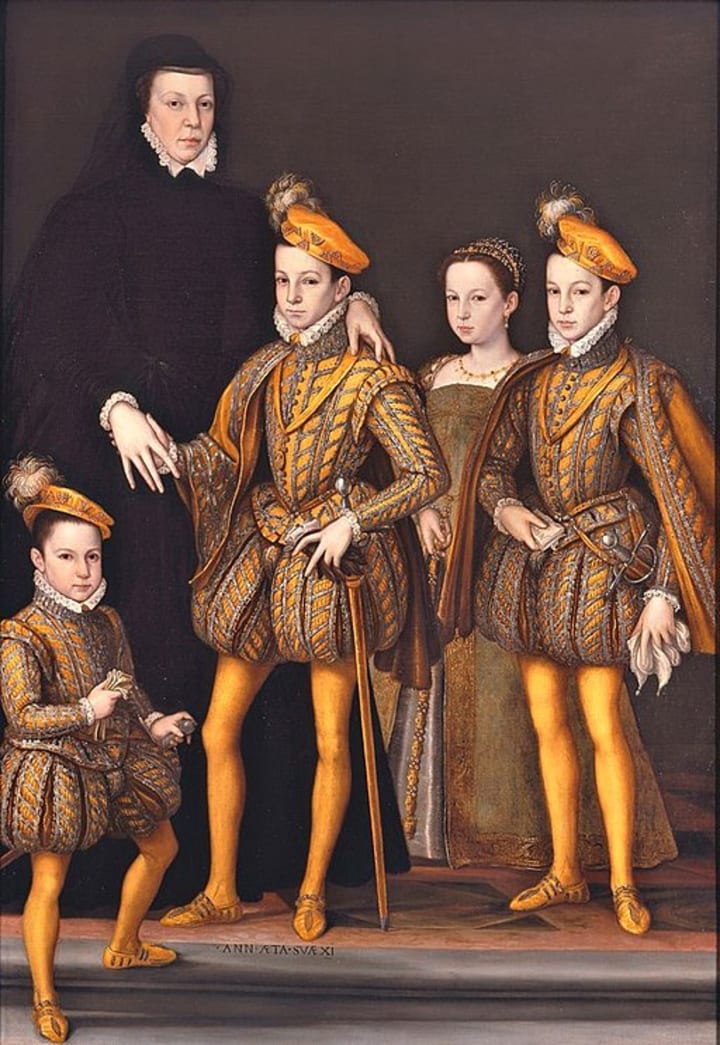
His education and proximity to the king may seem like Pedro was free to live and enjoy his life, but it was far from the truth. In reality, Pedro was still considered the royal family's property, so any decisions they made regarding Pedro's future were unquestionable.
Well aware of it, Catherine de Medicis decided to marry Pedro off. Why? Well, she was curious about what the offspring would look like if she chose a beautiful young woman as his future wife.
Pedro had no say in this matter.
And neither did the bride.
Beast Meets Beauty
Catherine Raffelin was a young Parisian, the daughter of a textile merchant Anselme Raffelin, and his wife Catherin Pecan.
How old she was on her marriage day or how the queen chose her to be the bride is unclear, but one thing is certain, the young woman had not seen Pedro until she walked down the aisle in 1570.
Imagine the surprise and shock she must have experienced, but still, Catherine said yes, and the newlyweds moved into their new home - part of the dowry from the bride's father.
Little "Beasties"
The following year the couple welcomed their first daughter Francoise who displayed no symptoms of her father's condition.
The queen and her entourage must have been disappointed, but the family still retained a strangely tight bond with the royals.
Pedro and Cahterine's children were all baptized, their godparents being high-ranking royal officials, such as the king's financial advisor, his royal secretary and treasurer, and even an officer acting on the king's behalf.
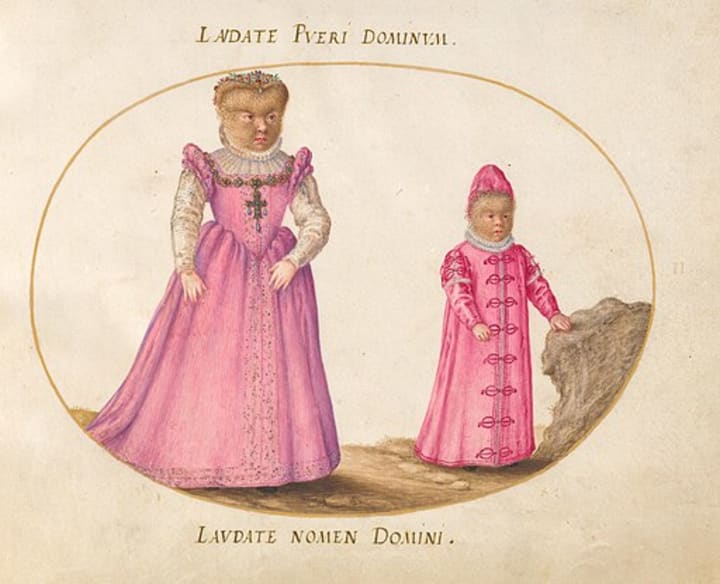
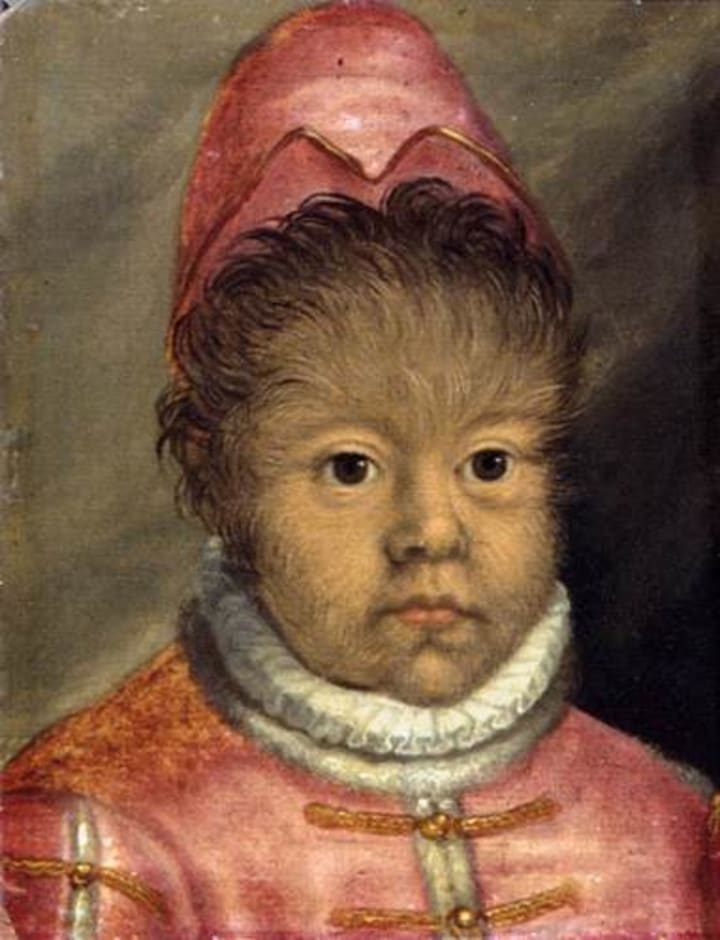
Long story short, four out of seven couple's children inherited their father's condition, thus becoming the entertainment Queen Catherine was initially looking for.
The whole family would accompany the royals on their trips to other European countries to be paraded around and shown off as a spectacle for the curious nobility.
Freedom in Chains
Although Pedro and Catherine were allowed a family life, and Pedro even became a teaching professor at the University of Sorbonne in Paris in 1582, they still had very little control over their future.
As if being dragged around Europe was not enough, life in Paris was also becoming less stable. Amid the religious wars and conspiracies, the Queen and her only remaining son Henry III - the new king, had to flee the capital and hide in the royal palace of Blois.
Then, ignoring his mother's warnings, Henry decided that the best way to deal with enemies was to assassinate them all. Once Catherine learned of her son's deeds, her health declined, and she passed away. Eight months later, in 1589, Henry III was assassinated, and the royal line of Valois-Angouleme ended with him.
Unfortunately, this also left Pedro and his family without the protection they had before. Desperate to not become treated like freaks, Pedro and Catherine began looking for a new protector.
And he came - a wolf in sheep's clothing.
New Trials in Italy
After traveling around Europe and looking for a new home, Pedro and Catherine returned to France, sold their property, and left for Italy with their kids.
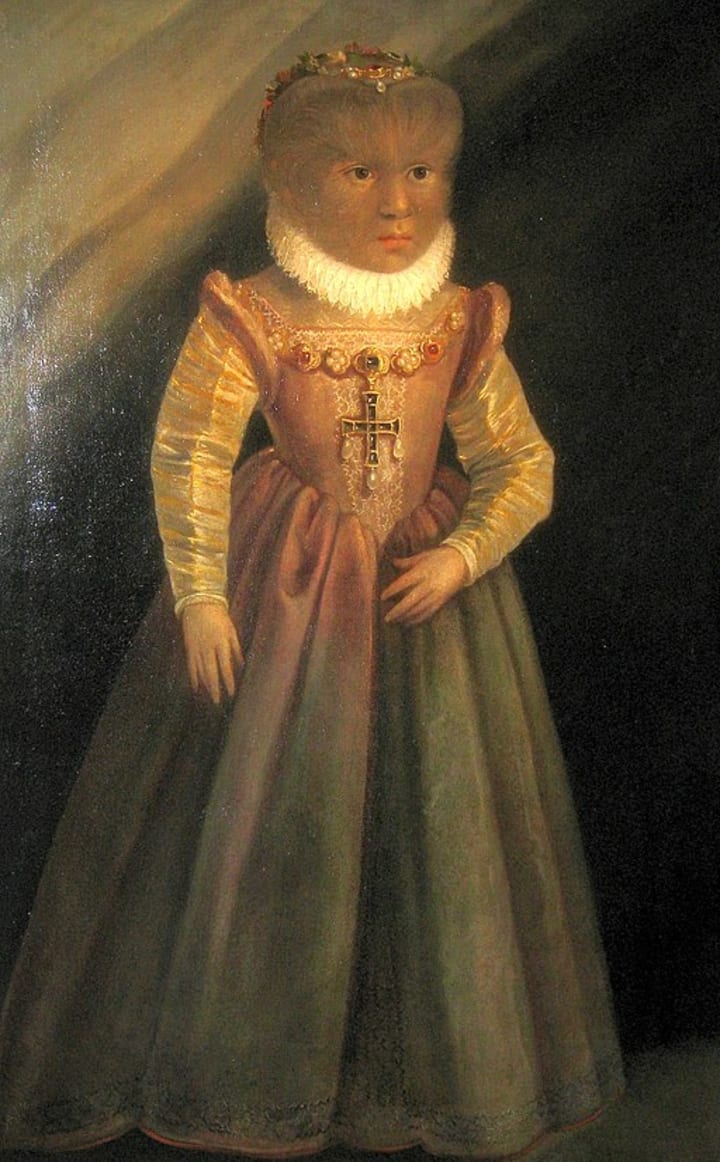
The Duke of Parma Ranuccio Farnese took them into his household, but unfortunately for the family, the new life turned out more sour than the previous one.
Fascinated with the "wild" children, Farnese gifted the four kids to his noble friends, ripping the family apart without hesitation.
Tender Portrait of Little Antonietta
One of those children was Antonietta, born in France shortly before Catherine de Medicis's death.
It is unclear how old the girl was when she was torn from her parents' arms, but we have physical proof that around the age of ten, she was already living away from her mom and dad.
An Italian artist Lavinia Fontana immortalized Antonietta in the painting that breathes tenderness and motherly love. The girl is portrayed wearing a beautiful dress, fitted for royalty, her soft gaze speaks of innocence, and the paper she holds cries of the sad story of her family.
"Don Pietro, a wild man discovered in the Canary Islands, was conveyed to his most serene Highness Henry, the king of France, and from there came to his Excellency the Duke of Parma. From whom [came] I, Antonietta, and now I can be found at the court of the Lady Isabella Pallavicina, the honorable Marchesa of Soragna."
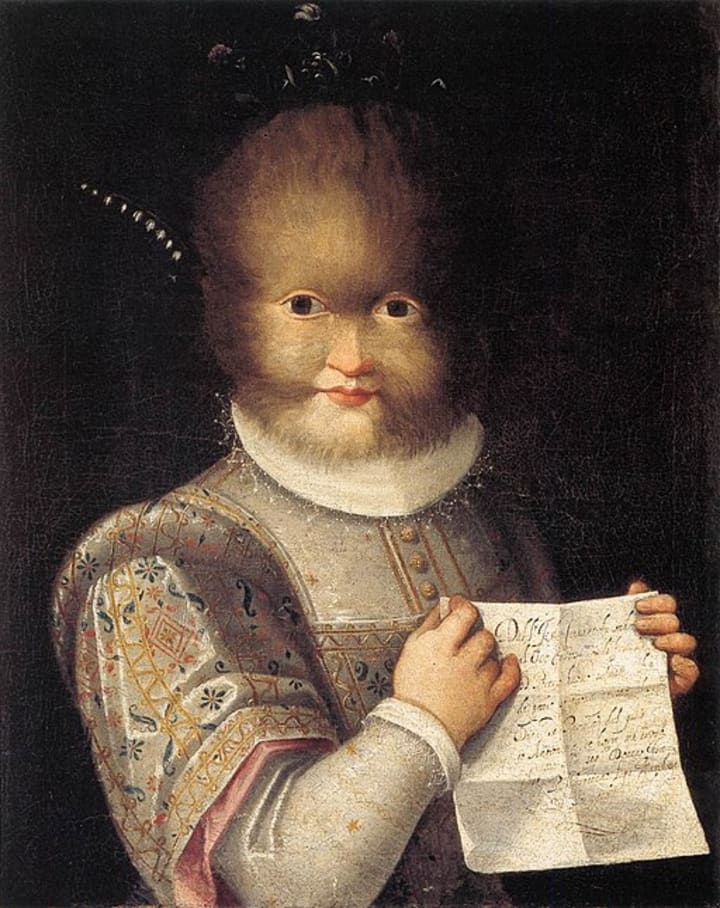
Aside from the portrait of Antonietta, not much is known about her life or her death, the same as what happened to her father later in life.
Quiet End and Invisible Death
After all the trials and tribulations, Pedro and Catherine finally settled in a small Italian village where they spent the last days of their 40-year-long marriage.
The date of Pedro's death remains unspecified, as he was never considered fully human, and maybe not even given a religious funeral. But we know the Beast died a few years before his Beauty followed him into the afterlife in 1623.
Hopefully, they found their happily ever after there.
***
Summing up the story of Pedro, Catherine, and their children is not easy. Deciding on who was wrong or right is like walking a thin line.
In Pedro's own writings from 1582, he praised all that Henry II and France did for the savage boy. He was grateful for his children, hairy and not, and his loyal wife:
"By divine grace, I was given a wife of singular beauty and children, precious fruits of our nuptial union; you can see the generosity of nature in the fact that some children resemble the mother for her beauty and incarnation; other children, on the other hand, are covered in hairs, they resemble the father."
And maybe Pedro was right. Had he not been brought to France, he may have suffered a worse fate, still sold around by his father for pennies as a freak of nature.
Pedro may not have been seen as fully human, but he was still valued for his talents, intelligence, and knowledge. And his story, however sad it may be, is also witness to his resilience, strong will, and the love he had for his family.
And yes, it is widely believed that Pedro and Catherine's story inspired the French novelist Gabrielle-Suzanne Barbot to write and publish "Beauty and the Beast" in 1740.
About the Creator
GD Madsen
A historian by education, a former journalist by profession, now living in the French countryside writing books and articles.
Oil Prices and the Hidden Struggles Behind Global Energy
Oil prices influence daily life in ways many people rarely notice. From the cost of gasoline at the pump to the price of food in grocery stores, shifts in oil prices ripple through the global economy. A sudden rise can strain family budgets, while a sharp drop can shake entire industries. Behind these changes are complex forces such as political tension, supply shortages, economic growth, and environmental concerns. Yet for many people, oil prices remain a distant headline rather than a personal story. The truth is far more connected to everyday life. Understanding how oil prices move, why they change, and who feels the impact most can reveal a deeper picture of the modern world and the fragile balance that keeps global energy flowing.
By Muqadas khan7 days ago in FYI


Comments
There are no comments for this story
Be the first to respond and start the conversation.