
Navigating the Pain Game
Why you should thank your brain for aches

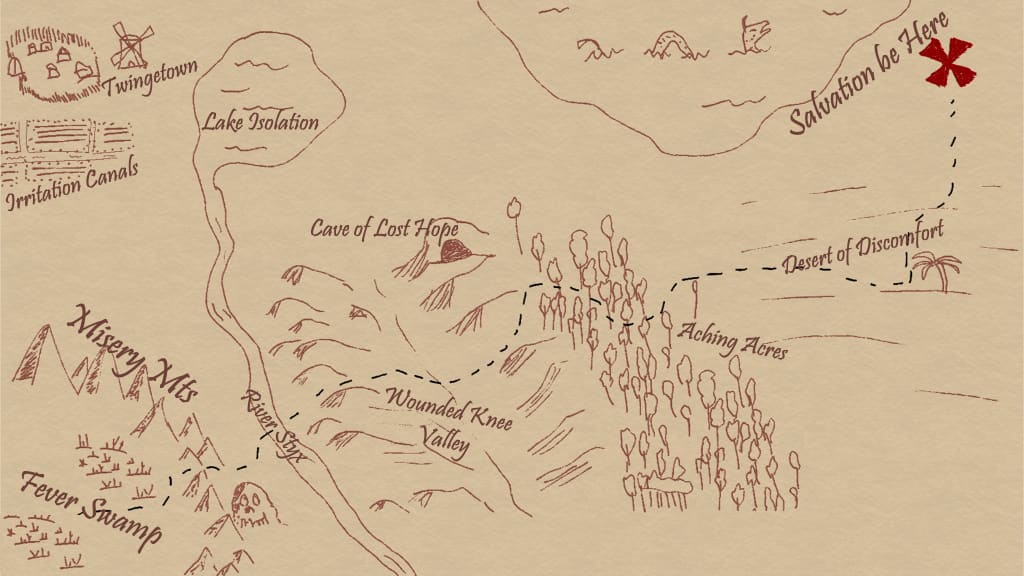
“Candidate One-Zero-Eight, out of the van,” the unseen driver barked. I disembarked hastily from the back of a blacked-out moving van and hustled towards the silhouette in the adjacent clearing. The tacticool ball cap rattled off two series of numbers before dismissing himself. On bended knee I raced through a few calculations and scratched a few figures on my laminated map.
I hustled over to the ball cap’s hideout in a youthful copse. His stern demeanor turned sour as the steaming mug of coffee had to be forced out of sight in my presence.
“Candiate One-Zero-Eight, ready to report, sir,” I stated. He stepped in close. I revealed my map. “I am here. I am going there.”
The ball cap snuck a glance at his answer key, “Very well, One-Oh-Eight. Remember, keep a distance of at least five meters off all roads and cross at a ninety-degree angles. Your time starts now. Good luck.”
I bolted in the general cone of direction towards my target. Seven kilometers to the waypoint. Just seven.
In theory, the distance was insignificant. I had been a distance runner in high school. A 5k race schedule achieved frequent sub-eighteen minute finish times. But I wasn’t wearing a singlet and specialized shoes with custom-built gel insoles. The combat boots felt stiff. The camouflage uniform felt like heavy canvas. The forty-five pound rucksack felt like a boulder of vastly superior weight. This was day five of the land navigation portion of Assessment and Selection.
Trampling through forested hills and creek-laden draws in utter solitude bends the mind to dark places. Could I really continue to justify my attempt at joining an elite military outfit via the same insouciant conduit? “It seemed like a good idea at the time” seemed to emanate from a jaunty pillock now replaced by a sore, tired and desperate me tripping my way through endless backwoods.
These were the times that tried men’s soles. From aurora to the nearly snuffed out embers of dusk, I walked on invisible lines from point to point to point, crisscrossing the same features so often that - had it not been for a dulling wit - I hardly needed a map anymore. The skin clinging to my pelvic bone was rubbed raw. My shoulders smarted at unsteady footfalls as the rucksack jostled unevenly. My fingers were swollen from the ruck’s garrote-tight straps.
But hark! I recalled my nascent days; the recruiter bestowed a cornucopia of swag upon me to win my favor. Wasn’t that when I learned “pain is weakness leaving the body”? I literally “got the t-shirt”. I trudged up the next runaway truck ramp-gradient hill wondering when un-pain will be strength retained in the body.
The pains passed as did I surpass the Assessment and Selection and eventually pass out of military life and back to a civilian one. We all, generally, feel pain in our lives. In youth, it is often acute pain and easily forgotten (as most of childhood is). Middle and old age offer the exciting experience of chronic pain which remains as a broken record talking point (as most talking points of the elderly often are). As a species, we share that aspect of the human condition across the board. I dare claim that there is only a percent of a percent of people who make it through their entire lives without feeling a pang of physical discomfort at some point.
The ubiquity of pain plays a vital role in society. If a particular demographic ceased to ache or throb, the endemic sympathy we feel for one another would vanish. Imagine visiting a medical professional who could not mentally conceive how your condition was affecting you. Hospitals are already clinical enough; without a humanizing touch, I think I’d rather visit the undertaker.
Pain is, titularly, common knowledge.
How to Live Pain-free?
There is, of course, a percent of a percent of all of mankind that doesn’t feel pain. How many times have I raised my head to the heavens and silently appealed to the greater powers to alleviate a physical burden? To be pain free so that I might overcome a challenge? Did I really know, crawling through the night covered in ticks and sores dragging a quartermaster’s wet dream worth of equipment behind me, what I was truly asking for?
I think not.
Congenital insensitivity to pain (CIP), or congenital analgesia, is a rare disorder where the inflicted feel no pain. The first time I came across this concept was - embarrassingly - from 1999’s The World Is Not Enough. James Bond’s nemesis, the film’s “heavy”, had a bullet lodged in his brain which impeded his ability to perceive pain. In the late ‘90s, the world wide web wasn’t wily enough to make heads or tails of the evil Renard’s head. I thought the condition was a modernized rendition of the previous decades’ circus act bad guys (e.g. Jaws, Oddjob, Nick Nack). Something of a twist for Bond to overcome, and, yet again, prove his prowess as a top secret agent.
I stand by my youthful ignorance. Moreover, I postulate that The World Is Not Enough is a contemporary starting point for the propagation of painlessness portrayed in Hollywood. But that pop culture digression will spiral down the rabbit hole and terminate or devolve into (Tony) stark raving madness (Note: bonus points if you find the other two film references to nigh-invincibility).
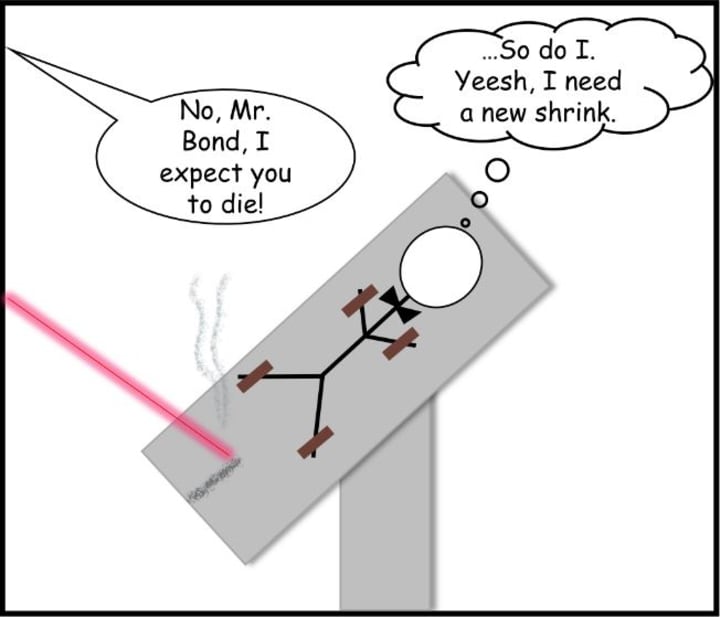
Rather opposite to Hollywood’s interpretation of physical suffering - or rather its vastly restrictive definition via close-up grimace reaction shots - CIP is extremely dangerous to those suffering from it. Imagine having no sensation when touching a hot pan. Imagine if, when Renard breaks a glass table with his fist, he lacerated an artery. I don’t think Elektra King’s (the damsel in undress) champagne bucket ice would be enough to stave off the bleeding.
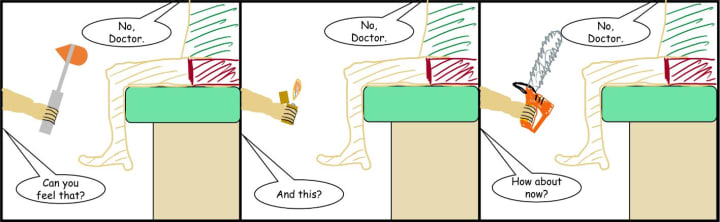
I limited those examples to the external. It is quite easy for a victim of CIP to recognize blood and blisters. Blindness, as far as I have researched, is not a symptom of CIP. What happens when someone inflicted with the inability to perceive pain has an infected appendix? Ulcers? Sepsis? A broken rib? With the exception of breathing-related ailments, someone with congenital analgesia has no indications of internal problems, no central nervous system rattling alarm bells letting the brain know it’s time to seek help.
As a bullheaded hard man of the military mindset, I wanted to be free and clear of pain but only of the pain that slowed me down and made me feel weak.
Path to Better Health
Physical pain is a mindset. We think of it as a detriment, not a warning. We have normalized the idea that life should be essentially pain-free, that pain means a problem and a problem is an outlier. The baseline for the vast majority of us is no pain equals normal. Herein lies the uncommon knowledge:
Pain is just a sign that you are still alive.
How strange a civilization we have collectively molded where there is a definition for legal death. Police officers can stumble upon the bottom nine-tenths of a decapitation victim (or, really, the top ten percent too), and they are forbidden to legally pronounce that person as dead. Only a certified coroner has the medical know-how to take that pulse with certainty.
Likewise, our beloved civilization has created a clause for the presumption of death as well. For if the decapitation victim has fled, head and all, for a period of seven years, effectively “absent” from his/her appointed place of duty, then the definition of death is once more legally met.
Pain ought to be considered the presumption of life. Treating it as such (and ignoring the legal parlance which darkly - if not oxymoronically - deals with execution) fosters a healthier relationship with that element of the human condition. If we accept pain as a fact of life, then Elektra King’s quote, “there’s no point in living, if you can’t feel alive”, rebrands itself with a practical, staid logic.
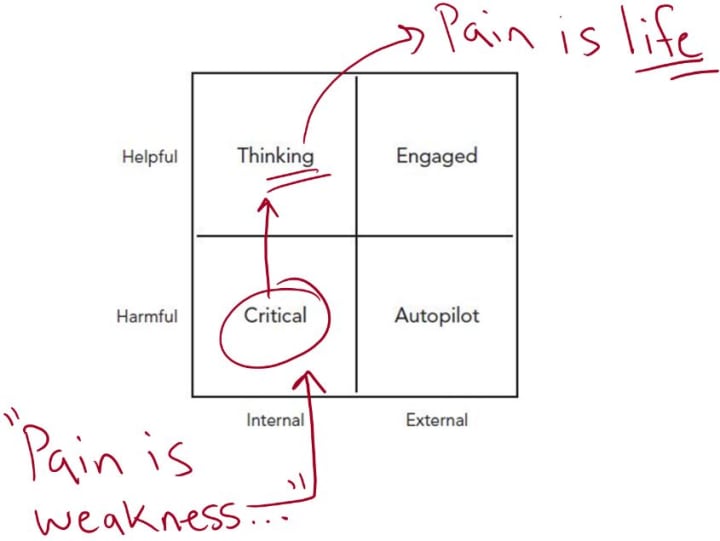
Borrowing some theory from Farnam Street’s blog “Four States of Mind”, pain and its role in life requires an adjustment to mindset. Consider the following graphic for how you process any situation:
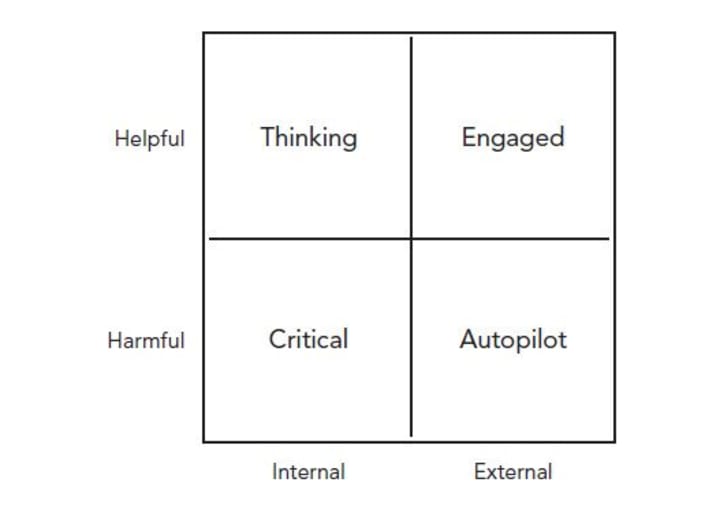
In regard to pain, Thinking is reflecting (“I’m sore today, that workout is doing something), Engaged is theraputizing (“These pains won’t go away, I’m going to do something about it), Autopilot is chronic acceptance (“I will limp until I’m wheelchair-bound) and Critical is accumulating the negative (“I can’t function normally, I don’t want to get help, I don’t need help, I don’t care if I don’t heal”).
The aches and twinges and worse that most of us feel throughout our lives are unassailable and unyielding. We can, however, effect change in attitude, resist transmogrification of physical pain into mental anguish. Move the relationship of pain from one of distress to one of contemplation.
Remember, we need pain. It’s what tells us we’re still alive.
About the Creator
Nom de Guerre
A wayward seafarer only truly found on the deep; all at sea when on land.
Creative writing is a hobby I aim to professionalize as the next step in my career quartet - soldier, sailor, writer, rogue.
Keep reading
More stories from Nom de Guerre and writers in FYI and other communities.




Comments
There are no comments for this story
Be the first to respond and start the conversation.