

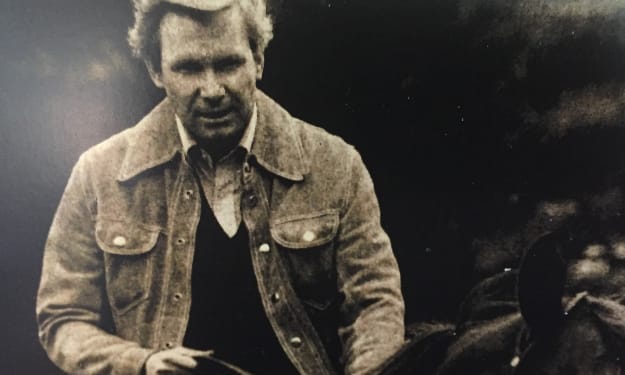
I lost the most ordinary, ungainly looking colt in 1975 because I flat ran out of bullets. I will never forget that day, July 19th when Fasig-Tipton was offering a group of yearlings, selling them from a tent when a sudden summer storm pelted the tent with heavy rain, wind, and lightning. All the horses were raising nine kinds of loud fearful whinnies, rearing on hind quarters but I noticed this ugly duckling just standing in the midst of panic and he did not turn a hair. I went down and checked his legs, and he didn’t flinch. I turned his lip and looked him in the eye...and fell in love with the colt of my lifetime. The Taylors and the Hills outbid me, and they named what was to become one of the greatest horses in the history of thoroughbreds. Seattle Slew was an ungainly, undervalued colt who outran and outproduced his modest pedigree due, in fact, to the characteristic which attracted both me and the ultimate owners...it was The Look in his eye...it was the spirit in his gut which set him above the bar! As a colt, Slew didn't look like the typical champion. But looks, it turns out, didn't matter. Two couples, the Taylors (Karen and Mickey) and Hills (Jim and Sally), bought him on July 19, 1975 at the Fasig-Tipton of Kentucky yearling sale in for a relatively modest sum of $17,500.00 which is about $83,000.00 today!. In 1977 he became just the 10th horse to win the Triple Crown -- the Kentucky Derby, Preakness Stakes, and Belmont Stakes -- and the first to do so with an undefeated record. Seattle Slew never trained or raced in his owners' home state; his lone appearance in Washington was as a celebrity, galloping around the track between races for two days at Longacre’s racetrack in Renton. For more than 20 years after he retired from racing in 1978, he was one of the world's most-sought stallions for breeding purposes. Seattle Slew died in Kentucky exactly 25 years after winning the Derby, with the Taylors by his side. His offspring and his offspring's offspring keep adding to his legacy as "the people's horse" who became one of the all-time greats out of sheer courage...a horse who stumbled at the start of the Kentucky Derby, and then bullied his way to fame and fortune.
The dark bay colt was gangly, but big and with a strong frame. He had a spirited look in his eye and was full of energy and power, but he was reserved, under control in the face of this mighty storm. I had already purchased my limit but pushed the bid. I did not know that the ultimate winners had also gone beyond their limit by a couple of thousand dollars. I knew Fasig-Tipton would not grant me the time to raise the funds necessary to keep bidding, so, history will show the two couples from Washington State got the horse for $17,500, an almost unimaginable bargain.
Seattle Slew was born on February 15, 1974, near Lexington, at White Horse Acres, the third foal by his sire, Bold Reasoning, and the first for his dam, My Charmer. The colt ended up at the Fasig-Tipton auction after being rejected for the more prestigious Keeneland summer yearling sale, partly because his parents had not yet proven their worth in the breeding shed. He also had a slight angling out of his front right foot, and he had a mule-like face which would change as he aged. All the little people can take a certain amount of joy at Keeneland’s loss as they turned up their noses at one of the greatest horses never to set foot on its track.
The Taylors had been involved in racing for three seasons, but they were hardly typical racehorse owners. They were young, only recently prosperous, and from the Pacific Northwest, far from Kentucky's Bluegrass Country, the traditional center of Thoroughbred racing and breeding. They lived in a mobile home in a town of 600 on the Yakama Indian Reservation. Mickey was from Ellensburg, the son and grandson of loggers. Karen Pearson was from Yakima, the daughter and granddaughter of accountants on her father's side and apple growers on her mother's side. They met on a blind date in 1963, their senior year of high school. She went to Eisenhower High; he led the Ellensburg Bulldogs to the state basketball tournament. They dated for seven years before getting married. Meanwhile, he graduated from Western Washington State College (later University) in Bellingham in 1968, majoring in accounting and economics, and she became a flight attendant for Northwest Orient Airlines.
They moved to White Swan on the Yakama Reservation in Yakima County when Mickey took a job with White Swan Lumber Company, which hired loggers to work the surrounding forests. When two of those loggers went out of business, Mickey bought their equipment for $500 and he and his brother Quirt formed their own company, Taylor and Taylor Logging. Then came their big break. In 1973, a newsprint shortage caused the price of pulpwood to triple; in a little more than a month, Taylor and Taylor sold more than $2 million worth of pulp.
Karen and Mickey Taylor became horseracing fans, betting at Yakima Meadows and Longacre’s. For a third-anniversary present, Mickey promised his wife a racehorse, something she said she wanted more than a house. They bought their first horse that summer at a Washington Thoroughbred Breeders and Owners Association sale for $5,000 and made their racing debut and got their first win that December with a second horse. He ran under the name Pearson's Barn, Inc., with black and yellow silks that included a drawing of a logging truck.
By the 1975 summer yearling sales in Kentucky, the Taylors owned four winners of stakes races (those in which the owners of the horses contribute to the purse, or prize money, thus attracting better horses than lower-paying races). They also had met Jim Hill, a New York veterinarian who tended to racehorses. The Taylors liked Hill and his wife Sally. Together they formed a corporation called White Horse Investments for the purpose of acquiring more horses. The idea was that Jim Hill would help pick the horses and Mickey Taylor would buy and manage them.
Hill especially liked the big bay colt at the Fasig-Tipton sale on July 19, 1975. Although some had found fault with the horse, Hill saw his big bone structure, powerful shoulders, and long neck, and was convinced he would be a strong runner. The vet had to leave for New York before the auction began; he told Mickey Taylor to do what he could to buy the horse. Karen Taylor made sure they did. ninety seconds after bidding started, they had an animal that would change their lives, and mine as well.
On Hill's recommendation, the Taylors assigned the horse to a trainer the vet knew in New York. He was Billy Turner (b. 1940), a former steeplechase jockey who had been training horses for about 10 years. But first the colt was sent to a farm in Maryland, where Turner's wife Paula was assigned the job of getting him used to being saddled and ridden and teaching him to respond to voice and hand commands. She quickly nicknamed him Baby Huey, after a big and clumsy cartoon character, but after working with him a bit she was impressed. She told her husband, "This is a very unusual horse. Very determined. I can't believe how businesslike he is" (Cady, 46).
Around the time he was moved to Billy Turner's stables at Belmont Park in New York, the colt acquired an official name. The owners wanted to pay homage to the Taylors' home state and to the swampy area around Fort Meyers, Florida, where Jim Hill was raised. They settled on Seattle Slew, although his handlers more often called him Huey. He was clumsy galloping, but uncommonly fast. The first time Turner worked him out alongside another horse, he got an eyeful of potential. "All of a sudden he looked over at her (the other horse), and for the first time, he saw competition. He just took off in a flash," the trainer recalled 26 years later; after the workout, the exercise rider told Turner, "Holy Christmas, this is an awful lot of horse" (The Blood-Horse, April 6, 2002).
Once Turner knew the horse could run, he decided to delay his racing debut and let him add muscle. He also tried to get him to relax, jogging him until he did, before letting him gallop. The colt continued to impress in workouts. It was becoming apparent that Seattle Slew was something special.
On September 20, 1976, after most of his fellow 2-year-olds already had raced several times, Seattle Slew made his competitive debut. Wearing the black and yellow silks was Jean Cruguet (b. 1939), a native Frenchman and veteran rider who would be his jockey through the Triple Crown campaign. The race was six furlongs (3/4 of a mile) at Belmont Park. Slew initially was established as a 10-1 long shot, meaning a $1 bet on him would pay $10 if he won. But word of his speedy workouts had spread. When betting closed, the big dark horse was the 7-5 favorite. He won by five lengths.
Seattle Slew's first real test came in his third race, the Champagne Stakes on October 16. It was a showdown with For the Moment, a million-dollar horse. Seattle Slew won by 9-3/4 lengths and posted the fastest mile time ever by a 2-year-old at Belmont. After the race, Mickey Taylor said to his wife, "If we can keep this horse in one piece, I'll never have to chop down another tree in my life" (BloodHorse.com). Despite having raced only three times within just a 21-day stretch, Seattle Slew won the Eclipse Award as 1976 champion 2-year-old male and was installed as the early favorite to win the 1977 Kentucky Derby.
The Taylors and Hills raised insurance coverage on their horse -- what started out at $50,000 was bumped for the second time, to $2 million -- and sent him to Hialeah Park in Florida for winter training. Turner already was thinking beyond the Derby to the larger challenge of also winning the Preakness and Belmont. That would mean winning three races in five weeks against the toughest possible competition. The trainer spent the winter and early spring bringing the horse along slowly, gradually building his endurance.
In his debut as a 3-year-old, on March 9, 1977, at Hialeah, Slew won a seven-furlong allowance race by nine lengths in record time. Next was the Flamingo Stakes, at 1-1/8 miles Seattle Slew's longest race to date. He won by four lengths, with speed to spare. The owners increased his insurance coverage again -- to $3.5 million, with weekly premiums of $2,000. One Derby tune-up remained. On April 23 in the Wood Memorial at the Aqueduct racetrack in New York City, Seattle Slew led all the way and coasted to victory by 3-1/4 lengths.
He had raced six times, all victories and all without being extended. He was ready for the biggest show and most prestigious event in horseracing.
The Kentucky Derby, held the first Saturday in May at Louisville's historic Churchill Downs, is the youngest of the three Triple Crown races, but unlike the other two has been run every year since 1875. It also tops the other two for pageantry and attendance. As Dan Mearns put it in his book Seattle Slew, "The Derby is the primary goal of every racehorse breeder and owner the world over. ... The Triple Crown is an afterthought; you must first win the Derby" (40).
The 103rd edition of the "Run for the Roses," as the race is called, was on May 7, 1977. Attendance was 124,038, including nearly 100 guests of the Taylors. Seattle Slew was the most lightly raced horse in the field of 15 3-year-olds and he was spooked by the enormous crowd and commotion. Uncharacteristically he began to sweat during the walk from the barn area to the paddock, and when the band played the traditional pre-race anthem, "My Old Kentucky Home," he became jumpy. Adding to his fans' and owners' anxiety, Slew hesitated when the starting gate opened and then swerved suddenly to the outside, throwing Cruguet off-balance. When he regained his footing, he was boxed in by other horses. He responded by barreling through the crowd, literally forcing rivals aside, and soon was running with the leader, For the Moment. As they entered the home stretch, For the Moment faded. Run Dusty Run (The Lehman’s bred John Henry) mounted a late charge but couldn't catch Seattle Slew, who won by nearly two lengths. It was an impressive show of power after a shaky start.
The winning purse was $214,700 -- $197,200 more than what Mickey Taylor had bid for the horse less than two years earlier. It also was an emotional payoff for all the people who had guided the horse from raw colt to Derby winner. Groom John Polston (b. 1945), leading Seattle Slew back to his stall after the trophy presentation, put a hand to his face and wiped at tears of joy.
The 102nd Preakness, on May 21, 1977, at Pimlico Racecourse in Baltimore, drew a record crowd of 77,346. This time Seattle Slew broke cleanly from the starting gate and quickly was running with the leading horse, Cormorant. They had an eight-length lead after half a mile. Heading into the final turn, the pace caught up with Cormorant and he began to slow. Slew won by 1-1/2 lengths, relaxing near the finish. Slew's winning time of 1:54-2/5 seconds was off Secretariat’s record by 1 and 2/5th seconds..
The Belmont Stakes presented a different challenge, because of its 1-1/2 mile-length. A horse fast enough to win the Derby and Preakness might not have the endurance to win at the longer distance. When Secretariat did it, taking the Belmont by an astounding 31 lengths, he became the first Triple Crown winner in 25 years and only the ninth ever.
Race day, June 11, 1977, was Seattle Slew Day in Washington by proclamation of Governor Dixy Lee Ray (1914-1994). A crowd of 71,026, second biggest in the event's 109-year history, gathered at Belmont. The track was sloppy after a hard rain. Seattle Slew was late in arriving from the barn area because parked cars blocked the normal route. When he reached the paddock area, a big cheer arose from the crowd and he began to sweat, although otherwise seemed calm. And he ran that way. He led all the way, enough so that as he neared the finish line Cruguet broke precedent. Knowing he would win, the jubilant jockey stood up in the stirrups with about 20 yards to go and raised his right arm in triumph, a move that would become customary in comfortable big-race victories.
This was certainly one of the biggest. Seattle Slew finished four lengths ahead of runner-up Run Dusty Run to win the Triple Crown with a perfect record of nine victories in nine starts. Affirmed won the Crown the following year, but for 37 years no other horse managed to do so. Not until 2015, when American Pharoah claimed it, did a 12th horse win the Triple Crown. Three years later, in 2018, Justify became the 13th Triple Crown winner and, with a career record of six wins and no losses, the first to match Seattle Slew's feat of winning the Crown with an undefeated record.
Until the Kentucky Derby, the Taylors generally were believed to be Seattle Slew's sole owners and Jim Hill merely their veterinarian. But after the big race, Hill and Taylor told some writers about the Wooden Horse partnership. Racing officials in Kentucky asked for more information about the ownership arrangement and were satisfied. After the Preakness, the New York State Racing and Wagering Board weighed in, citing a rule against hidden ownership, and saying Hill could not practice veterinary medicine in New York as long as he had horses racing there. He maintained he had done nothing unethical and that he did not officially own stock in Wooden Horse until June of that year. The board gave Hill and Seattle Slew 30-day suspensions, but the punishment was postponed until two and a half months after the Belmont.
While the ownership issue was being sorted out, the Taylors and Hills overruled their trainer and decided to fly Seattle Slew to California to race in the Swaps Stakes, a $200,000 race at Hollywood Park. It was just three weeks after the Belmont, and in the interim Slew was tranquilized three times to be photographed for an advertising campaign for a horse X-ray machine. He was tranquilized a fourth time to fly to California. The Triple Crown winner was a 1-5 betting favorite, but he proved no match that day for J. O. Tobin, a highly regarded 3-year-old who had skipped the Belmont. J. O. Tobin won by eight lengths. Slew finished fourth, the only time in his 17-race career that he would lose by more than a neck. The loss proved Billy Turner correct but he had lost the job over his objections to taking Slew west.
Seattle Slew developed respiratory problems in the fall and didn't race again as a 3-year-old. He still won Eclipse Awards as Horse of the Year and champion 3-year-old colt. Even so, Turner was on his way out as Slew's trainer. He and the owners had disagreed several times during the year, especially over the decision to race the horse in California so soon after the Belmont. As Slew was about to be shipped to Florida for winter racing, the owners replaced Turner with Doug Peterson (1951-2004). It was a controversial move; Turner having successfully orchestrated the Triple Crown campaign. The owners said they wanted a trainer who would work exclusively for them -- unlike Turner, who also trained horses for other owners. Years later Mickey Taylor added that the decision was partly due to Turner's drinking, something Turner acknowledged. He continued training horses, although he took a break in the early 1990s to check himself into a rehab center.
A serious viral infection kept Seattle Slew from racing during the 1978 winter season. While he was recovering, the Taylors and Hills took on minority partners by syndicating the horse for a record $12 million. Mickey Taylor was syndicate manager. The owners could have put Slew out to stud then, but Taylor said he didn't want to deprive the public of the sport's biggest star: "Racing has been good to us. We would like to do something good for racing" (Washington Thoroughbred, May 2002).
Seattle Slew raced seven times as a four-year-old. Two of those races were especially noteworthy. On September 16, 1978, the field for the $300,000 Marlboro Stakes at Belmont Park included Affirmed, marking the first time Triple Crown winners ever competed head-to-head. It also was Slew's first race with a different trainer and jockey. The owners had fired Cruguet after Slew lost by a neck one week earlier in the Paterson Handicap at The Meadowlands Racetrack in New Jersey. His replacement was the winning rider in that race, Angel Cordero Jr. (b. 1942). Although Affirmed was the newer star and a slight betting favorite in the Marlboro Stakes, Seattle Slew took an early lead and held it all the way, winning by two lengths.
The Triple Crown winners were matched again two weeks later in the 1-1/2-mile Jockey Club Gold Cup race. Raring to go, Seattle Slew broke early from the starting gate and had to be reloaded. When the race started for real, Slew and Affirmed immediately shared the lead. Affirmed's jockey, Steve Cauthen (b. 1960), slipped in the saddle at the first turn and was unable to restrain his mount after that. Affirmed and his stablemate Life's Hope forced a will-sapping pace, but Slew stayed narrowly at the front of the threesome as they clocked blistering times for the first half mile. Then Life's Hope dropped back and Affirmed started to fade, leaving Slew apparently in command.
But while the leaders were battling, a horse named Exceller was making his move from far back. Suddenly, with a quarter mile to go, Exceller had a slight lead and all the momentum. Seattle Slew, caught by surprise and close to running on empty, could have sagged but somehow found new reserves. They pounded toward home together, Slew surging as they neared the finish. The thrilling stretch run ended in a photo finish. The camera showed Exceller had won by a nose.
Although Seattle Slew lost the race, he added to his glowing reputation. By first matching the frantic early pace and then showing his strength and determination at the finish, he displayed an extraordinary combination of speed, stamina, and fight. Many consider it the best race of his career.
Seattle Slew raced one more time, winning the Stuyvesant Handicap at Aqueduct on November 11, 1978, and then was sent to stud at Spendthrift Farm near Lexington. He retired with 14-3 record and earnings of nearly $1.21 million. He was honored in his home state with Governor Julian Carroll (b. 1931) declaring November 30 Seattle Slew Day in Kentucky, and later was given a fourth Eclipse Award, this time as older male champion. (Affirmed narrowly beat him out for Horse of the Year, an honor never denied a reigning Triple Crown winner.)
For all his triumphs on the racetrack, Seattle Slew was nearly as successful in the breeding shed. The price of one of his shares, originally $300,000, had nearly tripled by the time he retired. He was scheduled to be bred to 45 mares in his first season at stud, and the results of that crop and ones to follow only drove his value higher. His first foals began racing in 1982 and by 1983 their earnings had reached $2 million. That year his son Slew o' Gold won the Eclipse Award as champion 3-year-old. In 1984 another of his sons, Swale, won the Eclipse Award for top 3-year-old male after winning the Kentucky Derby and the Belmont, and Slew o' Gold added another as older male champion. Seattle Slew was the country's leading sire with progeny earnings of more than $5.5 million by 1983, and a single share in him sold for nearly $3 million. At the 1984 Keeneland summer sale, eleven of his yearlings sold for an average of $1.7 million -- almost 100 times what their famous sire cost nine years earlier. In 1985 Seattle Slew's stud fee reached $800,000 regardless of whether a foal resulted from the pairing, and his insurable value, based on shares sold, was $120 million.
In September 1985, with Spendthrift Farm having financial problems, Seattle Slew was moved to Three Chimneys Farm near Midway, Kentucky. His offspring continued to command high prices and do well on the track. In 1989, Slew sired A. P. Indy from a daughter of 1973 Triple Crown winner Secretariat; their foal went on to be Horse of the Year in 1992.
The Hills and Taylors had formed several corporations over the years, starting with Wooden Horse Investments and later Tayhill Stables. But after nearly two decades together, their ties were frayed. In June 1992, Jim Hill sued Mickey Taylor for mismanagement of Wooden Horse, claiming he was diverting some of its money to Pearson's Barn, the Yakima-based company that managed Wooden Horse's racing and breeding stock. Hill also claimed Taylor was improperly compensating relatives. The case went to jury trial in Lexington in November 1993. By that time Wooden Horse was selling off some of its holdings and breeding stock, including 23 horses at a Keeneland auction during the trial. The jury sided with Hill and awarded him $4.4 million. The Cinderella partnership was over. When Three Chimneys Farm threw a 20th-anniversary Triple Crown party for Seattle Slew in 1997, only the Taylor half of the original Slew Crew was there.
Early in 2000, at the age of 26, Seattle Slew began losing coordination in his hindquarters while walking. The Taylors were living in Yakima and skiing in Idaho at the time, but they moved to Kentucky to be near their horse.
Slew was given injections to relieve pressure in arthritic neck joints, but relief was only temporary. On April 2, he underwent surgery to fuse the joints and reduce pressure on his spinal cord. The procedure was performed in Lexington by Dr. Barrie Grant, a former Washington State University professor of equine surgery. He inserted a device called a Bagby Basket, developed for humans by Spokane orthopedic surgeon Dr. George Bagby in the 1970s and successfully adopted for horses by Grant while he was at WSU. The surgery was successful, and in 2001 Seattle Slew returned to stud service. His fee was $150,000 with no guarantee of a foal, but he successfully bred with 43 of 46 mares that year.
His neurological problems returned early in 2002, however. Slew was removed from stud service on February 25, and on March 2 Dr. Grant inserted a second Bagby Basket above the first one in the horse's neck. On March 29, Slew was up and walking again. And his interest in mares had returned, which was a problem for his recovery. He would get agitated when he heard mares arriving to be bred with other stallions. Mickey Taylor decided Seattle Slew needed to be in a quieter setting, so on April 1 he moved the horse to Hill 'n' Dale Farm near Lexington. But instead of recovering, Slew weakened and died at 9 a.m. on May 7.
Seattle Slew's death saddened the horseracing world, which was left without a living Triple Crown winner for the first time since 1919, the year Sir Barton won the first Crown. Many publications already had prepared retrospectives on his Racing Hall of Fame career for the 25th anniversary of his Kentucky Derby victory. Those stories became obituaries. The major trade magazines, including The Blood-Horse and Thoroughbred Times, ran cover stories on Slew. The Seattle Post-Intelligencer devoted most of two pages to him.
Besides his Triple Crown triumph and four Eclipse awards as a racer, there was Seattle Slew's breeding record to consider. He sired 1,050 foals over 24 years, including 114 stakes winners and eight champions. He was the nation's leading sire in 1984 and leading damsire (grandfather on the dam side) in 1995 and 1996. As of 2011, his daughters had produced more than 200 stakes winners, and the earnings of his progeny totaled more than $84 million. All this after being bought for $17,500 and with it the distinction of being the only Triple Crown winner acquired at a public auction. Seattle Slew was buried at Hill 'n' Dale Farm, having lived as long as any Triple Crown champion.
________________________________________
Sources:
Dan Mearns, Seattle Slew (Lexington, Kentucky: Eclipse Press, 2000); Steve Cady, Seattle Slew (New York: The Viking Press, 1977); Jim Scoggins, "Mickey, Karen and Seattle Slew," Yakima Herald Republic, June 12, 1977, p. 2-B; Susan van Dyke, "Washington Racing Hall of Fame Class of 2011," Washington Thoroughbred, October 2011, pp. 180-181; Susan van Dyke, "There Ain't, Never Was, a Horse Like Seattle Slew," Ibid., May 2002, p. 526; Bill Christine, "Racing Loses Its Crown Jewel," Los Angeles Times, May 8, 2002, p. D-1; Steve Haskin, "Turnabout," The Blood-Horse, April 6, 2002, p. 2019; Haskin, "The Life and Death of Seattle Slew," BloodHorse.com, September 21, 2010 (http://cs.bloodhorse.com/blogs/horse-racing-steve-haskin/archive/2010/09/21/the-life-and-death-of-seattle-slew.aspx); Gerald Strine, "Slew Displays Class to Avoid Disaster," The Seattle Times, May 8, 1977, p. G-1; Edward Hershey, "Seattle Slew Finances Bared," Ibid., June 15, 1977, p. 1; John Owen, "People's Horse," Seattle Post-Intelligencer, July 10, 1977, p. D-4; Bob Schwarzmann, "Slew's Here! Triple Crown Winner Given Police Escort," The Seattle Times, July 7, 1977, p. E-1; Lenny Anderson, "Only 8,928 Get View of Slew," Seattle Post-Intelligencer, July 9, 1977, p. B-2; Bob Schwarzmann, "Few View Slew," The Seattle Times, July 10, 1977, p. G-11; David Schmitz, "He Made Everything Good," The Blood-Horse, April 26, 1997, p. 2388; Susan van Dyke, "Eastern Washington Doctors to the Rescue," Washington Thoroughbred, May 2002, p. 528; Michele MacDonald and Tom Law, "Seattle Slew Moved From Three Chimneys to Hill 'n' Dale," Thoroughbred Times, April 6, 2002, p. 6; George Vecsey, "A Champion Who Kept Going Till the End," New York Times, May 8, 2002, p. D-5; Joe Drape, "Triple Crown Legend is Gone," Ibid., May 8, 2002, p. D-1; John P. Sparkman, "Gone, But Not Forgotten," Thoroughbred Times, May 18, 2002, p. 1; Keith Chamblin, "More Than a Horse," The Blood-Horse, April 18, 1987, p. 2480; Laura Vecsey, "Farewell to a Champion," Seattle Post-Intelligencer, May 8, 2002, p. D-1; Lenny Shulman, "Simply Slewpendous," The Blood-Horse, May 18, 2002, p. 2886; "Crowning Glory: American Pharoah Pulls Away in Belmont, Becomes First Triple Crown Winner Since 1978," The Seattle Times, June 7, 2015, p. C-1; "Just Perfect: Justify Earns Triple Crown," Ibid., June 10, 2018, p. C-1..
Welby Thomas Cox, Jr., journalist, TV Faras
About the Creator
Welby Cox
Vocal plus has it?
Top 10 Luxury Travel Experiences Around the World for 2026
Luxury travel in 2026 is no longer just about opulence; it’s about immersive, transformative experiences that combine comfort, adventure, and cultural depth. For seasoned travellers seeking something beyond ordinary vacations, the world offers a rich tapestry of unique journeys—from private islands to cultural explorations with personal guides. Below, we explore ten luxury travel experiences that promise exclusivity, personalization, and unforgettable memories.
By All 4 Season2 days ago in FYI


Comments
There are no comments for this story
Be the first to respond and start the conversation.