
📝 Memory for Sale: When Nostalgia Becomes a Business Model
The digital age turned your childhood into a product—and we’re all buying it.

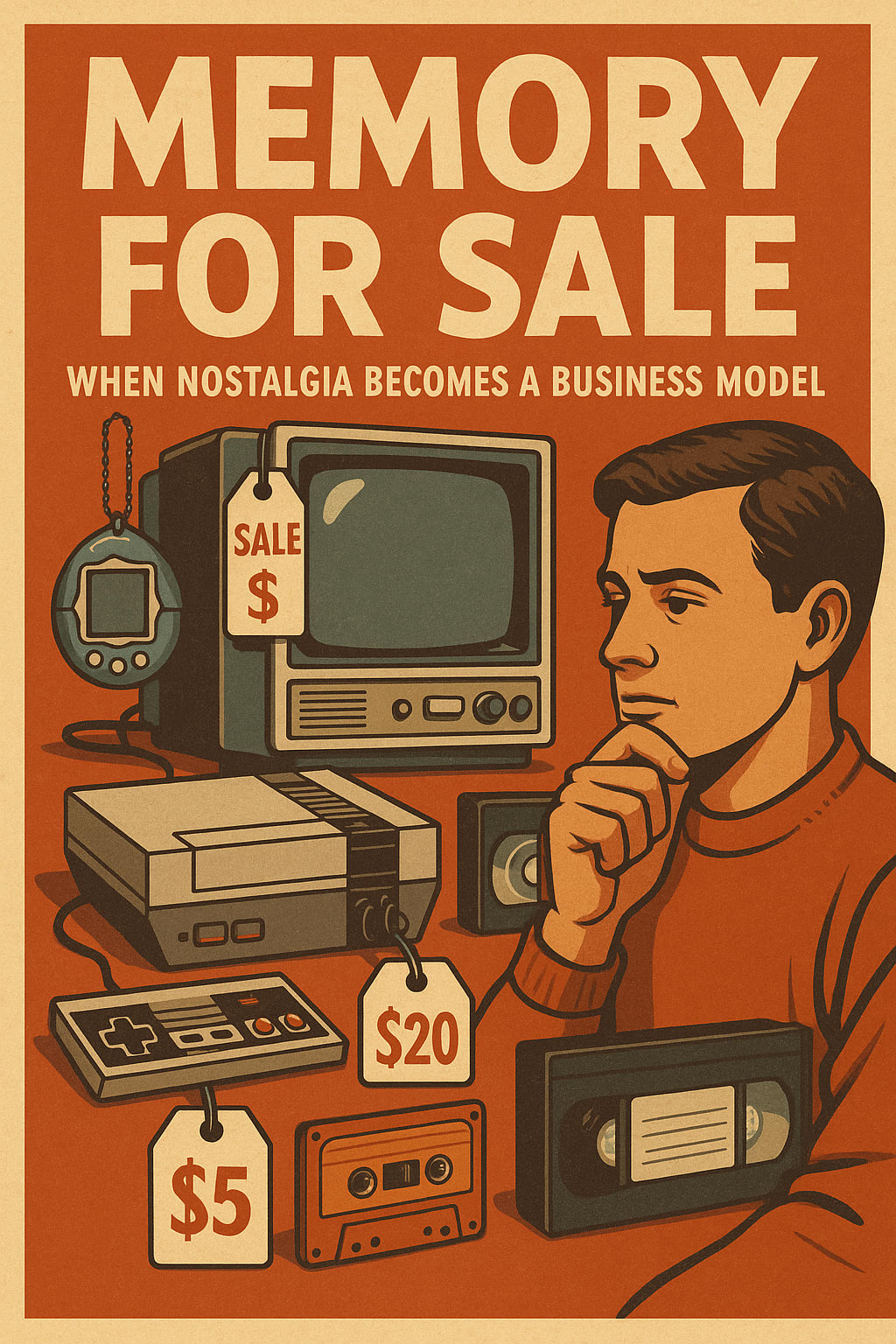
Nostalgia used to be a fleeting emotion—a sudden warmth when you smelled your grandmother’s cookies or an old song on the radio that transported you to high school days. But in today’s algorithm-driven, consumer-focused world, nostalgia is no longer a personal feeling. It’s a commodity. A business model. A product line with a targeted ad campaign.
We are not just remembering the past. We are buying it back.
📺 Reboots, Remakes, and Recycled Joy
The entertainment industry is the most obvious peddler of the past. From endless reboots of 90s sitcoms to remakes of every Disney classic, studios have realized that originality might be risky—but nostalgia is safe.
Streaming platforms, armed with troves of data, know exactly which generation is watching and what their emotional triggers are. Did you love “Friends” as a teen? Netflix will not only recommend it but flood your feed with similar shows, themed merchandise, and even limited-edition Central Perk coffee mugs.
But here’s the trick: you’re not just watching for fun. You’re subconsciously buying back your youth.
🎮 Retro Gaming and the Illusion of Simplicity
Nintendo sells you the same Super Mario from the 80s every decade—and you love it. Why? Because gaming, like childhood, felt simpler then. Retro game consoles are marketed not for their technical power but for the feeling they evoke. These “mini consoles” are physical capsules of comfort and safety in a world that feels increasingly chaotic.
The irony? Many buyers play for 10 minutes and then leave the console untouched. Because it was never about playing. It was about owning that feeling again.
👕 The Aesthetic of Nostalgia: Vintage as Identity
Fashion and aesthetics have also capitalized on this longing. Thrift stores, Y2K fashion, Polaroid filters, VHS-style videos, and cassette tape logos are now mainstream. Not because they’re practical—but because they evoke an emotional timeline.
Wearing a Nirvana T-shirt is no longer a musical statement—it’s a branding of one’s emotional heritage. It says: “I belong to a generation that remembers something real.”
This is no accident. Brands study cultural memory. They use retro designs and color palettes not for innovation, but to sell safety and familiarity.
📱 Nostalgia as an Algorithmic Tool
Instagram “Year in Review” stories, Spotify’s “Time Capsule,” and Facebook’s “Memories” feature are not thoughtful gifts. They are hooks. Each one is a carefully calibrated reminder:
“Look how good life felt. Wouldn’t you like to feel that again?”
Nostalgia, once an unpredictable emotional wave, is now a controllable lever. Tech companies pull it to increase retention, engagement, and time spent on apps. Your digital memories are being used to train algorithms—so that future versions of yourself can be better sold to.
We’ve entered the era of curated remembrance.
🧠 The Psychology of Remembering
Neurologically speaking, nostalgia activates the brain’s reward center. It releases dopamine and reduces stress. In a fast-changing, uncertain world, our brains crave the comfort of “known outcomes.”
Marketers know this too well. That’s why your favorite cereal from the 90s suddenly reappears on shelves with “Limited Edition” slapped across the box. You’re not buying food. You’re buying a feeling you didn’t know you missed.
And here’s the dangerous part:
We start to believe the past was always better—because it’s being edited, filtered, and sold back to us without its flaws.
🧃 Commercialized Childhood and Manufactured Memory
There’s something eerie about seeing a childhood cartoon now owned by a multinational corporation, rebranded and turned into a theme park, a Funko Pop, and a cryptocurrency mascot. Your memories have shareholders.
The commodification of memory changes how we remember. Our personal experiences are now tied to brand identities. A Saturday morning watching cartoons is no longer just a memory—it’s a licensed product you can repurchase in digital or physical form.
Childhood becomes a subscription model.
📉 When Nostalgia Becomes a Trap
There is a fine line between comfort and escapism. While revisiting old songs and shows can be healing, an overreliance on nostalgia can paralyze creativity. If we only consume the familiar, we never allow space for the new.
We risk living in a loop—always returning to a time we perceive as better, while ignoring the present's potential.
Artists struggle to create original work when the audience only wants reboots. Tech startups hesitate to build truly innovative products when retro aesthetics sell better. And we, as individuals, sometimes cling to past versions of ourselves instead of growing.
💭 So, What Do We Do With This?
Nostalgia isn’t inherently bad. It’s human. It connects us to a sense of continuity in a fragmented world. But it becomes dangerous when manipulated.
We must learn to recognize when nostalgia is being used against us—when it stops being a feeling and becomes a purchase.
So next time you find yourself buying a toy you once had as a child, or binge-watching a show you’ve already seen ten times, ask yourself:
“Am I enjoying this, or am I trying to feel something I’ve lost?”
Because maybe the past isn’t what’s missing.
Maybe what we really long for… is a future that feels just as meaningful.
About the Creator
Ahmet Kıvanç Demirkıran
As a technology and innovation enthusiast, I aim to bring fresh perspectives to my readers, drawing from my experience.
Keep reading
More stories from Ahmet Kıvanç Demirkıran and writers in FYI and other communities.
📝 The Empathy Deficit: Why We Feel Less in a Hyperconnected World
We have never been more connected—and never felt more alone. With a tap, we can message a friend across the world. We scroll through hundreds of faces a day, double-tapping to "like" moments we were never part of. We share stories, emojis, and reactions. And yet, when something truly painful happens—loss, fear, grief—we often feel as though no one really understands.
By Ahmet Kıvanç Demirkıran7 months ago in FYI



Comments (1)
Amazing 😊🌼😊