
MARRIAGE AND SEX IN THE MIDDLE AGES
Couples did not need to marry in a church-they could get married down the pub, round at a friend’s house or even in bed!


The prose of the Middle Ages is filled with praise and disapproval of marriage, and a heavy dose of cynicism we see today. In Medieval times, marriage differed from today. Women didn’t have a choice who they would marry and, most of the time, women didn’t even know the man before they wed.
The agreement of marriage was sorted by the bride and groom’s parents. In the middle ages, girls were usually in their teens when they married, and boys were typically in their early twenties. They founded the arrangement of the marriage on financial worth. The parents of the girl to be married would donate a dowry to the boy she was to marry. They would then give the dowry to the groom at the time of the marriage.
Getting married was extremely simple. Some practices and customs that depicted marriages at the time are still present now. What was more difficult, though, was evidencing your marriage. There were so many ways to marry someone, it wasn’t unusual to find yourself married to someone without your knowledge.
While it was the church that created and enforced marriage law and you could get married anywhere you wanted. In a pub, in bed, or at an acquaintance’s house. The choice was yours. People still married each other on the porch of a church, or in front of its doors. But that was to give it spiritual weight only. In reality, not even a priest was needed to preside over the ceremony. You could get married as soon as you hit puberty – and parental consent was not required.
In medieval England, the establishment of marriage was the only satisfactory place where two people could have sex in peace. This allowed Christians to marry as soon as they reached puberty, which was 14 for males and 12 for females.
People also didn’t need their parent’s consent to marry. Even after this law was abolished in England, disobedient couples crossed the border to Gretna Green, Scotland, where they could still marry without their parent’s permission.
Marriage was so easy in medieval England that couples had a wide range of actions they could use to form a marriage. Consent to marry could be given verbally, or in the form of a gift called a wed, (usually a ring). It was called ‘present consent.’
The ‘present content’ marriage didn’t have to be consummated for it to count. But if a couple had married at some point in the future, then had sex in the meantime, that meant they were married. Sex was a physical form of ‘present consent.’
Occasionally, even couples couldn’t decide among themselves if they were married or not. Since the procedures to marry were so many and so varied, mix-ups were bound to happen. This bothered the clergy so much in the 12th century. After an intense discussion, they decided marriage was a holy ceremony. This meant that the union of a man and a woman symbolised the union of Christ and the Church, and was not to be taken lightly.
Marriage was a self-contained matter with only one witness: God. Though it was highly encouraged to have people witness the wedding to avoid any doubt. Church services were also available, but only a minority of people had them. Once it’s become law to marry in Church, most couples who stood before the priest were already married either verbally or by deed.
Divorce, as it is today, did not exist in medieval times. There were a few reasons the wedding could be dissolved. One reason was if either the woman or man were not of legal age, fourteen for boys and twelve for girls. If the wife or husband had previously made a religious vow or was not Christian, it would dissolve the marriage.
The only way to end a marriage was to prove it didn’t exist. Medieval England was a committed society that valued the institution of marriage. Besides being single and vow-free, you also had to be marrying a fellow Christian. To invalidate a marriage, one had to prove one of these criteria was broken.
The description of the family was vague in medieval England. You could be considered a relation of someone, even if you only had a distant relative in common. Marrying inside the same family was seriously frowned upon, and illegal.
About the Creator
Paul Asling
I share a special love for London, both new and old. I began writing fiction at 40, with most of my books and stories set in London.
MY WRITING WILL MAKE YOU LAUGH, CRY, AND HAVE YOU GRIPPED THROUGHOUT.
paulaslingauthor.com
Keep reading
More stories from Paul Asling and writers in FYI and other communities.
THE WW1 ZEPPELIN AND THE HIDDEN 13th CENTURY ARCH AND A TUDOR FACADE
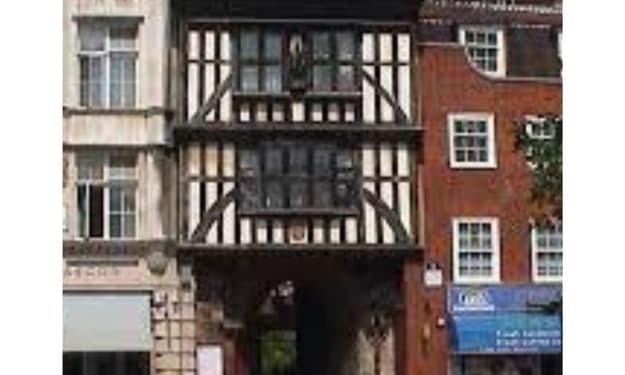
Standing at the entrance to one of London’s oldest churches lies St Bartholomew’s gatehouse, a rare survivor of Tudor London. Located on West Smithfield, not far from St Bart’s Hospital, is the St Bartholomew’s Gatehouse. Crammed between a French bistro and a red brick Georgian-style structure, the slender gatehouse encompasses a 13th-century arch, topped by a two-storey, 16th century Tudor building. The gatehouse guards, St Bartholomew-the-Great, which was an Augustinian priory.
By Paul Asling4 years ago in FYI
The Strange Reddit Post That No One Can Explain — And Why People Still Talk About It
The Strange Reddit Post That No One Can Explain — And Why People Still Talk About It The internet forgets almost everything. Posts disappear. Accounts vanish. Viral trends explode one day and are completely gone the next. What feels massive today often becomes impossible to find just a few weeks later. But every now and then, something strange slips through the cracks of the internet — something that refuses to disappear.
By Stephanie Edwardsa day ago in FYI


Comments
There are no comments for this story
Be the first to respond and start the conversation.