
THE WW1 ZEPPELIN AND THE HIDDEN 13th CENTURY ARCH AND A TUDOR FACADE
St Bartholomew’s Gatehouse in Smithfield features a 13th-century arch topped by a two-storey Tudor building

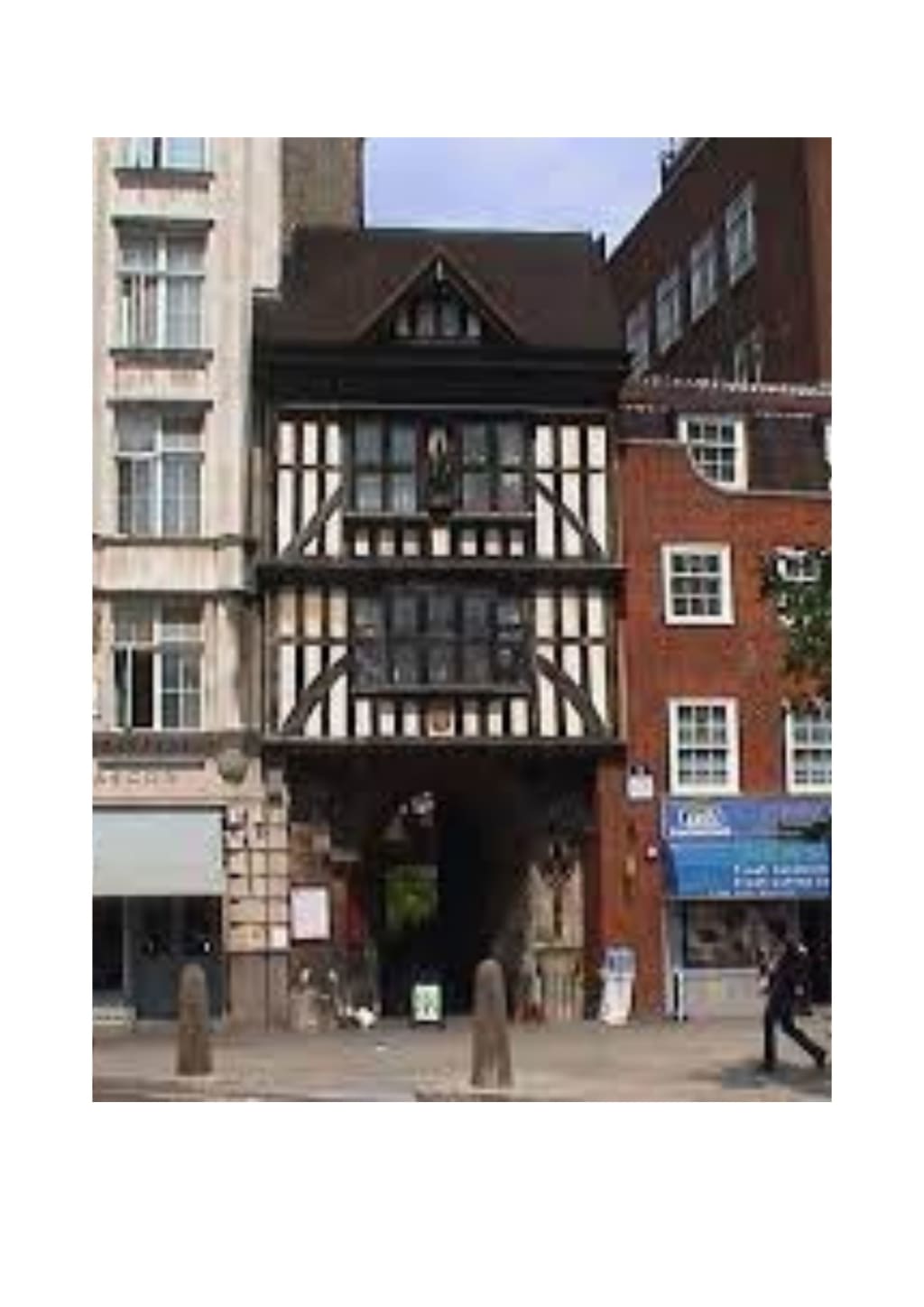
Standing at the entrance to one of London’s oldest churches lies St Bartholomew’s gatehouse, a rare survivor of Tudor London. Located on West Smithfield, not far from St Bart’s Hospital, is the St Bartholomew’s Gatehouse. Crammed between a French bistro and a red brick Georgian-style structure, the slender gatehouse encompasses a 13th-century arch, topped by a two-storey, 16th century Tudor building. The gatehouse guards, St Bartholomew-the-Great, which was an Augustinian priory.
Although remaining fairly unharmed for the first couple of centuries of its existence. It suffered a considerable amount of damage when the building was devastated in the dissolution of the monasteries in 1536. Despite the building having been built with an unprotected timber frame, the walls of the priory managed to deliver enough protection to save it from the Great Fire in 1666.
On 8 September 1915, a WWI Zeppelin blew the facade of the building open, revealing an amazing Tudor structure beneath. The Zeppelin L13 had released the biggest bomb to have ever hit London at that time. Falling on Bartholomew’s Close, the 600lb bomb caused a massive amount of destruction in the area. But it revealed the hidden gatehouse of St Bartholomew’s Church.
The Tudor structure had amazingly endured the Great Fire. In the 18th century, a Georgian frontage was built over the Tudor timber and the building disappeared into insignificance. For the next two hundred years, St Bartholomew’s Gatehouse was used as a shop.
The Priory Church of St Bartholomew the Great dates from 1123. In 1595, a local resident named William Scudamore grabbed the chance to build a new abode over the nave’s southern doorway. Though the residence was comparatively humble by Tudor standards, what it lacked in grandness it more than made up for in its location. Miraculously, it was spared from the Great Fire of London in 1666 by the massive walls of the adjoining priory. The priory walls protected not only the gatehouse but also most of the houses on the neighbouring Cloth Fair.
A common myth is Queen Mary sat in the house eating chicken and downing wine while viewing protestant martyrs being burnt at the stake. Whereas most of London’s martyrs met their end here, the Queen had died forty years previously.
The building was restored in 1932 and retains some of the 13th-century stonework from the original nave. On the first floor, there is bolection-moulded panelling from about 1700, while the attic has panelling dating back to 1595.
The building operated as a rectory for the church for many years. Between 1948 and 1979, the rector’s wife set up and ran an independent Montessori school. Due to the size, the building was not able to educate too many students. The school was ultimately moved to a bigger site in Bethnal Green. Today, the surviving church of St Bartholomew-The-Great is now the oldest parish church in London. The gatehouse today is a private building.
If you walk through the arch and turn right, you will see the dates 1240 and 1932 engraved in the stonework. The dates celebrate the year of the arch’s building and restoration.
Some people have said the church is haunted. Prior Rahere was one of the monks who created the church. He was due to make a journey to Rome when he became ill and died at the hospital nearby. Since then, witnesses have maintained his ghostly figure materialises in the Vestry on July 1st each year. The church and the gatehouse have been featured in films such as Robin Hood Prince of Thieves and Shakespeare in Love.
About the Creator
Paul Asling
I share a special love for London, both new and old. I began writing fiction at 40, with most of my books and stories set in London.
MY WRITING WILL MAKE YOU LAUGH, CRY, AND HAVE YOU GRIPPED THROUGHOUT.
paulaslingauthor.com
Keep reading
More stories from Paul Asling and writers in FYI and other communities.
LEADENHALL MARKET LONDON
Leadenhall Market started life as a forum in Roman London and there’s been a market on the site since the 14th century. The market actually dates back to 1321. Leadenhall Market has endured changes in use, rebuilding, the blitz and even the Great Fire of London. Originally a meat and game market, it is now home to many boutiques, restaurants, cafes and wine bars.
By Paul Asling4 years ago in FYI



Comments
There are no comments for this story
Be the first to respond and start the conversation.