
LIVING WORLD
SOME BASIC INFORMATION OF LIVING WORLD

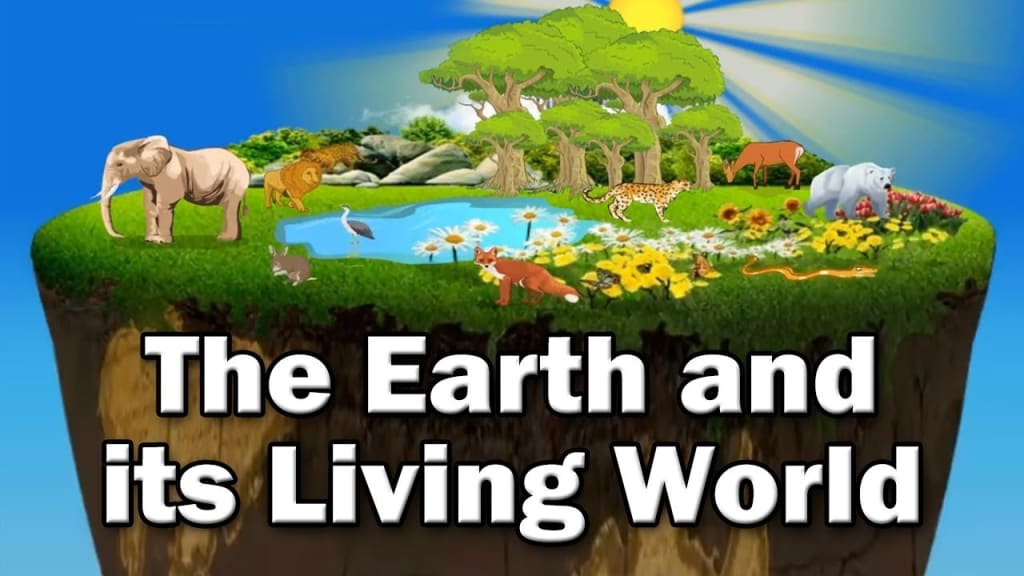
The world has two types of structure, living and nonliving. Viruses are peculiar in that they are lifeless particle outside lining beings but become active inside cells of living beings. Despite distinction of living (e.g.,Plants, Animals, Fungi, bacteria) from nonliving (e.g., bricks, stones, rocks, tables, nails), it is very difficult to define life and living being by any simple or composite property. Life is recognized by the mode of its working which Includes some unified and basic characteristics.

1) Sum basic information Of Earth
There are three-part of Earth :
- Central part: That’s Name is Core or barysphere = they contain Nickel and Iron (Ni,Fe)
- Middle part: that’s Name is mental or pyrosphere = They contain Silicon, magnesium (Si,mg)
- Outer part : That’s Name is Crust or lithosphere = they contain Silicon and aluminum atom (Si, Al )
ToDay present Atmosphere
Oxidizing Atmosphere
The First Living Molecule : The first living molecule is formed by RNA and DNA But RNA is early formed Then that of DNA is Formed
a) RNA is one of the most important molecules of origin of life
Note: The Most Primitive Organisms (OLD ORGANISMS )
- a) If the RNA is more reactive than that of DNA.
- b) If RNA act as a function of the Enzyme.
# Progenose was The most primitive and ancestral organism.
- They were chemoheterotrophs
- Soupy see is the source of nutrition.
- They were Anaerobic respiration. Carbon dioxide (Co2) Was Evolved
# Oldest fossils
Stromatolites = Prokaryotic cell
4) What is living : Living is something that is alive, something that can grow, move, reproduce, respire, and carry out various cellular activities that is called Living
Living Characteristic
Characteristics of life
- Living things are composed of cell
- Living things have different levels of organisms.
- Living things use energy
- Living things respond to the environment
- Living things grow and development
- Living thing reproduce
- Living things adapt to the environment
- Adaptation through evolution
Water is the cradle of life: Life originated, evolved and is sustained by water has been called the cradle of life
- Liquid States : Water remains liquid over a wide range of temperatures, from interacted, more less than 4 C to more than 90 C
- Origin of life: Various organic molecules got aggregated and interacted, more than 3 billion years back, in water to form the first living beings.
- Component: it is the major component of the body of a living being. 70% of the total and 90% of the living cells
- Growth: Water is essential for growth of cells as well as various body parts
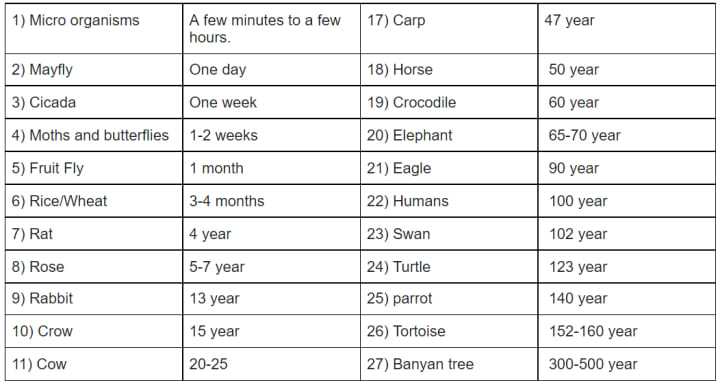
LIFE SPAN: The average longevity or period from birth to natural death is called life span. It is from a few minutes to several thousand years
About the Creator
Mangesh Ashok Jamnik
Hello friend's
I'm Mangesh Jamnik Student at Shri Shivaji college of Art, commerce, and Science
Keep reading
More stories from Mangesh Ashok Jamnik and writers in FYI and other communities.



Comments
There are no comments for this story
Be the first to respond and start the conversation.