
Is Interstellar Travel Possible?
Exploring the Feasibility of Traveling to Other Universes

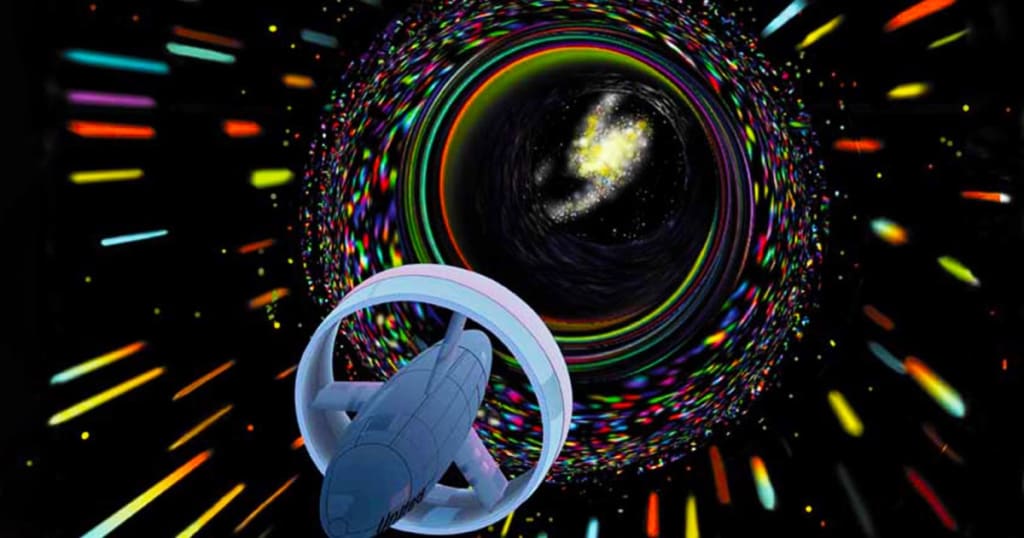
The concept of traveling to other universes and dimensions has been a popular topic in science fiction and fantasy for decades. But is it possible for us to actually travel to other dimensions or universes? While our current understanding of physics and the universe may seem to suggest that interdimensional travel is impossible, some theories and ideas have emerged that suggest it could be possible.
First, it's important to understand what we mean by "dimensions" and "universes." In physics, dimensions refer to the spatial and temporal axes that we experience in our everyday lives. We live in a three-dimensional universe (length, width, and height), and time is often considered the fourth dimension. However, some theories propose the existence of additional dimensions beyond the four we are familiar with. These extra dimensions are usually thought to be compactified (or "curled up") and too small to see or experience in our current state.
Meanwhile, the concept of other universes (also known as parallel universes or alternate realities) suggests that there could be many other universes beyond our own, each with their own unique properties and physical laws. The idea of parallel universes is supported by certain interpretations of quantum mechanics and string theory, which suggest that there could be many possible outcomes to any given situation, with each outcome corresponding to a different universe.
So, if other dimensions and universes do exist, could we travel to them? One idea that has been proposed is the concept of wormholes. A wormhole is a hypothetical tunnel through spacetime that could connect two different points in space or even two different universes. While wormholes have not been observed, they are predicted by some theoretical models and could potentially allow for interdimensional travel.
Another possible method for traveling to other universes is through the use of black holes. According to some theories, a black hole could lead to another universe through a phenomenon known as a "white hole." While white holes have not been observed, some physicists suggest that they could exist and could potentially allow for interdimensional travel.
However, both wormholes and black holes are purely theoretical concepts at this point, and we have no way of knowing whether they actually exist or whether they could be used for interdimensional travel.
Another idea that has been proposed for interdimensional travel is through the use of quantum entanglement. Quantum entanglement is a phenomenon where two particles become linked in such a way that the state of one particle is dependent on the state of the other particle, no matter how far apart they are. Some physicists have suggested that this phenomenon could be used to "teleport" information from one point in space to another, or even to another universe. However, it's important to note that while quantum entanglement has been observed in experiments, we have not yet been able to use it for teleportation or interdimensional travel.
While the idea of interdimensional travel may seem far-fetched, it's not entirely impossible according to some theories and ideas in physics. The concept of wormholes, black holes, and quantum entanglement could potentially allow for travel to other dimensions or universes. However, these are still purely theoretical concepts at this point, and much more research and experimentation would need to be done before we could even begin to consider the possibility of interdimensional travel.
Theories of Interstellar Travel:
There are several theoretical approaches to interstellar travel that could potentially allow us to travel to other universes. Here are a few:
1. Warp Drive: The concept of a warp drive was first introduced by physicist Miguel Alcubierre in 1994. The idea is to create a bubble of space-time around a spacecraft that would allow it to move faster than the speed of light. While the theory of warp drive is sound, the amount of energy required to create such a bubble is currently beyond our technological capabilities.
2. Wormholes: A wormhole is a hypothetical tunnel through space-time that could allow for faster-than-light travel. While the idea of wormholes is supported by Einstein's theory of relativity, no one has been able to confirm their existence, and it's unclear whether they could be used for interstellar travel.
3. Black Hole Jumping: Some scientists have proposed the idea of using black holes to travel to other universes. The idea is to use a black hole's gravity to slingshot a spacecraft to another part of the universe. However, the dangers of getting too close to a black hole are significant, and it's unclear whether this method of travel would be possible.
4. Generation Ships: Another approach to interstellar travel is to build a spacecraft that could sustain a human population for generations. The idea is that the ship would travel at sub-light speeds and take hundreds or even thousands of years to reach its destination. While this approach is currently beyond our technological capabilities, it remains a possibility for the future.
Challenges to Interstellar Travel:
While the theoretical approaches to interstellar travel are promising, there are several challenges that must be overcome before we can travel to other universes. Here are a few:
1. Distance: The nearest star to Earth, Proxima Centauri, is over four light-years away. This means that even with the fastest spacecraft we currently have, it would take over four years to reach it. Traveling to other galaxies would take even longer.
2. Energy: The amount of energy required to travel at near-light speeds or create a warp bubble is currently beyond our technological capabilities. We would need to develop new energy sources and propulsion systems to make interstellar travel possible.
3. Life Support: Interstellar travel would require spacecraft that could sustain human life for extended periods of time. We would need to develop new technologies for growing food, recycling water, and providing medical care in space.
4. Radiation: Space is filled with high levels of radiation that can be dangerous to humans. We would need to develop shielding technologies to protect spacecraft and their inhabitants from this radiation.
Conclusion:
While the idea of traveling to other universes is fascinating, it remains a distant possibility for the future. While the theoretical approaches to interstellar travel are promising, we still face significant technological and logistical challenges that must be overcome before we can travel to other galaxies. However, as we continue to develop new technologies and explore the mysteries of the universe, it's possible that we will one day find a way to travel to other universes.
Furthermore, some scientists believe that wormholes could provide a means of traversing the vast distances between stars and even galaxies. A wormhole is a hypothetical tunnel-like structure that connects two distant points in space-time. The concept of wormholes was first proposed by Albert Einstein and Nathan Rosen in 1935, and they were later explored in more detail by physicist Kip Thorne and others.
Wormholes could potentially allow for faster-than-light travel, as they could allow a spaceship to travel between two distant points without actually traversing the vast distances in between. However, the feasibility of wormhole travel is still very much an open question, as the energy requirements to create and stabilize a wormhole are likely beyond our current technological capabilities.
Another idea for interstellar travel is the concept of generation ships. A generation ship is a spacecraft designed to support a multi-generational crew on a long-duration journey to another star system. The idea behind a generation ship is that the crew would live, work, and die onboard the ship, with each successive generation taking over where the previous one left off.
While generation ships would not allow for faster-than-light travel, they could potentially allow for the colonization of other star systems over a timescale of centuries or millennia. However, the challenges of designing and building such a spacecraft, as well as maintaining the health and well-being of the crew over such a long journey, would be formidable.
In conclusion, while the idea of interstellar travel may seem like science fiction, it is not entirely beyond the realm of possibility. Advances in propulsion technology, as well as new concepts like wormholes and generation ships, could potentially allow us to explore and colonize other star systems in the future. However, such endeavors would require significant advances in our understanding of physics and technology, as well as a long-term commitment to space exploration and discovery.
About the Creator
DRD
a asted life
Outside Lands 2026: Music, Memory, and Magic
There is something different about a festival held in a park surrounded by fog. The air feels softer. The sound carries in a strange, beautiful way. Strangers stand shoulder to shoulder, waiting for a song that might stay with them for years. Outside Lands 2026 is already stirring that quiet excitement. Even before the lineup is announced, people are talking about outfits, travel plans, and who they want to see on stage. It is not just another music festival. It is a yearly ritual for thousands who return to Golden Gate Park for three days of sound, food, and shared emotion. Outside Lands 2026 promises more than performances. It promises moments.
By Muqadas khana day ago in FYI


Comments
There are no comments for this story
Be the first to respond and start the conversation.