
The Legacy of Alexander the Great
Conquests, Culture, and Leadership

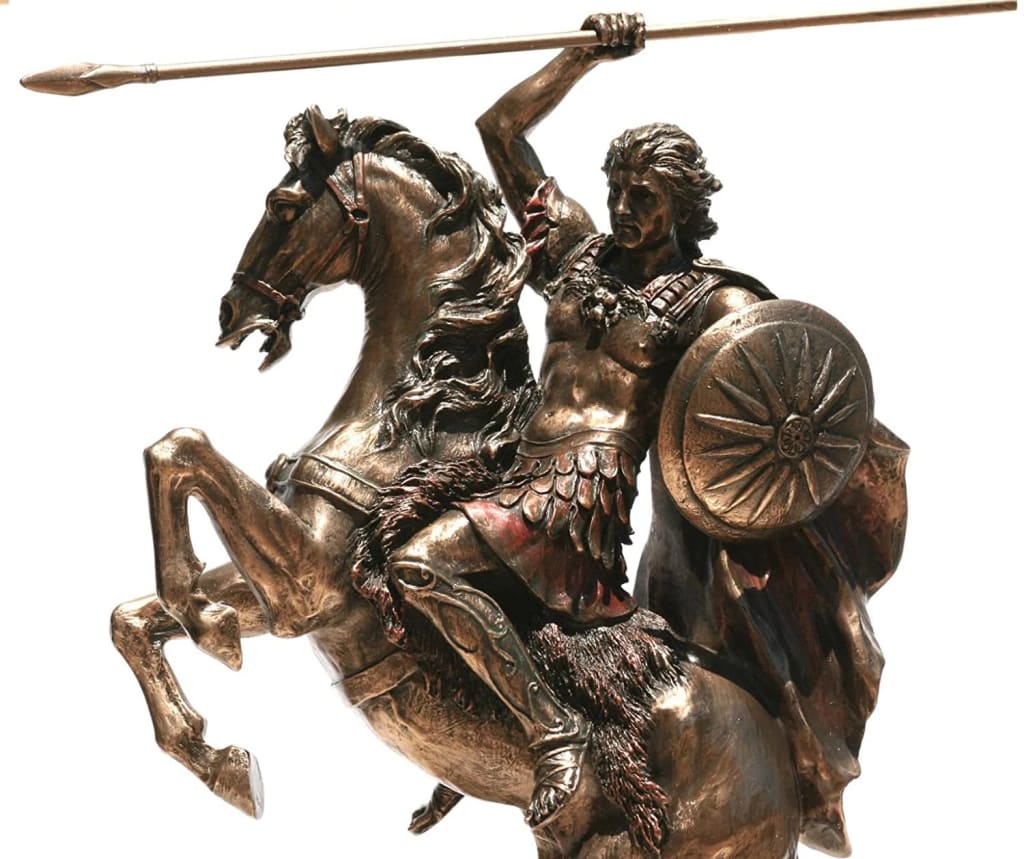
Alexander the Great, also known as Alexander III of Macedon, was one of the most successful military commanders in history. Born in 356 BCE in Pella, Macedonia, he was the son of King Philip II and Queen Olympia. He received his education from the famous philosopher Aristotle and grew up to be an intelligent and ambitious young man.
At the age of 20, Alexander ascended to the throne of Macedonia after his father's assassination. He immediately set out to fulfill his father's dream of conquering the Persian Empire. In 334 BCE, he led an army of 40,000 Macedonian soldiers into Asia Minor and defeated the Persian forces at the Battle of Granicus.
From there, Alexander continued his conquests, defeating the Persian king Darius III at the Battle of Issus in 333 BCE and then capturing the cities of Tyre and Gaza. He went on to conquer Egypt and was declared the pharaoh by the Egyptians.
Alexander's conquests continued, and he expanded his empire as far east as India, incorporating territories from Greece, Egypt, Persia, and India. He was known for his tactical brilliance, courage, and military strategy, which led to his success on the battlefield.
However, Alexander was not only a great military leader but also a philosopher, historian, and visionary. He had a great appreciation for the culture and knowledge of the peoples he conquered, and he encouraged his soldiers to learn from them.
Alexander was also a firm believer in the unity of humanity. He saw himself as a unifier of cultures and peoples, and he sought to create a world in which different cultures and religions could coexist in peace and harmony.
Unfortunately, Alexander's life was cut short. He died at the young age of 32, likely from malaria or typhoid fever. Despite his short life, he left an indelible mark on history, and his legacy continues to be felt to this day.
Alexander the Great was a remarkable leader and visionary who changed the course of history. His military conquests were matched only by his love of knowledge and his desire for unity among peoples. His legacy continues to inspire people around the world to this day, and he will always be remembered as one of the greatest leaders in human history.
After consolidating his power in Greece, Alexander set his sights on the Persian Empire, which was then the dominant power in the region. In 334 BC, he crossed the Hellespont with his army and began his campaign to conquer Persia. His first major victory came at the Battle of Issus, where he defeated the much larger Persian army led by King Darius III. Alexander went on to conquer much of the Persian Empire, including Egypt, before finally defeating Darius III once and for all at the Battle of Gaugamela in 331 BC.
With the Persian Empire under his control, Alexander continued to expand his empire, conquering parts of India and Central Asia. He founded many cities throughout his empire, most notably Alexandria in Egypt, which became a center of learning and culture.
However, Alexander's conquests also led to a great deal of resentment and opposition from conquered peoples, as well as from his own troops. In 323 BC, Alexander fell ill and died in Babylon, at the age of 32. His empire was divided among his generals, who continued to fight among themselves for control, ultimately leading to the collapse of Alexander's empire.
Alexander's legacy has endured for centuries, with many considering him one of the greatest military commanders of all time. His conquests had a profound impact on the ancient world, spreading Greek culture and influencing the development of many later civilizations. He is also remembered for his personal courage and charisma, as well as for his intellectual pursuits, including his patronage of the philosopher Aristotle.
Alexander the Great was a remarkable figure in history who left an indelible mark on the ancient world. His conquests and legacy continue to be studied and debated to this day, making him one of the most fascinating and enduring figures of antiquity.
As Alexander continued his campaign, he met with resistance from the Persian King Darius III. In 333 BC, they faced each other at the Battle of Issus. Despite being outnumbered, Alexander led his troops to a decisive victory, which led to the capture of Darius' family. Alexander then continued to conquer cities in the east, including the Persian capital of Susa and the famous city of Babylon.
In 331 BC, Alexander faced Darius once again at the Battle of Gaugamela. This time, Alexander's victory was even more complete, and Darius fled the battlefield. Alexander pursued him, but Darius was eventually murdered by one of his own governors.
With the Persian Empire under his control, Alexander continued to expand his empire, moving into India. However, his troops grew weary, and he was forced to turn back. On the journey home, Alexander fell ill and died in Babylon in 323 BC, at the age of just 32.
Despite his short life, Alexander's conquests had a profound impact on the world. He created an empire that stretched from Greece to Egypt and India, and his influence was felt for centuries after his death. He also helped to spread Greek culture throughout the world, which had a lasting impact on philosophy, literature, and art. Today, Alexander is remembered as one of the greatest military leaders in history, and his legacy continues to inspire people around the world.
About the Creator
DRD
a asted life
The Power of a Name: 10 Craziest Baby Names That Sparked Legal Battles
What’s in a name? For most of us, our name is a huge part of our identity. It’s how people recognize us, how teachers call on us, how employers scan our résumés, and how friends save us in their phones. Some people even redefine their names with personality and confidence, completely owning them.
By Areeba Umairabout 23 hours ago in FYI
My First Time Skiing and I Got Lost, Alone, in the French Alps
Looking back, I can trace some of my life’s biggest adventures to a simple action from my sister. She’d introduced me to Tommy (a very long time ago), a colleague of hers, who had overshared his penchant for Italian-looking women, and I ticked that box.
By Chantal Christie Weiss3 days ago in Humans



Comments
There are no comments for this story
Be the first to respond and start the conversation.