
Interesting Facts About Leonardo da Vinci
Interesting Facts About Leonardo da Vinci

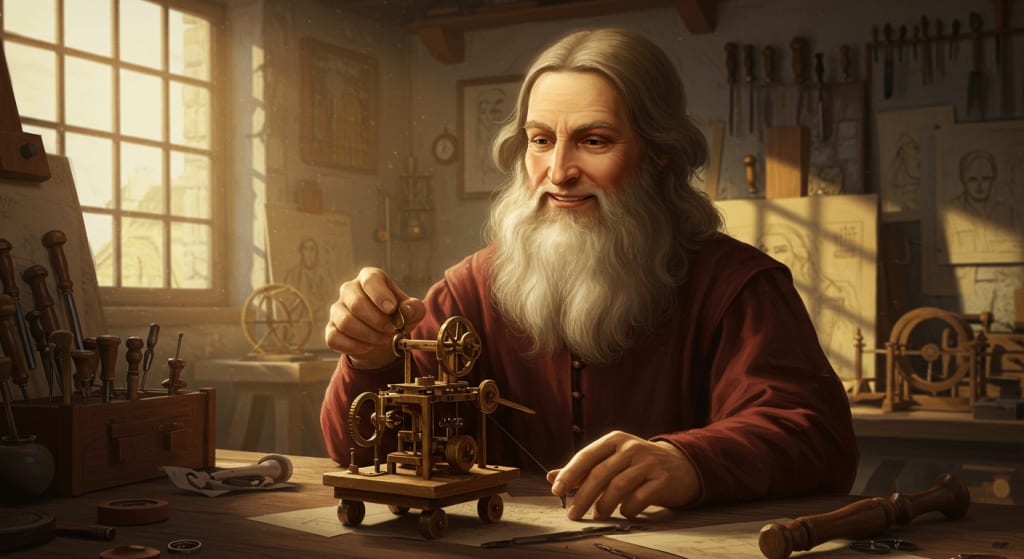
Leonardo da Vinci, born in 1452 in Vinci, Italy, remains one of history’s most enigmatic and brilliant figures. Known as a quintessential Renaissance man, his contributions spanned art, science, engineering, and anatomy, leaving a legacy that continues to captivate scholars and enthusiasts alike. Here are some fascinating facts about this extraordinary polymath.
A Self-Taught Genius
Leonardo had little formal education, learning basic reading, writing, and arithmetic in his youth. Largely self-taught, he developed his skills through observation and experimentation. At age 15, he apprenticed under Andrea del Verrocchio, a renowned Florentine artist, where he honed his craft in painting, sculpting, and mechanical arts. This lack of traditional schooling allowed Leonardo to approach problems with a unique, unorthodox perspective, fueling his innovative ideas.
The Mona Lisa’s Mysteries
Arguably Leonardo’s most famous work, the Mona Lisa (1503–1506) is shrouded in intrigue. Her enigmatic smile has sparked countless theories, with some suggesting it reflects a secret code or even a self-portrait in disguise. The painting’s small size—only 30 by 21 inches—surprises many who see it in person at the Louvre. Leonardo carried the Mona Lisa with him until his death, constantly refining it, which adds to its mystique.
A Visionary Inventor
Leonardo’s notebooks, filled with over 7,000 pages of sketches and ideas, reveal his forward-thinking inventions. He conceptualized designs for a parachute, helicopter, tank, and even a scuba-like diving apparatus—centuries before their practical realization. While many of his ideas were not built in his lifetime due to technological limitations, his sketches demonstrate an uncanny understanding of mechanics and aerodynamics.
Mirror Writing Mastery
Leonardo wrote most of his notes in mirror script, a backward handwriting that reads normally when reflected in a mirror. Some believe this was to keep his ideas secret, while others argue it was simply because he was left-handed, and writing backward prevented smudging ink. This quirk adds a layer of mystery to his already complex persona, as deciphering his notes requires effort and ingenuity.
A Pioneer in Anatomy
Leonardo’s curiosity about the human body led to groundbreaking anatomical studies. He dissected over 30 human corpses, creating detailed drawings of muscles, bones, and organs that were remarkably accurate for his time. His studies of the heart’s valves and the fetus in the womb were particularly advanced, predating modern medical illustration. These sketches were not widely known during his life but later influenced anatomical science.
A Vegetarian Ahead of His Time
In an era when vegetarianism was uncommon, Leonardo reportedly abstained from eating meat, believing it was unnecessary to harm animals for food. He wrote about his love for nature and even purchased caged birds to set them free. This compassion for living creatures reflected his broader philosophy of harmony with the natural world.
Unfinished Masterpieces
Leonardo was notorious for starting projects and leaving them incomplete. The Adoration of the Magi and Saint Jerome in the Wilderness are prime examples of works abandoned mid-creation. His perfectionism and tendency to pursue new interests often led him to move on before finishing, frustrating patrons but adding to his mystique as a restless genius.
A Musician and Performer
Beyond art and science, Leonardo was an accomplished musician. He played the lyre and was known for his singing voice. He even designed innovative musical instruments, including a viola organista, a hybrid of a piano and stringed instrument. His talents as a performer made him a sought-after guest at Renaissance courts, where he entertained nobility with music and theatrical displays.
A Man of Mystery
Leonardo’s personal life remains elusive. He never married, and little is known about his relationships. Some historians speculate about his sexuality based on ambiguous references in his writings and his close relationships with male apprentices. His private nature, combined with his cryptic notes, keeps scholars guessing about the man behind the masterpieces.
A Lasting Legacy
Leonardo died in 1519 in France, leaving behind a legacy that transcends time. His works, like The Last Supper and Vitruvian Man, remain cultural icons. His notebooks continue to inspire scientists, artists, and inventors. Leonardo da Vinci’s boundless curiosity and interdisciplinary brilliance make him a timeless symbol of human potential.
About the Creator
Fred Bradford
Philosophy, for me, is not just an intellectual pursuit but a way to continuously grow, question, and connect with others on a deeper level. By reflecting on ideas we challenge how we see the world and our place in it.
Keep reading
More stories from Fred Bradford and writers in FYI and other communities.
Five Interesting Facts About Albert Einstein
Albert Einstein, the name synonymous with genius, revolutionized our understanding of the universe with his theory of relativity and contributions to quantum mechanics. Beyond his scientific achievements, Einstein’s life was filled with quirks, passions, and lesser-known stories that make him a fascinating figure. Here are five intriguing facts about the man behind the iconic equation E=mc².
By Fred Bradford8 months ago in FYI


Comments
There are no comments for this story
Be the first to respond and start the conversation.