
In an Octopus’ Garden
Discover the Secrets of this Elusive and Clever Creature

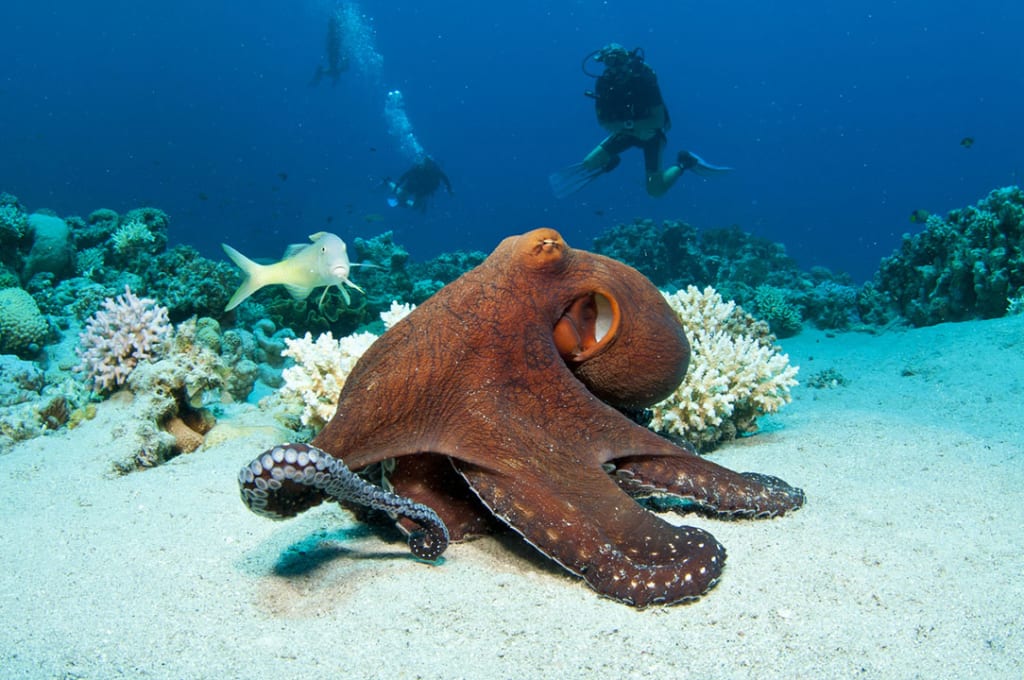
The boat is bobbing up and down and up and down, slamming against frothy waves, as I ready myself to disembark. I’m painfully aware of the near 30-kilograms of gear—air tank, BCD, regulator, weight belt, mask, snorkel, wet suit and flippers—that make out-of-water movements exceedingly difficult for my 170-centimetre, 54-kilogram frame.
Careful not to slip, I tiptoe my way towards the stern. With one big leap I’ll be free of gravity’s hold and mobile once more. Holding my mask and breathing apparatus, I jump. Relishing the cool water embrace my body. Flipping onto my back, I pump a little air into my BCD—also called a buoyancy compensator—which is similar to an inflatable life jacket. My legs powerfully kick away from the boat. We have to swim out for about 15 or 20 feet before descending onto the reef. This is my 51st dive, in the stunning tropical waters of Racha Noi, just off the coast of Phuket, Thailand. And there’s one sea creature in particular I’m hoping to see.
I feel like a bird flying against the wind as my body undulates with the waves—craning my neck to ensure I’m not veering off course. This is the hardest part of the dive. The splashing waves and my clumsy movements are tiring; loitering on the surface in my cumbersome gear feels like being stuck in the ocean’s limbo. While the water is clear and warm, I’m eager to submerge.
There’s this moment, when diving, where the surface world slips away and you find yourself surrounded by swaths of unending blue. It’s quiet; the only sound is the calming pulse of the regulator as you breathe. True peace.
For me, this moment is when I release the air from my BCD and let my weight sink steadily beneath the waves. My body and spirit feel effortless as I visit a world that couldn’t be more different to my life on land.
I’ve seen many creatures during my adventures below the surface. Playfully curious dolphins and sea turtles, schools of mackerel so thick it’s like being surrounded by a blanket of silver stars, colourful angel fish darting hither and to, and even a pair of coupling cuttlefish—changing colour hypnotically to attract their mates.
But it’s another cephalopod that I’ve yet to spy. Arguably, the most elusive and intelligent mollusc that’s factored in my imagination since I was a child. The octopus.
A master of disguise, octopus have thousands of colour-changing cells called chromatophores, iridophores and leucophores that lie just below the surface of their skin. Chromatophores have a minuscule amount of pigment at their centre, whereas iridophores and leucophores act more like mirrors. The former reflects iridescent tones and the latter replicates the colours of an octopus’ surroundings.
Together, these cells enable an octopus to change colours rapidly. In part, this creature can alter its appearance so quickly because it “sees” with its skin. A light-sensitive protein called rhodopsin (which is also found in the human retina) is imbedded within each chromatophore.
Their ability to seamlessly camouflage into coral reefs makes spotting immobile octopuses (yes, the plural of octopus really is octopuses, not octopi) almost impossible. Not only is the ability to disappear in any environment an evolutionary marvel, but it’s also ideal for hiding from predators in plain sight.
I often wonder how many octopuses I’ve drifted over unwittingly.
Pausing to look at my air (the dive has just begun, so my submersible pressure gauge is still at 200 bar) and check on my dive buddy (signally “are you okay?” with my hands), I take a minute to soak in my surroundings. The reef is spectacular. Corals more colourful than a garden in spring make an inviting home for all manner of creatures. I spot tiny clown fish weaving between pink anemones, moray eels poking their grey heads out of tube-like, purple corals and giant, yellow fan corals larger than my arm span spreading out gloriously beneath the waves.
The dive master sets off, and we dutifully follow suit. We’re nearly 18-metres below sea level, and at our lowest we’ll hit 30-metres. But it doesn’t feel like the surface is the distance of a multi-storey building away.
I keep my eyes peeled for signs of an octopus hiding amidst the coral. There are more than 300 species of octopuses found throughout the world. Not only are they adept at camouflage, but these invertebrates have many tricks up their tentacles.
Octopuses are known to carry shells for protection, and the common octopus—or Octopus vulgaris—uses shells, rocks and other objects to decorate their dens, or “gardens.”
Another species, Amphioctopus marginatus, or the coconut octopus, makes mobile homes out of coconut shells—even if that means digging up and painstakingly cleaning off shells buried in sand. They carefully squirt water at the dirty shells until satisfactorily clean.
Perhaps most impressively of all, the mimic octopus—or Thaumoctopus mimicus—is renowned for copying the appearance of other sea creatures. While it can emulate giant crabs and seahorses, the mimic octopus also mirrors sea life divers typically avoid, such as lionfish, jellyfish and poisonous sea snakes. While the mimic octopus is found in Phuket’s waters, they prefer sand to coral—so it’s unlikely I’ll see one.
Undoubtedly, octopus are highly intelligent creatures—and are the only invertebrates known to use tools. These fascinating animals can also solve problems, cooperate with fish—usually groupers—to catch prey, and are incredibly strong (being made out of mostly pure muscle.)
While some researchers debate just how intelligent octopuses are, what is a fact is that this mollusc has nine brains. A central brain located between its eyes, and a brain in each arm. Together, all of an octopus’ brains contain around 500 million neurons. (Humans have 86 billion neurons, while dogs have roughly 600 million neurons.)
But, not all of an octopus’ neurons are located in its central brain. Around two-thirds are in its arms. Each tentacle truly has a mind of its own—and can operate independently from the central brain. Should an octopus’ arm be severed, it remains autonomous and continues to move for up to an hour. The missing arm will also regenerate.
All eight tentacles are covered in hundreds of suckers. An adult Pacific octopus, or Enteroctopus dofleini, has around 280 suckers per arm. Each sucker has the capacity to taste and smell; suckers are how octopuses interact with the world around them.
Around me, my fellow divers are cramming together in what I can only assume is an excited fashion—as their dark masks and regulators leave reading expressions difficult. My heart skips a beat; is it an octopus?
I drift toward the group, hoping I haven’t missed it. The dive master points below him, in a small patch of sand between two coral-ridden boulders. There, in the sand, I can barely make out the outline of a small creature. If I weren’t under water, I’d be holding my breath in anticipation (a danger while scuba diving). I edge closer, mindful that my flippers don’t brush against the coral. The dive master sweeps his hand above the little creature, and the movement of the water brushes away the sand—revealing what’s beneath.
A blue-spotted stingray. Very common in Thai waters, and known for burying itself beneath a thin layer of sand to hide from predators. Not what I was hoping to see, but a beautiful little creature none-the-less.
The stingray scurries off, and we continue with the dive. My air is at 110 bar, signalling we’re nearing the end of our underwater adventure. In the distance, black-tipped reef sharks keep a careful distance. They’re not the only creature steering clear of curious divers.
Despite their incredible intelligence and skill at evading predators (and me, it seems), octopuses only live for a very short time. Some species live up to five years, while others have a lifespan of only six months. An octopus will only breed once in its life, and it’s this act of propagation that causes its demise.
Male octopuses mate using a special arm called a hectocotylus, which deposits sperm packets into the female’s mantel. Sometimes the process can take several hours. The male will die not long after (if he’s not eaten by the female first), as he’s used up all his body’s energy in the process.
The female hangs onto the sperm packets until she’s ready to lay her eggs. When this time comes, she’ll stay to watch over her eggs until the very end—never leaving her babies, not even to hunt. Eventually, she starves to death; usually just as her young are born.
While different species have different brooding periods, most shallow water octopuses guard their young for three months. But one variety, the deep-sea Graneledone boreopacifica, was discovered guarding her eggs for four-and-a-half years. Never eating, never moving. Just waiting for her little ones to hatch.
My dive buddy catches my eye, motioning, “are you okay?” with his hands, and tapping his wrist to signify I should check my air. My gauge reads 70 bar: time to ascend. We begin to kick up, the deep blues of the ocean fading as the bright sun starts to warm my face. At 4.5-metres we wait five minutes for a safety stop, before continuing onward. As we swim up, the air pressure begins to decrease and I feel my body pulled towards the surface. Breaking through the water, I inflate my BCD once more and start to kick back towards the boat. The underwater world and its mysteries lie far below me.
And somewhere below me, too, one of its mysteries continues to elude my curious eyes. Perhaps camouflaging from predators, or selflessly guarding her eggs. Or maybe finding a new shell—for his octopus’ garden, in the shade.
About the Creator
Sarah Comber
Storyteller at heart. Writing is my favourite escape. Always imagining new little worlds and scribbling down ideas. Some of these ideas are stories here.
Thank you for taking time to read my stories—I hope they offer you a little escape too.
Keep reading
More stories from Sarah Comber and writers in FYI and other communities.
Neutraceutical Packaging Market Size and Forecast 2025–2033
Neutraceutical Packaging Market at a Glance The Neutraceutical Packaging Market is projected to expand from US$ 4.92 billion in 2024 to US$ 7.63 billion by 2033, growing at a CAGR of 4.99% from 2025 to 2033. This steady growth reflects the accelerating global demand for dietary supplements, functional foods, herbal products, and wellness beverages. Rising health awareness, aging populations, sustainability expectations, the rapid growth of e-commerce, and evolving regulatory frameworks are reshaping how nutraceutical products are packaged, protected, and presented.
By Aaina Oberoi4 days ago in FYI


Comments
There are no comments for this story
Be the first to respond and start the conversation.