


A white giant looms in the Roman sun. One look and you know this structure was meant to evoke awe and wonder, and house a cacophony of noise and screams. It is a monument of, and a testament to, the genius of the Ancient Romans, a colossus of Roman engineering. The Colosseum is two-thousand years old, has four levels, 80 entrances, can hold up to 80,000 people, and measures in at 160 feet tall, 617 feet long and 517 feet wide; it was also equipped with elevators and trapdoors. Construction began on Rome’s Colosseum in 72AD, during the reign of Emperor Vespasian, when the Holy Roman Empire was at its peak. Made out of limestone, marble, concrete and tufa, 200 ox carts per day would carry stone along the ancient Appian Way to Rome for its construction, totaling 240,000 cart trips in all. The Colosseum was a gift to the people of Rome, one of many from the spoils of the Empire, whose reign stretched from as far as Britain in the West to Syria in the East. It not only signified Rome’s domination of the world, but this building could have been considered the epicenter of the world as well, for many centuries. The largest amphitheater ever built in the classical world, an arena of blood and sand, a place where gladiators would fight to the death, providing the amazed public with never before seen entertainment; a true festival of revelry and gore. Today, the Colosseum stands quiet, filled not with gladiators, but with tourists, yet we can still hear the long evaporated roars of its crowds echo in the annals of history. Heralded as one of the wonders of the world, here is everything you need to know about Rome’s Colosseum.
The Colosseum only took about eight years to construct. An extremely fast pace for 2,000 years ago, let alone by today’s standards. The Colosseum was not, in fact, always called the Colosseum. It was originally known as the Flavian Amphitheater, named after the Flavian dynasty of Emperors. It was built at the request of Emperor Vespasian, a founding member of the Flavian dynasty. It’s known now as the Colosseum because of a “Colossal” bronze statue of the Emperor Nero that stood next to it. The outline of the base of the statue is still there, but Nero’s statue is long gone.
The wooden sticks you see in the picture protruding from the top of the Colosseum, secured into brackets just under the roofline, were used to support the very first retractable roof, called the Velarium. The roof was made of heavy canvas, very much like a sailboat sail, and was put in place by 300 sailors that could climb a staircase on the façade of the building, parts of which are still visible today. The Velarium’s purpose was to keep the sun and rain off the spectators, it also created an updraft, providing spectators with a supposed continual, cool breeze. The gladiators themselves, and the center of the arena were not covered.
Our current, modern day word “arena” is taken from the Colosseum, because it had a sand floor, a wooden floor, with sand laid on top, to help soak up all the blood that was shed. The Latin word for sand is “arena”.
When the Colosseum first opened it offered 100 continual days of “games”. People throughout the Roman Empire flocked to Rome, and seating was based upon class, with the rich in the first tier, closest to the action, commoners in the middle, and slaves and women in the top tier. The first 100 days were bloody, with 5,000 animals being slaughtered PER DAY. Trap doors made it seem that animals appeared out of thin air, which were advanced special effects for 2,000 years ago.
Estimates show that around 50,000 people were killed in the arena, with over a million wild animals succumbing to death in the Colosseum as well. That level of slaughter at the arena contributed to the plummeting number of tigers, lions and jaguars around the world, and some say that entire species of wildlife were wiped out across North Africa and the Mediterranean region as a result of the Colosseum’s requirements for entertainment. The Colosseum could hold 60,000 spectators, some reports say 80,000, and the entire building was able to empty completely in under 10 minutes. Much like our modern day arenas, it even had drinking fountains, lavatories, and vendors outside.
The main attraction at the Colosseum were gladiators. Gladiators were essentially slaves, born and trained to fight. They lived in the Ludus Magnus, a smaller training complex, a mini Colosseum, if you will, connected by a tunnel to the actual Colosseum. Gladiators would live and practice in the Ludus Magnus. There were three main events that took place in the Colosseum:
Gladiator vs gladiator; Gladiator vs wild animals; and they also used to flood the basin of the Colosseum with water and put on “mock” naval battles to the delight of the crowd. Imagine in even a modern day arena, seeing its basin filled with water and then watching ships maneuver around, recreating historic naval battles for your amusement. An incredible feat of engineering, utilizing aqueducts, but this spectacle didn’t last too long however, as flooding and drainage were a serious problem that over time, would have weakened the foundation of the Colosseum.
The Roman’s also created a volcano in the center of the Colosseum as well, which even erupted to the delight and surprise of the audience. They would also decorate the Colosseum as a jungle, and have gladiators hunt and kill wild animals, and unfortunately, sometimes the other way around.
The Colosseum had many examples of exotic plant life as well, many of which were not found in Rome other than in the Colosseo itself. This was due to the fact that people would travel to Rome from all over the Empire to see the games; these people would bring food, and seeds, and the seeds that fell onto the floor, germinated. Also, seeds embedded in the exotic animal’s fur, found across every corner of the Empire, are attributed to the vast variety of plants found in the Colosseum, over 420 different types of flora. At one point the Colosseum was so overcome with flora and vines that it became a structural issue, weakening the building, and were subsequently eradicated.
Contrary to popular belief, when two gladiators fought, one did not necessarily always die. It took many years and a lot of money invested to train the gladiators and they would not want to lose half of their fighting force that quickly. There were 20 different types of gladiators, each with different armor and weapons. Each style was meant to represent the different enemies the Roman empire defeated throughout its history. Some are seen below...
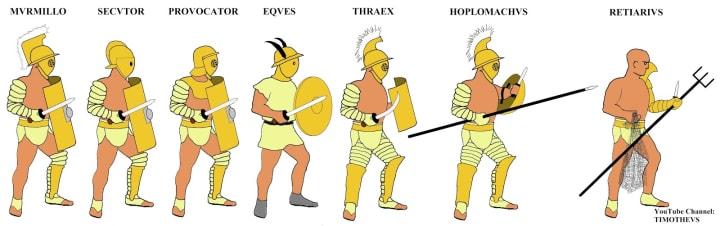
When a gladiator was defeated, the victor would look to the Emperor, seated in his royal box (still visible today) and the Emperor would listen to the crowd and give a hand signal. Most people believe it’s the “thumbs up/thumbs down” signal, but this is incorrect. The signal was actually “thumbs up and in, towards the throat” which meant for the victorious gladiator to deliver the final death blow to his defeated opponent, and a “thumbs down and out, to the side” signaled for the gladiator to throw down his sword and let the defeated gladiator rise and live to fight another day. The following is depicted incorrectly, as are most modern day representations...
Gladiators are called gladiators because of the swords they used. The Gladius...

While it is certain that a lot of what went on at the Colosseum was underhand and definitely dangerous, there is also a literal underground area of the Colosseum, known as the Hypogeum. The Hypogeum was a two-level subterranean network of tunnels with 32 animal pens. There were also 80 vertical shafts which allowed for instant access to the arena, which were used for shifting animals and scenery during shows.
Successful gladiators on a long win streak would become quite famous and would be assigned a slave themselves to help them get ready for battle, get their gear on, etc. in the Hypogeum. It is said that the most famous of gladiators would tell their slaves to warm up the cold marble toilet seat for them before usage so their buns wouldn’t get cold. Supposedly the phrase “I’m just keeping your seat warm for you” stems from this tradition. A successful gladiator, after many years of victories, could win back his freedom and retire in peace for the rest of his days, symbolized by receiving a wooden sword, but many continued to fight or train new gladiators, as this was the only life they had known. These successful gladiators gained “star” status, the first “celebrities” in the world. It was said that the sweat of some gladiators was collected and worn as cologne so the person wearing it would be “sexier.” And yes, there were female gladiators who competed as well, known as the gladiatrix.
Tickets to get into the Colosseo were free and the tickets themselves were actually broken shards of pottery with a Roman numeral etched into it that corresponded to your specific gate number. Sound familiar? Gate numbers are still visible today on the top of the Colosseum’s 80 arched entryways.
It is also speculated that flyers were distributed to the public listing the various gladiator’s statistics-- wins, losses, kills, types of beasts defeated, etc. An ancient type of baseball card, perhaps?
Each arched window of the Colosseum was filled with a tributary life-sized statue of Roman gods and goddesses. None remain today.
The Colosseum was at one time rounded, perfectly intact, but today, the broken parts of its roofline were due to earthquakes, fire, lightning, and war. In 217 AD, a huge fire gutted the Colosseum. It took 20 years to rebuild, and damage repair from earthquakes were helped financed by citizens, who in return for money for repairs, would get their family name etched into the marble facade.
There is no evidence that Christians were ever fed to the lions in the Roman Colosseum. This may, however, have happened in other cities that had their own amphitheaters (ex. Verona).
The games held in the Colosseum eventually dwindled due to the financial problems of the Empire and due to the rise of Christianity, and its moral concerns. At its lowest point, instead of lions or elephants running into the Colosseum, house cats or chickens were used in substitution, creating an almost circus like atmosphere. In 404 AD, the games were officially banned from taking place, and in the years following, the Colosseum was subsequently used as a church, a private fortress for the Pope, a dumping ground for the city’s manure, a quarry, a gunpowder factory, and it was almost turned into a wool factory.
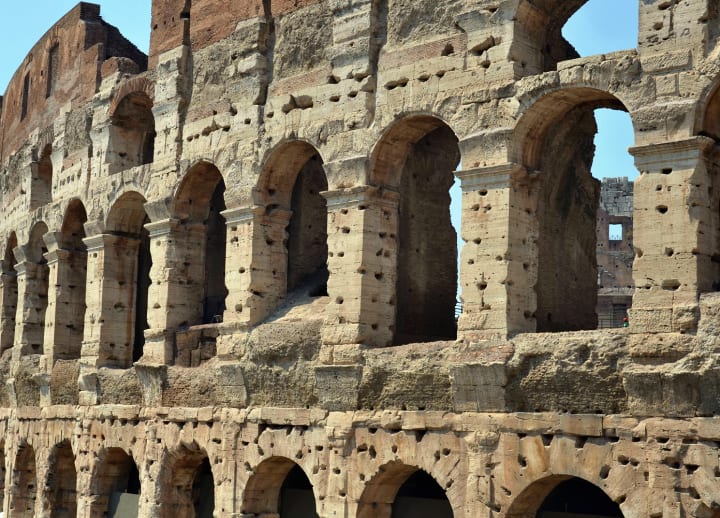
Much of the marble and material that was used to make Rome’s Colosseum was plundered and used to build St. Peter’s Basilica in Vatican City.
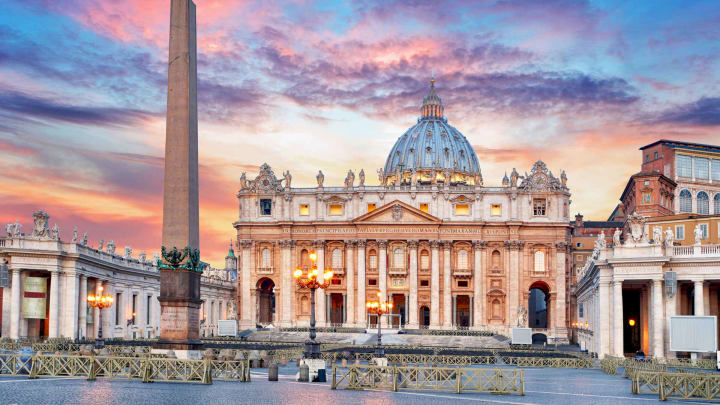
The massive holes pockmarking the outer façade of the Colosseum speak to the building’s history after it fell into disuse and decline. Looters grabbed all the precious materials in the amphitheater’s fabric, including the massive metal clamps that helped keep the building’s various floors together. These clamps would mostly have been melted down and turned into weapons during the Middle Ages. One study estimates that the clamps alone were comprised of 300 tons of iron. Less than half of the original structure still stands today. It is said that only gravity and good design are the only things holding up the Colosseum today.
In most recent history, Benito Mussolini held rallies in the Colosseum; and in celebration of the new millennium, in the year 2000, a stage was built over half of the Hypogeum (the underground system of tunnels) for a performance of Oedipus Rex, the classic Greek play written by Sophocles. This marked the first time in over 1,500 years that a performance took place inside the Colosseum, one of Greek tragedy, not of gore and beasts. The millennium celebration undertaking and stage building took five years and a reported 25 million dollars to design and renovate.
Visiting the Colosseum today, we can still somewhat imagine the sights, sounds and the feeling of the events that took place there all those centuries ago. While today it is filled mostly with curious tourists, there is another population residing inside the walls of the Colosseum-- there is an abundance of cats that now call the Colosseum home. No one knows why these four legged felines enjoy basking in the sun on a slab of 2,000 year old marble, but they do. These cats are now the true inhabitants of one of the world’s most famous (or infamous) structures ever built.

While back then it was free admission for anyone looking to get inside the Colosseum, today it will run you about 12 Euros, just under 15 dollars. Not bad given 2,000 years of inflation and fascinating history. An interesting quote pertaining to the Colosseum is as follows…
“Rome will exist as long as the Colosseum does;
when the Colosseum falls, so will Rome;
when Rome falls, so will the world.”
-Saint Venerable Bede, English Benedictine monk.
Not too bad a quote, as far as a building goes. As far as the city goes, with its beautiful and historic buildings and monuments, incredible works of art, small-town charm, leisurely pace of life and amazing cuisine, the Eternal City of Rome is worth a visit at least once, though it would take a lifetime to see all it has to offer.
Got wanderlust?
About the Creator
Keep reading
More stories from Joe Palumbo and writers in FYI and other communities.
"Let Me Apologize In Advance"
We’ve been telling stories for millennia. The first stories were told 40,000 years ago via primitive art--cave paintings akin to murals, which depicted short, ritualistic events, usually the hunt. Exciting stuff, no doubt, but what was its purpose? Was it meant solely to increase the heart rate of the intended viewing audience? Was it to bookmark our ancestors’ existence in a specific moment in time? Or was it to woo that cute Neanderthal girl you’ve had your one good eye on? At its core, storytelling is meant to entertain and educate, preserve tradition, history, and culture, all while instilling moral values and a sense of community.
By Joe Palumbo5 years ago in FYI
How an Australian Farmer Is Planning to Get US Consumers Hooked on Camel Milk
An Australian farmer’s unusual plan to export camel milk to the United States is capturing attention in both agricultural and wellness circles, marking a potential new chapter in the global dairy market. After more than a decade developing one of Australia’s first commercial camel dairies, Paul Martin is now preparing for his first major overseas shipment — and he believes the US market could be a game-changer. The Guardian Martin operates his camel farm on a 130-hectare property in the Scenic Rim region of Queensland, southeast of Brisbane. Over the past 10 years, he and his team have built a productive herd, including standout camels such as Caroline, whose genetics produce more than twice the average milk yield of wild camels. This selective breeding, Martin says, is crucial to scaling camel milk production from a novelty to a serious commercial product. The Camel Milk Opportunity Camel milk has long been a staple in pastoral communities in Africa and the Middle East, prized for its nutrition and digestibility. But in western countries, it remains a niche product — one that is starting to attract health-minded consumers. Camel milk is naturally lower in allergens than cow’s milk because it lacks the protein beta-lactoglobulin, a major trigger for dairy sensitivities. Its nutritional profile has led some in wellness circles to describe it as a “superfood,” appealing to people with gut-health concerns or dietary restrictions. Martin plans to export 60,000 litres of camel milk to the United States this year, his first shipment aimed at testing US demand. If successful, he believes exports could grow into a major new commodity for Australia — much like beef or sheep products once did. Australia’s Unique Camel Advantage Unlike many countries, Australia has a naturally large population of feral camels — descendants of animals brought in during the 19th century — estimated at hundreds of thousands across the interior. While these populations are often seen as an ecological challenge, some see a commercial opportunity in turning them into dairy resources. However, experts caution that relying on feral harvests for commercial milk production presents challenges in scale, animal welfare, and sustainability. Government reports suggest that commercial use could support targeted population control, but that captive breeding remains a more realistic path for industry growth. On Martin’s farm, camel milking is a hands-on, psychology-driven process: camels must be “coaxed” rather than forced to release milk, requiring trust, calm handling, and careful understanding of herd dynamics. “Once you do that,” Martin says, “they’re like a grass-eating Labrador.” Marketing to US Consumers For camel milk to catch on in the United States, producers must navigate a complex food environment. Unlike traditional dairy products, camel milk still lacks widespread retail presence, and in some US states there are strict regulations on raw milk production and sales. However, pasteurised camel milk and camel-based products have already begun appearing in specialty markets, often tied to migrant communities familiar with camel milk’s cultural and nutritional value. Martin believes that the milk’s health positioning — particularly for people with allergies or digestive issues — could help broaden its appeal beyond niche markets. He points to the similarities in health trends between Australia and the US, noting that wellness consumers there have shown interest in alternatives to traditional dairy. Cultural and Economic Potential Camels also hold cultural significance for some communities in both countries. Somali Australians, for instance, see camels as symbolic of resilience and heritage, connecting traditional food practices with modern industry innovation. Martin’s farm even offers camel milk cappuccinos and camel-meat pies, blending tradition with contemporary food culture. Despite the logistical and marketing challenges, Australian producers — including larger players like Aus Camel Dairies Pty. Ltd. — are investing in technology and production facilities aimed at scaling for global markets. Some are even exploring infant formula and powdered camel milk products to broaden export opportunities. Auscamel Dairies Conclusion As Martin prepares his first shipment of camel milk to the United States, the venture represents a broader trend in agricultural innovation: turning unconventional resources into high-value export products. If Australian camel milk can find a foothold among US consumers hungry for healthful, alternative dairy options, it could usher in a new era for an industry once confined to arid deserts and traditional markets.
By Fiaz Ahmed 5 days ago in FYI


Comments
There are no comments for this story
Be the first to respond and start the conversation.