
How Russia can become SUPER POWER again
How Russia can become SUPER POWER again

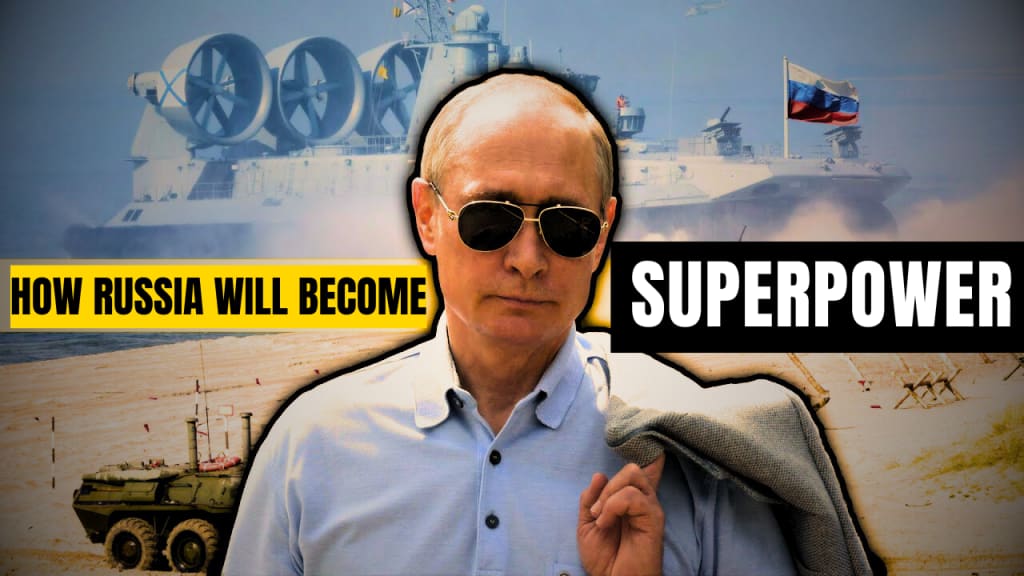
Russia possesses secret natural advantages that could enable it to regain its status as a superpower.
On one hand, a large part of Russia is covered in snow, and on the other, NATO allies have effectively surrounded it.
So what is holding Russia back—despite having the world’s second-largest military after the United States—from reclaiming the title of superpower, which currently belongs to America?
How will Russia come back? What geographical or environmental changes could propel Russia to superpower status once again?
We all know Russia is the largest country in the world by area.
When the sun rises in western Russia, it’s already dinner time in the east.
Spanning 17.1 million square kilometers, Russia is so vast that it can fit 204 United Arab Emirates—or 5 Indias, 8 Saudi Arabias, or 19 Pakistans—within its borders.
Russia is not just vast in area, it also holds the world’s largest underground reserves of oil and natural gas.
It ranks first in natural gas reserves and eighth in oil reserves.
A 2021 survey found that many European countries depend entirely on Russian gas. On average, 40% of Europe’s gas comes from Russia.
This means if Russia stops supplying gas, it could severely impact Europe’s economy.
Besides being rich in natural resources, Russia is also a major wheat exporter, accounting for approximately 18% of global wheat production.
However, despite these advantages, Russia faces a significant geographical challenge that has prevented it from becoming the strongest nation.
Most of Russia’s land lies unused due to extremely cold weather, especially in Siberia, where the average yearly temperature is only 0.5°C.
This region is home to the coldest inhabited city on earth—Oymyakon—where winter temperatures can plummet to minus 71°C.
Because of such harsh conditions, Russia’s population density is very low relative to its size. In fact, 75% of Russians live in just 20% of the country’s territory.
Russia has been struggling with this issue for centuries but has not yet overcome it.
In addition to its vast area, Russia’s coastline is much longer than America’s, stretching over 37,650 kilometers.
But here too, Russia faces obstacles: the Arctic Ocean remains frozen most of the year, making much of this coastline inaccessible.
Countries with greater access to navigable seas can trade more easily, boosting their economic and military strength. The ocean allows goods to be transported globally at low costs.
Due to icy waters, cargo ships in Russia face difficulty and danger navigating its coasts.
Currently, all Russian trade relies on just three main ports: Vladivostok in the east, St. Petersburg in the northwest, and Novorossiysk on the Black Sea in the south.
Vladivostok’s waters freeze for months. When trade resumes in summer, Russian ships must pass through waters controlled by Japan—a strong U.S. and NATO ally.
Similarly, ships departing from St. Petersburg face icy conditions and must navigate through NATO-aligned countries.
Novorossiysk, while ice-free, requires ships to pass through a narrow corridor near Turkey, another NATO member.
Thus, despite having a large coastline, Russia must wait for favorable weather and navigate through waters controlled by adversaries, limiting its trading freedom.
Despite these challenges, Russia ranks 11th globally in GDP—Gross Domestic Product—the total income of all its people, often used as a measure of a country's success.
But GDP doesn’t fully capture a country’s power.
Militarily, Russia possesses the world’s largest stockpile of nuclear warheads, surpassing even the U.S.
It is widely regarded as having the second most powerful military in the world after America.
Again, Russia’s harsh climate plays a role. Its freezing temperatures have historically deterred invasions.
Napoleon invaded Russia with over 600,000 troops, but only 100,000 survived due to the brutal winters.
During World War II, Hitler’s 3.8 million-strong army suffered catastrophic losses in Russia, with over a million soldiers killed and the remainder captured.
Hitler’s defeat was so devastating he ultimately committed suicide.
So, the cold climate has long been Russia’s greatest defense—but also its biggest barrier to growth.
If Russia could overcome its frigid weather, it could exploit its northern seas for trade and unlock vast mineral wealth, including gold, uranium, and diamonds—currently inaccessible due to the cold.
With better climate conditions, Russia could vastly expand its wheat exports beyond the current 20% of its land in use.
Imagine the economic growth if Russia could fully utilize its territory—it could surpass America in GDP.
Surprisingly, global warming might provide this opportunity.
Due to climate change, Russia’s cold climate could moderate in the coming decades.
This heat map shows countries where average temperatures range between 11°C and 15°C—the ideal range for human productivity.
Currently, this temperature range covers much of America, Europe, Japan, China, and South Korea—all successful economies.
Experts predict that by 2280, this optimal temperature zone will shift northward, benefiting Alaska, Canada, Greenland, Iceland—and especially Russia.
NASA’s data reveals that Arctic sea ice has drastically shrunk since 1979, decreasing by 13% each year.
If this trend continues, the Arctic Ocean could be ice-free by 2035, allowing Russia to access its northern seas year-round.
Melting ice also causes rising ocean levels, threatening coastal cities worldwide—especially in America, where many major cities sit on the coast.
These cities could face evacuations and expensive damage repairs.
Russia, however, has only three coastal cities, with most major cities located at least 600 kilometers inland—making it less vulnerable.
This geographic advantage will only increase in the coming decades.
Currently, ships from China and across Asia travel through the Suez Canal in Egypt to reach Europe, paying hefty tolls—up to $400,000 per vessel.
The Egyptian government earns about $8 billion annually from this canal.
Shipping from Shanghai to Rotterdam currently takes 37 days over 18,000 kilometers.
But with Arctic ice melting, ships could take a shorter route through Russia—only 10,500 kilometers and 22 days—saving millions in transportation costs.
Of course, Chinese companies would pay Russia substantial tolls to use this new route.
From agriculture to natural gas to mining, and from population growth to trade, climate change could become Russia’s greatest blessing.
There is a strong possibility that within 50 to 60 years, Russia will once again rise as a global superpower.
About the Creator
Keep reading
More stories from Jehanzeb Khan and writers in FYI and other communities.
How Dubai is Making Artificial Rain ?
In Beijing, China, preparations for the 2008 Summer Olympics were in full swing. After years of effort, China was finally hosting the Summer Olympics for the first time. Determined to execute the international event flawlessly, the Chinese government spared no expense—spending billions of dollars to construct new stadiums, renovate the Beijing Airport, and upgrade local transportation with thousands of new buses.
By Jehanzeb Khan8 months ago in FYI


Comments (2)
good creator
Nice 👍 bro also like my stories please