
How Dubai is Making Artificial Rain ?
How Dubai is Making Artificial Rain ?

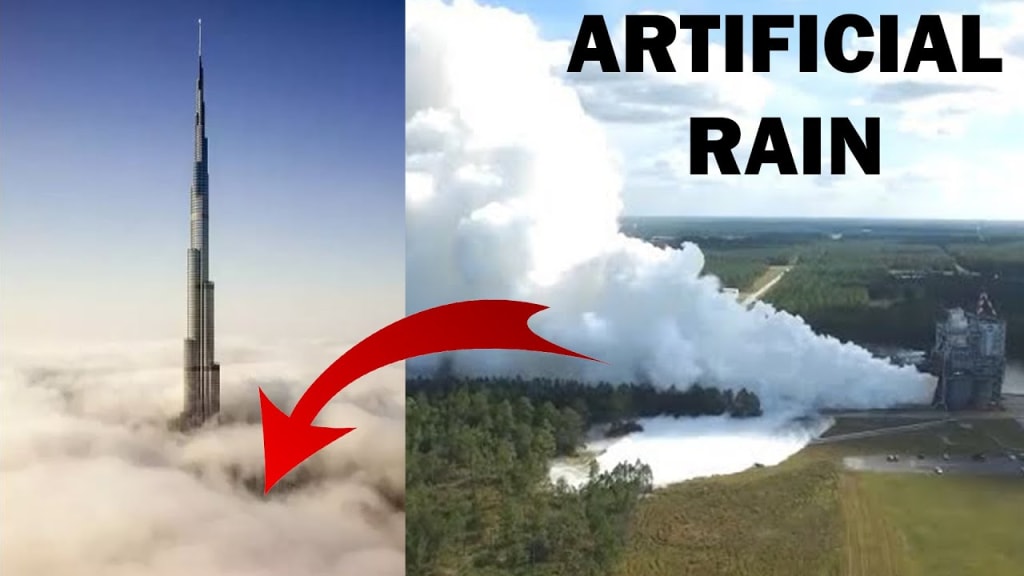
In Beijing, China, preparations for the 2008 Summer Olympics were in full swing. After years of effort, China was finally hosting the Summer Olympics for the first time. Determined to execute the international event flawlessly, the Chinese government spared no expense—spending billions of dollars to construct new stadiums, renovate the Beijing Airport, and upgrade local transportation with thousands of new buses.
Lighting, generators, security, and transport—everything was ready. But something still felt off. Just two days before the Opening Ceremony, all global teams had arrived in Beijing, tickets were booked, and the entire world was eagerly awaiting the spectacle.
Then, the Chinese government received devastating news.
The China Meteorological Department issued a storm forecast—for the exact day of the Opening Ceremony.
This shocked Olympic organizers. The main stadium, the Beijing National Stadium (Bird’s Nest), was open-air. Years of preparation could be ruined by just one hour of heavy rain.
With only a day left before the event, Chinese administrators scrambled to find a solution—one that would allow it to rain, but not over the stadium or Beijing’s roads.
To solve this, China turned to a remarkable scientific method called Cloud Seeding.
On the day of the event, as dark clouds advanced toward Beijing, Chinese authorities seeded them outside the city—forcing them to pour rain before reaching Beijing. As a result, the skies over the stadium remained clear during the ceremony.
But what exactly is Cloud Seeding?
Cloud Seeding is a weather modification technique used to artificially create rain. To understand how it works, we must first understand how natural rain forms.
Rain begins with the sun. When the sun heats the ocean's surface, water evaporates and rises into the sky as vapor. As it cools, it condenses into tiny droplets, forming clouds.
However, these water droplets often don’t collide or merge due to a lack of solid particles within the clouds. When dust or other particles do enter the cloud, they serve as a nucleus, enabling droplets to join, grow larger, and fall as rain due to gravity.
Cloud Seeding works by adding those particles artificially. First developed in 1946 by American chemists, the method involves dispersing a compound called silver iodide into clouds. This helps the cloud droplets bind together, grow, and ultimately fall as rain.
But because it is artificially triggered, this is called artificial rain.
This technology has also been used in military warfare.
During the Vietnam War, from 1967, the U.S. carried out Operation Popeye, using C-130 Hercules aircraft to secretly conduct cloud seeding along the Vietnam border. The goal was to extend the monsoon season, which led to severe flooding, landslides, and damaged roads—weakening Vietnam’s supply chains and military efforts year after year.
Today, one of the most innovative uses of cloud seeding is in Dubai.
Despite being a land of luxury, Dubai has a serious problem—a lack of drinking water. It rains only about 10 times a year, and the region has no natural rivers or fresh lakes. While water is abundant from the sea, it's salty and undrinkable. Drinking raw sea water can be deadly.
To solve this, Dubai uses massive reverse osmosis plants to purify seawater. However, these plants consume a huge amount of electricity, making it extremely costly—about ₹4,500 ($60) to purify 1,000 liters of water.
To reduce costs, Dubai also uses cloud seeding to harvest natural rain.
The government has constructed dams in the Hajar mountains, where seeding is carried out above the skies. When rain falls, the water slides down the hills into these dams instead of running off into the sea. This collected water is then used for drinking and electricity generation.
Compared to the ₹4,500 cost per 1,000 liters of filtered water, cloud seeding reduces it to just ₹75.
About the Creator
Keep reading
More stories from Jehanzeb Khan and writers in FYI and other communities.
30 Fascinating Facts About Space You Never Knew
Today, we’re diving into some jaw-dropping facts about space, our planet Earth, and the mysterious universe beyond. Why does the sky appear blue from Earth but black from space? The answer lies in sunlight, which contains all colors. When sunlight enters Earth’s atmosphere, the blue light gets scattered in all directions due to its shorter wavelength. That’s why the sky appears blue. But in space, there’s no atmosphere to scatter the light, so everything looks black.
By Jehanzeb Khan8 months ago in FYI
Top Tarot Readers in Spain 2026
The Rising Power of Tarot in Modern Spain In today's fast-paced, uncertain world, tarot reading has transformed from niche mysticism into mainstream essential guidance for millions of Spaniards. From intricate love triangles and treacherous career crossroads to profound personal destiny inquiries, people seek authentic voices amid chaos. Industry reports confirm a 25% annual surge in esoteric consultations since the 2020 pandemic, propelled by user-friendly online platforms, social media testimonials, and a cultural shift toward spiritual self-help.
By Laura Sanz2 days ago in FYI




Comments (1)
amazing