
How much would it cost to buy Greenland? Trump's dream of "the biggest real estate deal in history"
Donald Trump revived the idea of buying Greenland. He first brought it up in 2019, and then again after his re-election in 2024. He argues that it is essential for national security, countering Russia and China in the Arctic, gaining access to rare earth elements, and securing its strategic position.

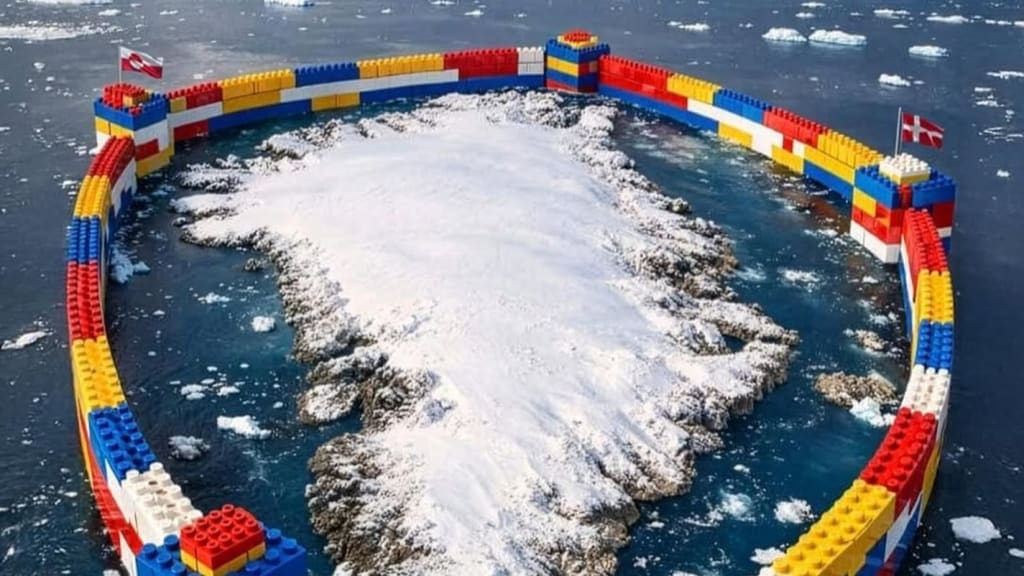
For more than a hundred years, American politicians have occasionally cast covetous glances toward Greenland, the world's largest island, which occupies a strategically important position between North America and Europe due to its location. But it was only U.S. President Donald Trump who revived this idea with unprecedented vigor. He first mentioned it in 2019 during his initial term, but after his re-election in 2024, he elevated it to the level of a national security priority. The Trump administration presents it as a necessary step against Russian and Chinese influence in the Arctic, access to critical minerals, and defense of the northern border.
The logical question that arises: How much would such a purchase actually cost? And is it even possible?
Greenland (in Greenlandic: Kalaallit Nunaat – “Land of the People”) had an estimated population of approximately 56,000 inhabitants according to 2025 figures (recent official estimates place it around 56,500–56,900 as of early 2025/2026). The island is an autonomous part of the Kingdom of Denmark with extensive self-government and holds the right to full independence. Both Denmark and the Greenlandic government have repeatedly stated that Greenland is not for sale.
The United States already maintains a strong military presence in Greenland thanks to the 1951 agreement from the Cold War era. American forces can build and operate bases across the island, control airspace and maritime traffic, and station personnel there. The main base is Pituffik Space Base (formerly Thule Air Base). A purchase would therefore not merely provide military access but would involve a complete change of sovereignty, which would require the consent of the local population, complex political negotiations, and long-term economic guarantees.
America has a rich history of territorial expansion through purchase. The most famous examples seem ridiculously cheap today, but only at first glance:
Louisiana (1803, from France): $15 million for 2.14 million km² → in today's dollars, about $444 million.
Alaska (1867, from Russia): $7.2 million for 1.52 million km² → today about $163 million.
Gadsden Purchase (southern parts of present-day Arizona and New Mexico) (1853, from Mexico): $10 million for 78,000 km² → today about $433 million.
However, when considering the proportion of U.S. GDP at the time, these purchases were enormous. Louisiana cost about 3% of American GDP back then. Adjusted to today's economy (around $30–31 trillion in 2025), a similarly scaled purchase would come to roughly $90 billion.
Greenland itself has an area exceeding 2.16 million km², most of which is covered by the ice sheet, making it comparable in size to the Louisiana Purchase. Yet historical analogies fail here.
The modern value of Greenland lies not in settlement or agricultural land, but primarily in its strategic and geological significance:
Arctic position: The island is key for defense against Russia and China, monitoring missiles, satellites, and new shipping routes opened by melting ice.
Rare earth elements: Greenland holds some of the world's largest untapped reserves of rare earth elements (estimated at about 1.5 million metric tons of reserves according to USGS data), including heavy rare earths. These minerals are essential for electric vehicles, wind turbines, smartphones, military technology, and the Green Deal transformation. Add to that uranium, zinc, gold, and potential oil and natural gas extraction.
21st-century geopolitics: Unlike the 19th century, climate change, global competition for the Arctic, and the rights of indigenous peoples (Inuit make up about 85% of the island's population) all play major roles.
A simple conversion of historical prices would thus lead to billions. In reality, however, the price would include not just monetary value but also political costs: resistance from Greenland (surveys show over 85% of residents reject joining the U.S.), tensions within NATO, an international scandal, and massive investments in infrastructure under extreme conditions.
The Trump administration is also considering other alternatives: from direct payments to residents ($10,000–$100,000 per person), through a “Compact of Free Association” model (similar to that with some Pacific islands), to open threats of military force. Public support in the U.S. remains minimal (current polls show only around 17% of Americans in favor), and European allies outright label it unacceptable.
Greenland has thus become a symbol: once a “cheap” piece of land, today an invaluable piece of the Arctic in the era of climate crisis and great-power rivalry. Whatever the outcome, a simple “real estate deal” it certainly will not be.
About the Creator
Keep reading
More stories from Elvira Diggory and writers in FYI and other communities.
The Murder of James Bulger: The Case That Shook Britain
Little James was with his mother Denise in the New Strand shopping centre in Bootle that day. Shortly before 3:40 p.m., Denise let go of James's hand for a moment to pay at the butcher's. When she turned back, James was gone.
By Elvira Diggorya day ago in Criminal
A Failed Artist, A Disillusioned Poet, An Underpaid Game Show Host
I took my son and niece to Gori, a small town in Georgia where Joseph Stalin was born. They talked me into visiting the Stalin's Museum, the largest in the post-Soviet space. I had resisted going there because I just can't stand the monster and know enough about him, or so I thought.
By Lana V Lynx25 days ago in FYI
The Rise of AI Agents at Work
For years, businesses have invested in software to speed things up. Tools to manage tasks. Tools to track progress. Tools to automate steps. Yet despite all this technology, work often still feels slow, fragmented, and dependent on human follow-ups.
By Wama Sompura4 days ago in FYI


Comments
There are no comments for this story
Be the first to respond and start the conversation.