
How KFC Was Born After 65: The Real Story Behind Colonel Sanders
From poverty and failures to building a global brand—how Colonel Harland Sanders created KFC when most retire.

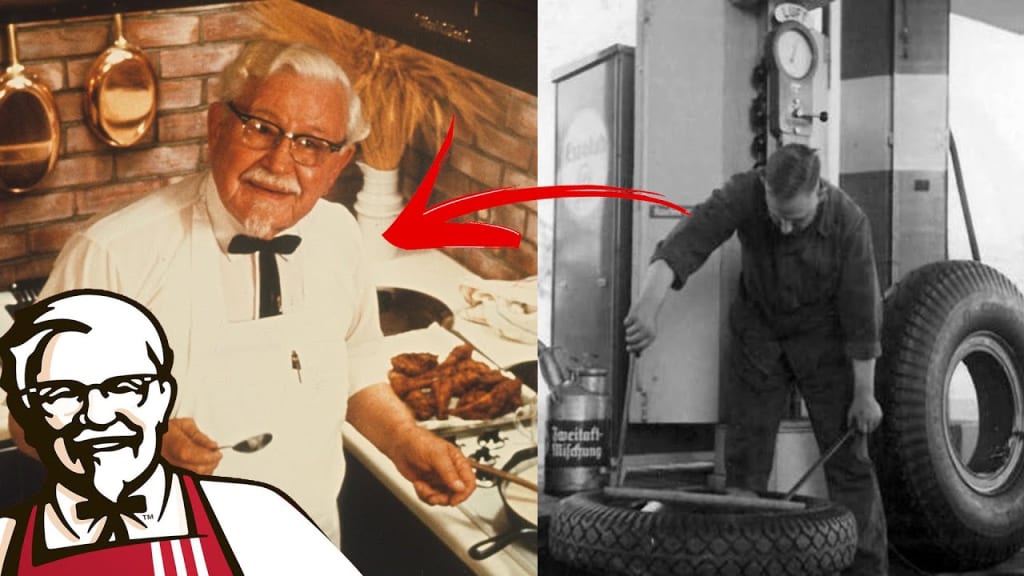
The man seen on the logo of the world’s most famous fast-food chain, KFC, is named Colonel Harland Sanders. He worked hard his entire life and faced many hardships. But what happened at the age of 65 that changed his destiny? What struggles did he go through on his journey to success, and why did his own company, KFC Corporation, file a court case against him?
Harland Sanders was born on September 9, 1893, on a small farm near Henryville, Indiana. His first major hardship came at the age of just six, when his father passed away. Being the eldest sibling, he had to take care of his younger brothers as his mother had to work outside the home to earn money. By the age of seven, he had already mastered cooking bread and vegetables.
When his mother’s income was not enough to sustain the family, Harland took up his first job at the age of 10, feeding animals on a farm. However, due to his young age and lack of interest, he was soon fired. At the age of 12, his mother remarried, but his stepfather didn’t like having children around. Eventually, Harland was separated from his mother and had to live with a relative, along with his siblings.
To support his brothers, Harland again began working on a farm. He fed animals at 6:00 AM, then went to school, and worked in cornfields in the evenings. At just 13, he was juggling an intense routine all by himself. But soon, another problem arose—he was expelled from school due to poor academic performance, particularly in algebra.
He continued working on the farm for two more years, but expenses kept rising. So, at 16, he decided to join the U.S. Army. He lied about his age to enlist. However, just a year later, when the Army discovered the truth, he was discharged. Now 17 and jobless again, he struggled for years, trying every job he could find—streetcar conductor, railroad fireman, insurance salesman, lawyer, steamboat operator, even tire salesman. He was either fired or quit nearly every job. His wife eventually left him, frustrated with his unstable career.
In 1934, at age 41, Sanders met the general manager of an oil company who offered him a gas station to manage. Initially, sales were low, but Sanders turned things around by treating customers with great hospitality. His kindness and care helped triple the sales.
Just as things were improving, the Great Depression hit the U.S. and the world, causing his gas station’s business to collapse. The oil company took it back, leaving Sanders jobless again in his 40s. In 1930, Shell Oil noticed his experience and offered him another gas station. He accepted and restarted with hope. This time, he began cooking meals for travelers who stopped by, setting up a small dining table in his room for six guests.
His hot biscuits, country ham, and string beans became popular, and later, he added fried chicken to the menu. His food was so well-loved that he opened a full restaurant seating 142 people and called it "Sanders Court & Café." People began traveling from far and wide to eat there.
However, preparing fried chicken took over 30 minutes, and customers disliked the wait. To solve this, Sanders started using a pressure cooker instead of pan-frying, which reduced cook time to just 8 minutes. The trick worked, and Sanders kept refining his fried chicken recipe.
But then came World War II in 1939. As the U.S. entered economic crisis again, people stopped going out, and Sanders’ business dropped drastically. By 1942, at age 52, he had to shut down his restaurant.
After the war, in 1945, Sanders planned to reopen a restaurant but lacked money and strength to do it alone. So he partnered with a friend to open a new place along a highway in Georgetown, Kentucky. It was a success. In 1949, the Governor of Kentucky awarded him the honorary title "Colonel," and from that day, he became known as Colonel Harland Sanders.
He later bought out his partner and fully owned the restaurant. His chicken became so famous that a real estate agent offered to buy his property. Sanders refused several offers. But six months later, a new highway bypass diverted 90% of the traffic away from his location, crashing his business. Eventually, he sold the property for just $75,000.
At 65, Sanders had no income other than $105 from Social Security. After facing so many failures, he got an idea—why not franchise his chicken recipe? He registered his secret formula under the name “Kentucky Fried Chicken” and traveled around the country with his second wife Claudia, carrying a pressure cooker and ingredients in their car. They would cook for restaurant owners, and if they liked it, they’d buy the rights.
He earned a few cents per chicken sold. The couple often had to sleep in their car. But gradually, Sanders’ recipe spread far beyond Kentucky. By the time he was 73, more than 600 restaurants were serving his fried chicken.
Managing everything at his age became difficult, so in 1964, Sanders sold the Kentucky Fried Chicken Corporation for $2 million (worth around ₹124 crore today). It was agreed that his image would remain on the KFC logo, and he would appear in advertisements as the brand’s face. KFC paid him $250,000 annually for this role.
Later, the new owners altered his original recipe. Sanders was furious and sued the company, arguing that they had no right to use his image while selling a product he didn’t make. In response, he and his wife Claudia opened a new restaurant called "Claudia Sanders Dinner House," which served his original fried chicken.
The KFC Corporation didn’t like this and sued him, winning a court order to prevent Sanders from using the KFC name. Today, Claudia Sanders Dinner House still operates and is the only non-KFC restaurant authorized to serve the original Kentucky Fried Chicken.
And so, the story of Colonel Harland Sanders comes to a close—a man who faced countless failures, restarted at 65, and built a global legacy.
About the Creator
Keep reading
More stories from Jehanzeb Khan and writers in FYI and other communities.
Mystery of Time Traveler who sent his Photo From Future
This story isn’t too old. Back in 2006, in Ukraine’s capital, a young man was found in a confused state. He was wearing old-fashioned clothes and had an antique camera dangling from his neck. People initially thought he was mentally unstable, but no one knew that he was about to become part of a time travel mystery.
By Jehanzeb Khan6 months ago in FYI


Comments (1)
amazing