
Mystery of Time Traveler who sent his Photo From Future
Mystery of Time Traveler who sent his Photo From Future

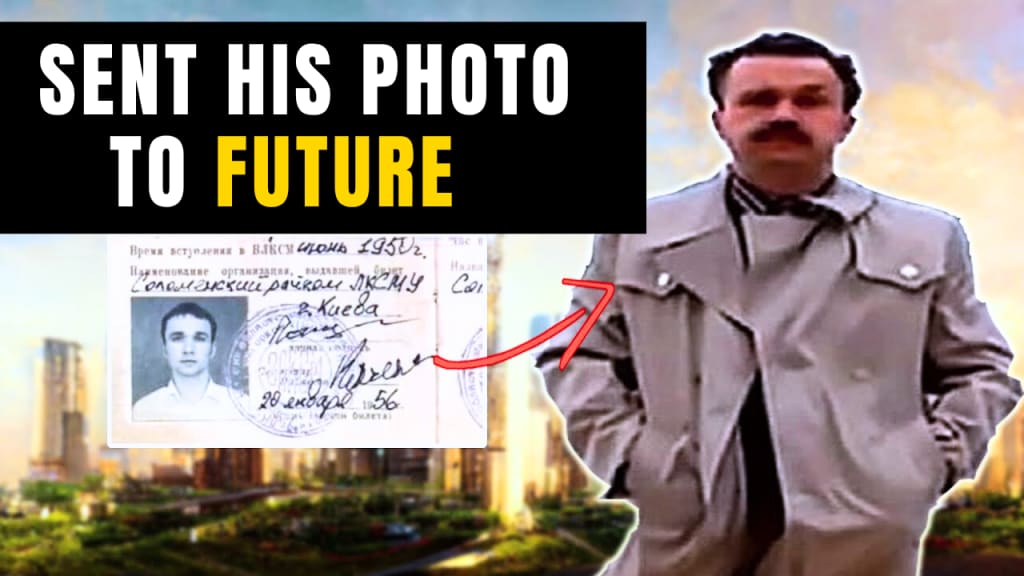
This story isn’t too old. Back in 2006, in Ukraine’s capital, a young man was found in a confused state. He was wearing old-fashioned clothes and had an antique camera dangling from his neck. People initially thought he was mentally unstable, but no one knew that he was about to become part of a time travel mystery.
A man introduced himself as Sergei Ponomarenko. When the police asked for his ID, it turned out to be from a country that no longer exists — the Soviet Union. Now, we all know Ukraine was once part of the Soviet Union, but by 2006, it had been over two decades since the USSR collapsed.
The police had seen Soviet-era IDs before, but something was odd — this man looked 20 to 25 years old, yet his date of birth was listed as 1932. Not only that, but the photo on the ID matched his current appearance. This didn’t make sense: how could someone born in 1932 look so young in 2006?
The police asked him the current date. After thinking for a moment, Sergei replied:
"April 23rd, 1958."
This convinced the police he might be mentally ill, so they took him to a mental hospital, where a doctor named Pablo Trifonov examined him.
Sergei himself seemed confused, not understanding what was happening. The doctor asked if he remembered how he had arrived in 2006 from 1958. Sergei explained that he had gone out during the day to take some photographs during a city walk, when he saw something strange in the sky. He claimed he had even taken a photo of it with his camera.
When asked to describe it, he said he couldn’t explain, but handed the camera over. The doctors were shocked. It was an old Yashimaflex camera, but in pristine condition, not looking like an antique at all. The real mystery was retrieving the photos — the film roll used in this camera had been discontinued in the 1970s.
An expert named Adam Poizner was called in. He examined the camera and confirmed the film roll was manufactured in 1956. When developed, the photos added even more confusion — they clearly showed Kiev from decades ago, including old cars, buildings, and signs — some of which had been demolished long ago.
There were also pictures of Sergei and a young woman — his girlfriend — in front of these buildings. He looked exactly the same in those photos as he did while sitting in front of the doctor. The last photo showed what looked like a UFO, just as Sergei had described.
At this point, the doctors had no choice but to consider that maybe — just maybe — Sergei had actually traveled through time. But before they could do anything further, Sergei vanished. He walked out of the hospital room, closed the door — and was never seen again.
All that was left behind was his camera, the photos, and his bizarre story.
Later, when police investigated further, they found that in 1960, there really had been a person named Sergei Ponomarenko who had gone missing. The woman in the photos was also found — now a 70-year-old lady — and she confirmed that Sergei had vanished in 1958 but reappeared shortly afterward, only to disappear again in 1960, never to return.
But the story didn’t end there. Years later, she received a photo of Sergei dated 2015. In it, he appeared older, and the background showed a modern city full of skyscrapers. A note on the photo said he would return soon, but for some reason, he never did.
This incredible story aired on a Ukrainian TV show and quickly went viral on the internet. But the question remains:
Was this story real?
Before answering that, let’s understand:
Is time travel even possible?
There’s no doubt that in one way, we’re all time travelers — moving one hour at a time into the future. But if someone could experience one hour in just 30 minutes, they would technically be ahead of the rest — in the future. This concept was introduced by Albert Einstein in his Theory of Special Relativity, which states that time in space is relative, not constant. It depends on mass and speed.
Just as oxygen levels vary by altitude, time behaves differently depending on where you are in space. For example, time on Earth is based on its mass and rotation speed. On Jupiter, which has more mass, time would pass more slowly.
The faster you go, the slower time passes. If we could travel in a spaceship at the speed of light for five years and return, only 5 years would pass for us, but 36 years would have passed on Earth. This difference is called time dilation.
To prove Einstein’s theory, the 1971 Hafele–Keating experiment was conducted using 12 atomic clocks. Clocks sent eastward in airplanes were found to be 59 nanoseconds behind, while those sent westward were 273 nanoseconds ahead, due to Earth’s rotation.
Gravity is another way to manipulate time, according to General Relativity. Higher gravity means slower time. In a 2010 experiment, two atomic clocks were placed at different heights — one on the floor and one 33cm higher. The lower one ran slower, because it experienced more gravity. Though the difference was small, it proves time can be affected by gravity — dramatically so near black holes.
This concept was shown in the movie Interstellar, where an hour near a black hole equaled seven years on Earth.
Even GPS satellites experience time differently because they orbit Earth at high speeds. Their clocks are constantly reset to stay in sync with Earth’s time.
So yes, theoretically, time travel into the future is possible. But in practice, it’s currently impossible — we can’t build spacecraft fast enough or get close to a black hole.
Now, let’s return to Sergei’s story.
This tale first aired in 2012 on a Ukrainian show called “Aliens”. In episode 3, titled “Time Traveler,” the story of Sergei Ponomarenko was shown. But viewers later found major loopholes:
- The CCTV footage from the hospital showed April 23, 2006 as a Wednesday, but April 23rd that year was actually a Sunday — indicating the footage was likely staged.
- Experts claimed the stamp on Sergei’s ID didn’t match the type used in that era.
- The 2015 photo of Sergei was analyzed, and many buildings in the background were duplicates, suggesting it was Photoshopped.
- No real police or hospital records exist to support the story.
- The “famous” Dr. Pablo Trifonov couldn’t be found anywhere online — suggesting he may not even exist.
So was it real? Most signs point to no — the story was likely created to boost TV ratings.
But the concept of time travel continues to fascinate. Confusion often arises from the idea:
“If time travel to the future is possible, then why not to the past?”
The problem is, traveling to the past creates paradoxes.
For example, if you travel 10 years into the past and stop yourself from building the time machine, then how did you get there in the first place?
This is known as the Time Travel Paradox.
In 2009, Stephen Hawking hosted a party for time travelers — but he only sent out invitations a year later. No one showed up. This was his way of showing that past time travel is likely impossible.
About the Creator
Keep reading
More stories from Jehanzeb Khan and writers in FYI and other communities.
A Failed Artist, A Disillusioned Poet, An Underpaid Game Show Host
I took my son and niece to Gori, a small town in Georgia where Joseph Stalin was born. They talked me into visiting the Stalin's Museum, the largest in the post-Soviet space. I had resisted going there because I just can't stand the monster and know enough about him, or so I thought.
By Lana V Lynx6 days ago in FYI
How Trial and Error Built the Foundations of Aviation
When we think about aviation today, it’s easy to picture sleek aircraft, precise engineering, and highly controlled systems that make flying feel almost routine. But the reality is that aviation was not born from certainty or perfect calculations. It emerged from trial, error, and relentless experimentation, often driven by individuals willing to risk failure again and again. The foundations of aviation were not built in laboratories alone they were shaped in open fields, improvised workshops, and moments of painful learning.
By Beckett Dowhanabout 5 hours ago in FYI
Bruce Lee and The God of War: Kuan Ti
It starts with love.. The Power to the God Of War and Wealth Walk into a Chinese restaurant (even in Oklahoma, USA), a Chinese police station, a kung fu martial arts studio or even a Chinese temple and you often see a red faced warrior holding a heavy quan-do (spear like weapon).
By WILD WAYNE : The Dragon King5 days ago in Chapters


Comments (2)
nice
amazing