
How I beat back the ghosts of the Moor
And Solved a Pesky Problem--for VV
Do you know your own mind? I've been living with mine for decades, and I'd like to think I have some sense of it, although I'm probably not objective. Let's try a more specific question: does your mind stick to the subject at hand, or does it "doff about"? In the film Shakespeare in Love, Lord Wessex says to Juliet, "How your mind doffs about!" I wanted to retort "And what's wrong with that?"
Mental doffing about, which is what I do, is responsible for some mighty important connections and discoveries. Think of the guy who figured out the benzene ring. He found that out not by reasoning but by meditating and imagining, in a word by doffing about. Do I know what the benzene ring is? No but Italian cars run on 'benzina,' so it must be important.
My story has two quick vignettes, a longer episode that connects them, and a surprising epilogue. First vignette: my grandmother's new German shepherd. I was with her three days after she got her new dog. She had previously taken on a dog the owner couldn't keep and really liked him, so she wrote to the same breeder to explain her need. Grandma lived alone near a penitentiary that had escapes. She wrote that she wanted a dog that would eat an intruder alive and ask questions later. A German shepherd was duly airlifted from the kennel in Manitoba and now he stood in the farmhouse kitchen.
'Paul I think this dog is afraid,' Grandma said to me. 'When someone comes to the door he backs up.'
I had drawn a very different conclusion from my first face-to-face with the canine. 'Grandma,' I ventured, 'I think he backs up just so he will have room to lunge.'
'Oh,' she mused. 'That's all right, then.'
Indeed it was. There was no trouble at the farm with that dog in charge of security. He was a master of deterrence.
And my suggestion is well aligned with the latest neurological models. It is slow-acting peptides that convey the chemical signal for the fight or flight response to the amygdala. The slight delay gave this dog the chance to reason, 'If I'm going to rip out this guy's throat I need to step back a bit.'
The next link in the chain interested me as a music prof. Vignette 2, graduate seminar presentations. How many singers in performances and how many speakers in my seminars got nervous, tight, high-pitched, quiet, squeaky voices when performing or presenting? A whole lot. Since I had solved the puzzle of grandma's German Shepherd, I thought I would think about performance anxiety in a different way.

What if, I thought, it's not nervousness but instead it's the phenomenon that has been casually identified as Celtic battle rage? What if it's like the stories of Cú Chulainn, the mythical Irish hero? Anne Williams writes that ''he defended Ulster from many threats with his unstoppable rage, inhuman strength, and iron will." Iron will sounds like a conscious decision, but not unstoppable rage. Unstoppable rage. So what caused the unstoppable rage? This was my scientific question. How did I get there? I made the connection just looking around at the students in my grad seminar, seven out of seven with Irish heritage, all of them speaking with taut vocal chords during presentations. You see the problem and the connection, I'm sure. Oh yes, and I myself have Irish heritage, five out of eight of my great grandparents.
And now to the main story. It was a summer trip to the Scottish Highlands that my wife and I took. It was thrilling. I saw my first Harrier jets take off and hover at the Inverness airport, where we rented the car, more luxurious than we planned on because we needed automatic transmission. I thought my AMEX card insured the vehicle but it wouldn't have been true for that Range Rover.
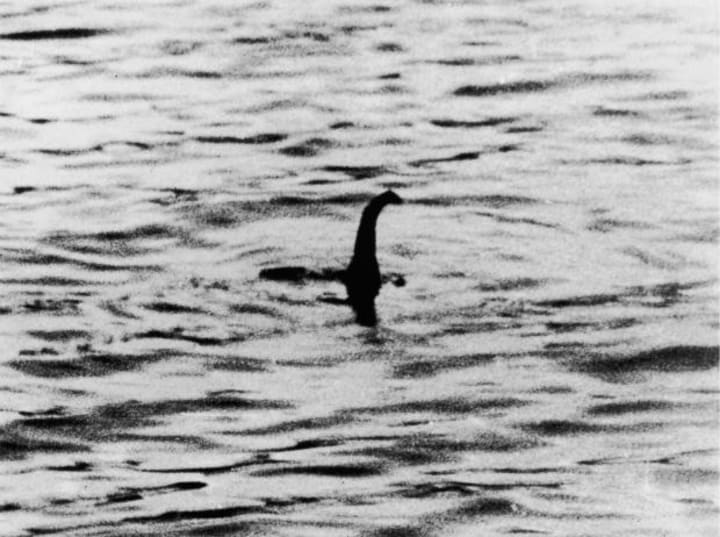
My very patient wife waited while I peered into Loch Ness (no monster in sight) and she even walked through the local museum with those military photos that clearly show something fishy in the Loch, so don't tell me Nessie is a myth. The medieval monks spotted her too, and there is the "Surgeon's Photograph" as well.
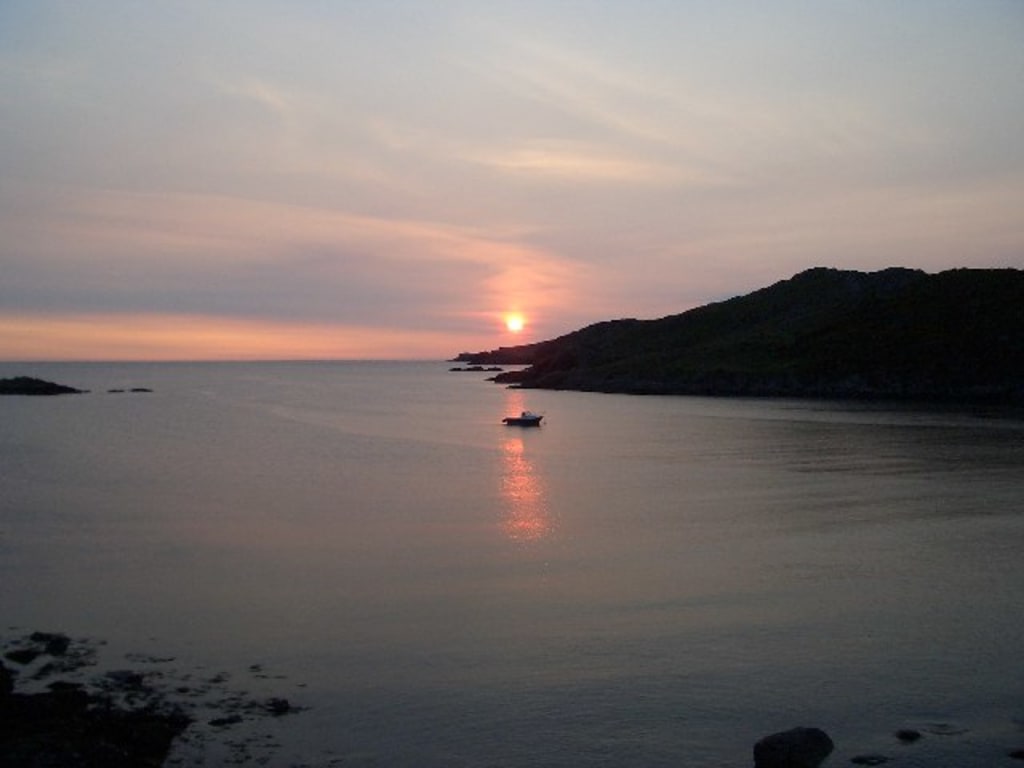
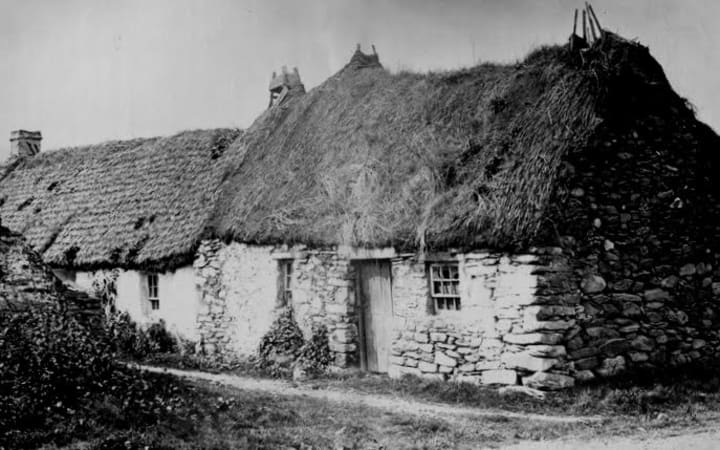
A friend was letting us stay in her cottage in Scourie, on the north coast (see the photo above). It was a crofter's cottage. There was little timber in the Highlands, and the soft stone can be split, so older buildings are made of stone and this was no exception. The crofters were given feudal concessions, narrow strips of land that went down to the sea. They could fish, farm the land, and fertilize it with seaweed. Their cottages were called 'Black Houses' because they burned peat for heat. Generally they had two rooms, one for humans and the other for their animals. That way of life came to an end in the late eighteenth century, when the Scottish lairds, who by then lived in London, realized that they could make more money off their lands by grazing sheep than by letting the property out to crofters. The Clearances, as that event is called, were brutal, often inhumane, as families who had lived in the same house for generations were evicted mercilessly so that their landlords could make more profit.
The Highlands are sparsely populated and only a few people live in Scourie. As I bought our provisions for the day, we wondered if I was disrupting the supply. How much milk had the store gotten in, and how much cheese? How carefully had they calculated? There were some pointedly angry remarks made in my direction in the village. I put it down to anti-American sentiment and the luxury car.
We toured during the day, climbing up the stone paths to burial cairns, exploring a smugglers' cave, and getting the car buffed by a herd of sheep when the shepherd drove them across the highway. We stopped and wondered what would happen. The car was softly cleaned with white wool.
There were striking castles, beautiful coastal scenes (see above) and there was a mobile lending library that we passed twice on the loop road. When it was dark we settled into the crofter's cottage for the night.
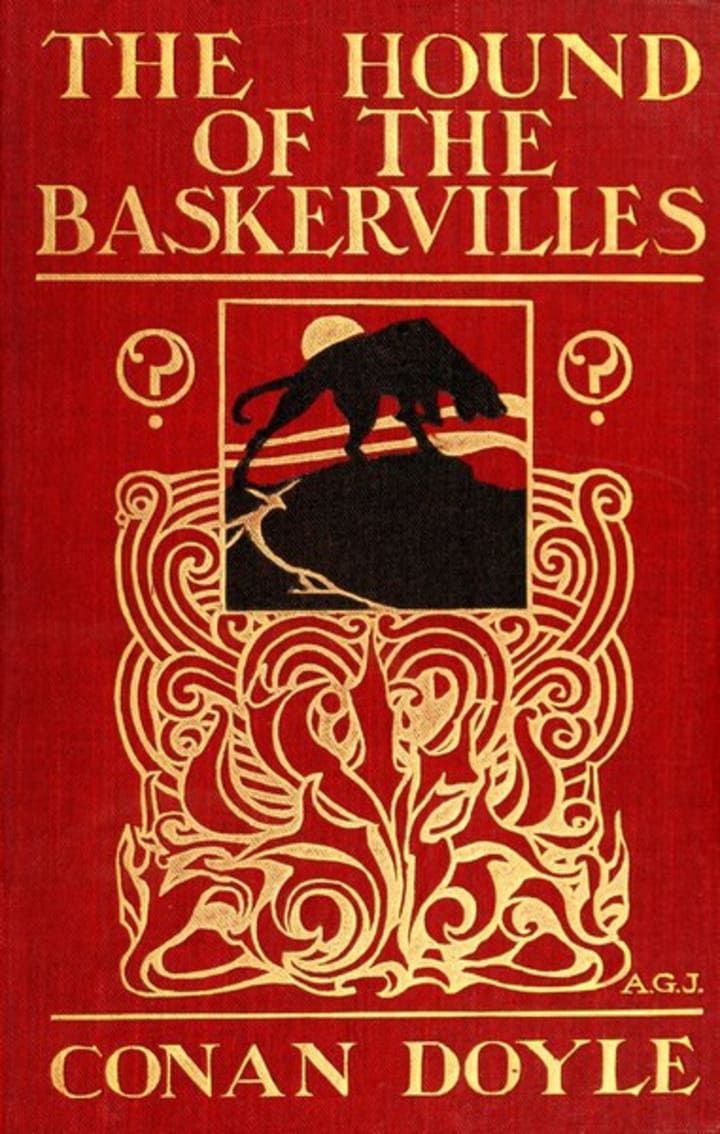
I had brought the Sherlock Holmes story of the Hound of the Baskervilles. What an idiot I was. When I finished reading it out loud, every strange sound of the wind whistling around the stone walls seemed menacing.
We were both freaked out. We had parked the car partway down the hill and my wife was convinced someone was breaking into it. Then she heard eerie sounds of singing outside the cottage. I refused to go out to look. Her hearing was several notches more sensitive than mine.
'It must be just the wind,' I said.
'No, he is singing a tune,' she replied.
I owed my father a phone call. That should calm us down, I thought, so I telephoned him in Toronto. He laughed about our situation. 'It sounds like the Hound of the Baskervilles,' he remarked, 'and that was one big Hound!'
Great, we thought, how can we calm down now? 'If they're stealing the car, we should call the police,' my wife offered. Did I mention she was a genius? Well she was.
That made sense to me, so I did, much to the amusement of the Scottish police. 'Where are they going to go with a stolen car?' the constable asked. 'This is an island.' Click.
Plenty of adrenaline was flowing, and each of us was making the other worse. Traditionally, in these situations, it falls to the man to confront the actual intruder. More than once I had been sent downstairs in our house to fight an imagined burglar. Waking up, halfway down the stairs, I sometimes wondered what I was supposed to do if there was an armed burglar. Speak to him sternly? I supposed that must be it.
Well, as my fears grew and grew that night, I realized that I probably did believe in ghosts. A human enemy was one thing, but it was not hard to imagine that some spectral form might invade the house. Just as creatively as the man who found the benzene ring, I hit on a solution. 'We're going to bed,' I said.
'What?' she asked in disbelief.
'We're going to bed. I'm grabbing every walking stick in the house, and anything that comes through the door, mortal or a ghost, I'm going to beat it to death with the walking sticks!'
I think she had too much nervous exhaustion to argue. She fell asleep right away. As for me, I collected four stout sticks, sat up in the bed, and stared fixedly at the doorway. My back was against the thick stone wall. It was a barricade centuries old, impenetrable. Suddenly, I relaxed. I realized that I could not be attacked from behind. Surely no ghost could penetrate those stones. An enemy in front of me I could make short work of. I straightened up and noticed my breathing slow and my determination grow.
Little by little my analytical mind kicked in, starting to question the hysteria of the amygdala. Oh and you, Reader, thought I didn't have an analytical piece to my mind. Oh you lose ten points for saying that...
Thought by thought the analytical part climbed that emotional ladder. Determination to go to bed and solve everything from that vantage point. That sounded a little like iron will.
Beating someone (or a ghost) to death with a walking stick. Impractical, but it does sound like rage, maybe even unstoppable rage? I was a mini-Cú Chulainn, defending my wife in this cottage. I was a German shepherd with a triggered amygdala, preparing to lunge. And, interestingly, the effects were going away thanks to a stone wall. No attacks could come from behind...
It took just a few minutes for me to fall asleep, and sleep soundly. In the morning I wondered what the walking sticks were doing in bed...
In daylight we knew the sounds were just the winds on the Moor. I checked on the car and saw it was fine. We went on with our trip.
Epilogue: Back home
That fall I again taught a grad seminar with presentations. The first presenter was a singer, Siobhan McMullin. She spoke with a weak, tremulous voice. 'You sound shaky,' I said.
'I'm nervous,' she said.
'Is it like this when you sing in public?' I asked.
'Always,' she said.
'I don't think you're nervous,' I said, 'I think you have Celtic battle rage.'
'What?' she asked. I had it admit that was a good question.
'Stand with your back against the wall, touching the wall,' I said.
She did so, and started to speak. The tone was full, resonant, and it carried.
'Sing something.'
She complied. Her voice was lovely, expressive, rich. 'Is that different?' I asked.
'Night and day!' she exclaimed.
'Okay, you have to learn to create the feeling of that wall behind you. That way you will be sure that no one can sneak up behind you.'
'What did you call this?' Siobhan asked. 'This out of control feeling?'
'Celtic battle rage,' I answered.
'But how did you know I am Irish?' she asked.
So there it is, Gentle Reader, you need never again speak or sing with a pinched voice, because my mind doffs about.
About the Creator
Paul A. Merkley
Mental traveller. Idealist. Try to be low-key but sometimes hothead. Curious George. "Ardent desire is the squire of the heart." Love Tolkien, Cinephile. Awards ASCAP, Royal Society. Music as Brain Fitness: www.musicandmemoryjunction.com
Keep reading
More stories from Paul A. Merkley and writers in FYI and other communities.
Oil Prices and the Hidden Struggles Behind Global Energy
Oil prices influence daily life in ways many people rarely notice. From the cost of gasoline at the pump to the price of food in grocery stores, shifts in oil prices ripple through the global economy. A sudden rise can strain family budgets, while a sharp drop can shake entire industries. Behind these changes are complex forces such as political tension, supply shortages, economic growth, and environmental concerns. Yet for many people, oil prices remain a distant headline rather than a personal story. The truth is far more connected to everyday life. Understanding how oil prices move, why they change, and who feels the impact most can reveal a deeper picture of the modern world and the fragile balance that keeps global energy flowing.
By Muqadas khan4 days ago in FYI




Comments (2)
Best of it
Nicely done it