
How Healthcare Goes Digital with Integration of AI Technologies
Why AI Is the Catalyst for Next-Gen Healthcare Transformation

Introduction
The healthcare ecosystem is rapidly evolving toward a more sustainable and connected future. In this evolution, AI in healthcare has emerged as a key pillar of medical innovation in the 21st century. One of the leading transformative fields of AI is in medical diagnostics, where AI can provide the most accurate and efficient outcomes.
AI diagnostic tools developed from advanced machine learning (ML) and deep learning models can process large amounts of clinical datasets in a matter of seconds. Thus, AI in diagnosis will provide faster, more profound, and more actionable insights to healthcare providers in treating patients, and therefore can reinforce clinical decision-making.
The impact is also reflected in market growth. The global AI in medical diagnostics segment, valued at $1.33 billion in 2023, is expected to reach $4.72 billion by 2029.
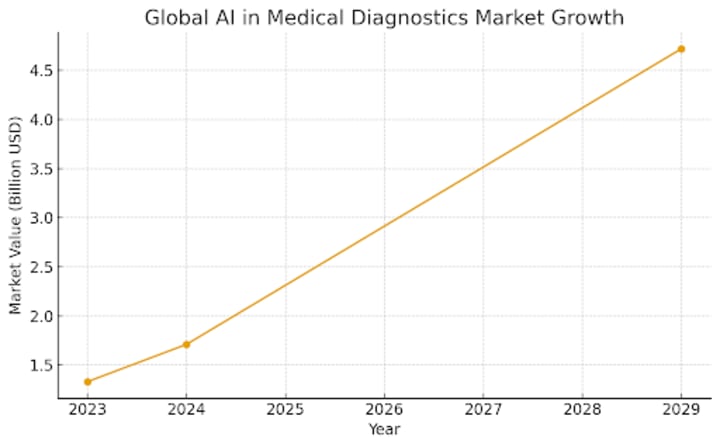
The statistics above clearly illustrate the pace at which AI is moving from the experimental to a key part of digital transformation in healthcare. This will assist not only in diagnostic capabilities but also in earlier detection and more personalized treatment. Given all the nuances in this area, this blog will give readers a frank and pragmatic view of the advantages and challenges associated with incorporating AI into healthcare.
The Role of AI in Modern Medical Systems
Medical diagnostics is undergoing a radical turning point where high-tech and smart technologies are redesigning the workflow of clinical assessment. One of these healthcare digital transformation innovations, which is transforming the accuracy and speed of patient care, is AI-driven diagnostic systems.
These systems detect finer patterns that exist within large clinical datasets, which are impossible to detect with human examination. Consequently, to improve patient outcomes, decrease the burden on hospital personnel, and steadily increase diagnostic accuracy, hospitals and clinics are implementing such tools.
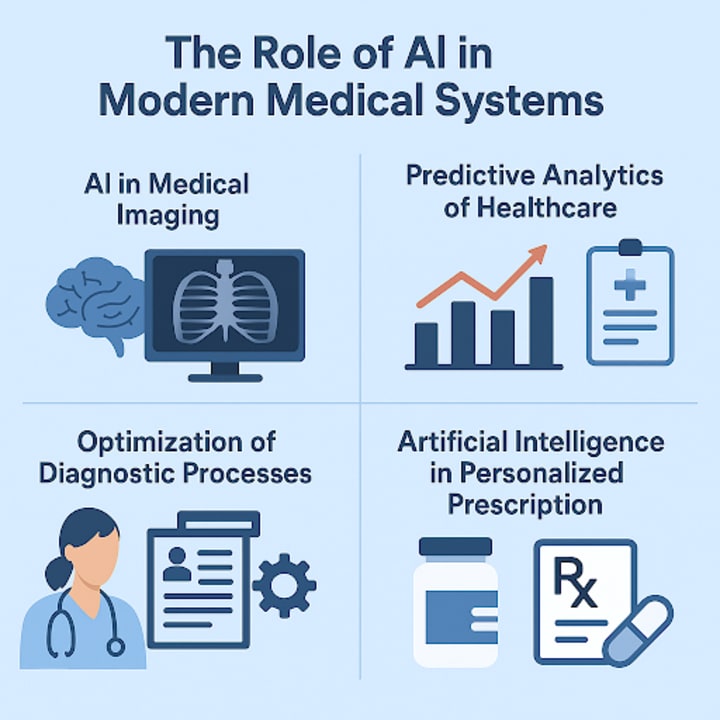
Some of the most influential healthcare workflow automation developments that changed the world of diagnosis are listed below:
1. AI in Medical Imaging
Intelligent imaging analysis is a significant upgrade in radiology, pathology, and other fields. This healthcare automation enhances the interpretation of X-rays, MRIs, and CT scans, enabling the detection of diseases at an earlier stage.
As an example, sophisticated models can analyze the mammograms with impressive precision- often doing better than the manual examination. This identifies early signs of breast cancer and results in more rapid interventions and a much-improved prognosis.
DeepMind Health and other AI tools can also scan retinas to diagnose diabetic retinopathy, which is one of the most common causes of blindness. These systems can detect complications at an early stage, which prevents severe, long-lasting complications.
2. Predictive Analytics in Healthcare
Predictive analytics can be used to forecast the development of diseases and risks that may affect a patient. These systems predict potential health problems with a high level of precision by examining a wide range of clinical variables.
In one instance, models assess vital signs, laboratory findings, lifestyle statistics, and the environment to determine the early signs of worsening conditions. This provides clinicians with a crucial head start when responding to the situation before it deteriorates.
This intelligence is also transferred to genomics. Genetic patterns of hereditary disorders are easily identified using a modern analytical engine.
3. Optimization of Diagnostic Processes
The application of AI in healthcare for medical diagnostics is already supporting treatment closely, combining and interpreting varied clinical data in an exceptionally accurate way.
Multimodal Data Integration
AI combines imaging files, lab reports, and patient history into a single integrated analysis. The old records are scattered throughout the documents, PDFs, and pictures. AI removes irrelevant data immediately, providing medical staff with more precise and practical data.
AI Symptoms Checker
Smart symptom-checking machines compare patients' reports with large medical databases. These platforms will identify cross-disciplinary patterns as opposed to specialists who focus only on limited areas, resulting in lower accuracy and a higher chance of misdiagnosis.
4. Artificial Intelligence in Personalized Prescription
Personalized care is becoming increasingly accurate as AI healthcare solutions
are becoming more refined in the creation of treatment plans. These systems maximize the effectiveness of therapies by examining genetics, medical history, and lifestyles.
Targeted Medications
AI forecasts how a patient will react to specific medications and adjusts dosage-controlling mechanisms to achieve improved treatment results.
Precision Imaging
Deep learning models identify subtle disease features in MRI scans and pathology slides, thereby improving the quality of clinical decision-making.
Data-driven Cancer Therapy
Platforms such as Tempus and IBM Watson for Oncology analyze genomic and clinical datasets to match patients with optimal cancer treatments based on genetic markers and tumor signatures.
AI is transforming overall healthcare automation by enabling it to be quicker, more accurate, and much more personal. These technologies will continue to advance modern medicine by improving patient care and clinical outcomes.
How AI Improves Diagnostics and Patient Monitoring
The healthcare sector is embracing digital transformation with AI. Medical diagnostics are becoming more accurate in treatment, quicker in decision-making, and reducing healthcare operational costs with the help of AI.
Hospitals can process a large volume of data, perform predictive analytics in healthcare to diagnose diseases at an earlier stage, discover the most promising therapies, and automate end-to-end clinical workflows. This is how this change is making a tangible difference.
1. Increased Diagnostic Accuracy
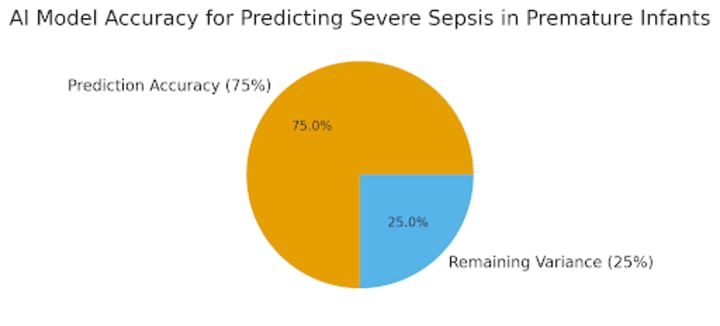
AI-based algorithms analyze the outcomes of imaging, laboratory reports, and clinical notes to identify hidden trends that are usually overlooked. This helps to make earlier and more accurate diagnoses that are already enhancing daily practice.
An AI model, supported by IBM, predicts severe sepsis in premature infants with 75 percent accuracy in neonatal care. This is because early detection will provide clinicians with an invaluable edge, as it will reduce the chances of life-threatening complications.
2. Faster Diagnosis and Turnaround Time
AI significantly reduces the time spent on interpreting tests and image data. Formal processes can be time-consuming, from hours to days; in Big Data, information is ready in minutes. This is of high priority, particularly in emergency cases where the speed of response can save lives.
It is also through AI that genomic interpretation can be accelerated, enabling clinicians to diagnose genetic diseases or mutations that are associated with cancer much earlier. These features allow a more focused and quicker diagnosis with a close analysis of the individual patient.
3. AI for Clinical Decision-Making
Smart platforms provide physicians with evidence-based decision support by assessing collections of medical publications, treatment guidelines, and past treatment history. They emphasize the most successful treatments based on a patient's genetic records and symptoms.
In challenging cases where multiple options are available, AI can be used to weigh the risks, benefits, and the probability of success of each option. To ensure smooth integration of these tools into care processes, organizations that adopt them typically consult AI development services to implement them without difficulties.
4. Cost Reduction in Healthcare
AI in medical diagnostics helps reduce healthcare costs by boosting efficiency and minimizing medical errors. Billions of dollars are spent annually on unnecessary tests. To address these problems, administrative inefficiencies and medical errors must be fixed.
Automation of administrative activities will lead to reduced paper usage and human errors, and streamlined processes in hospitals. Artificial intelligence-based virtual assistants also respond to questions posed by patients, schedule appointments, and offer some simple tips, easing the burden on medical personnel.
Challenges and Ethical Considerations for AI
As AI in healthcare transforms the diagnosis and personalized treatments. It comes with multiple challenges. The risks of ethical issues, data security, and bias of AI models should be addressed to achieve fairness and trust. These are the main challenges and factors.
1. Risks of Data Privacy and Security
AI relies heavily on a lot of patient data to operate efficiently. Yet, the process and storage of sensitive health data increase the likelihood of cyberattacks, data breaches, and unauthorized access. This could result in identity theft or misuse of personal medical records due to a violation.
Healthcare professionals must adhere to stringent regulations, such as the GDPR and HIPAA, to protect the privacy of patients. These regulations establish a system of accountability and safety of patient data. High-level encryption, access control, and anonymization methods can also be used to ensure the safety of sensitive information.
2. Bias in AI Algorithms
The AI models are based on historical data, and in case the information is not balanced or complete, then the system may produce biased results. It means that AI will be effective in relation to one group but not the other, increasing healthcare disparities.
As an example, an AI in a medical diagnostics tool is mostly trained on data of one group of people; it cannot recognize diseases in groups that are underrepresented. Such bias can lead to incorrect diagnosis and a lack of quality care.
3. Lack of Transparency
Many AI models still function as “black boxes,” where clinicians receive predictions or recommendations without understanding how the model arrived at those conclusions. This lack of interpretability creates hesitation among healthcare providers when diagnosing critical cases. Without visibility into the decision logic, accountability, trust, and clinical adoption become major hurdles.
Building transparent, explainable AI is now a priority for teams driving healthcare innovation. Organizations are increasingly hiring AI developers who can create models with clear audit trails, interpretable layers, and outcome justification. This ensures that AI systems support physicians rather than introduce new risk vectors.
4. Challenges with Data Quality and Variability
AI’s effectiveness is only as strong as the data it processes. In reality, healthcare data is fragmented, distributed across unstructured notes, PDFs, imaging systems, handwritten prescriptions, legacy EHRs, and inconsistent formats across hospitals. This inconsistency makes it difficult for models to generalize across diverse clinical environments.
For example, an AI system trained primarily on structured EHR data may perform poorly when exposed to handwritten notes, scanned lab reports, or patient histories captured through older systems. Such variability impacts prediction accuracy, delays deployment, and drives up project costs.
Healthcare organizations are increasingly partnering with experts in healthcare application development services to clean, unify, and standardize datasets before model training. By establishing high-quality data pipelines, they reduce bias, improve model performance, and accelerate real-world adoption.
Wrapping Up
AI is dramatically changing the fundamental ecosystem of modern diagnostic processes in healthcare. AI healthcare is not about replacement; it is about enhancing human performance. AI provides medical teams with tools that enhance clinical decision-making by improving the speed of diagnostic assessments, offering personalized treatments, and facilitating preventive care. This transformation enhances patient outcomes, reduces workflow challenges, and establishes a better proactive healthcare approach. As healthcare providers modernize their digital infrastructure and integrate AI-powered solutions, there is a need to hire app developers with deep expertise in innovation to build scalable, compliant, and future-ready medical applications.
About the Creator
Nathan Smith
Nathan Smith, Technical Writer at TechnoScore, excels in software docs, API guides, and UX. Skilled in HTML, CSS, JS, JIRA, and Confluence, with expertise in DevOps, AI/ML, QA, Cloud, App Development, and Staff Augmentation services.
Keep reading
More stories from Nathan Smith and writers in FYI and other communities.
How Advanced WordPress Design Practices Elevate Accessibility and User Experience
Accessibility can no longer be a compliance box in the modern digital environment because it has become a brand differentiator. With the digital ecosystems of organizations developing, WordPress accessibility has been recognized as a primary source of user retention, inclusivity, and conversion rates. An easy-to-use interface makes sure that all visitors, regardless of his or her devices, capabilities, and limitations, will find the interface equally convenient to use.
By Nathan Smith3 months ago in FYI


Comments
There are no comments for this story
Be the first to respond and start the conversation.