
How Hawaii Was Stolen by the US
The story of how the United States took over Hawaii.


The ocean floor split open forty million years ago, letting molten lava pour out. As it collided with the chilly ocean water, it cooled and solidified, ultimately forming mountains in the water. These mountains continued to grow in height, and eventually a chain of islands emerged.

Then, in canoes, a group of people made their way to these islands some 2000 years ago. These groups eventually unified into the Kingdom of Hawaii, an independent country in the center of the Pacific Ocean. Hawaii developed into a language, a culture, and a distinct national identity, but its sovereignty, culture, and identity were quickly taken by a new, larger country across the ocean.

There was no land here for millions of years, just the ocean. Before individuals showed up, the Kingdom of Hawaii was a quite isolated, undeveloped nation for a long time. Many travelers from Europe and the United States visited Hawaii throughout the 1700s and 1800s, mostly on ocean exploration trips. However, the majority of those who stayed were Americans who traveled to the islands with the intention of sharing their faith in Jesus. The Kingdom of Hawaii often accorded these tourists a warm welcome. One time a British flag was given to the Hawaiian King by a British explorer, and Hawaii later adopted the British flag as their own flag. Here, everyone got along well and was kind. After having children and grandchildren, the American missionaries who had established themselves on the island found that they were no longer only engaged in preaching about Jesus. They had a keen interest in starting enterprises, mostly in the sugar industry.

These Americans, who had originally come as missionaries, became much more interested in sugar as a result of this heightened economic interest, and they did what people of European descent have been doing for many centuries—looking at a culture and a system of government that differs from their own and saying, "We think we could do this better, let's take it from here." As a result, during the 1800s, these Americans gradually undermined the Hawaiian political system. In this long-established island country, they were still strangers. They possessed little authority. But that rapidly changed.
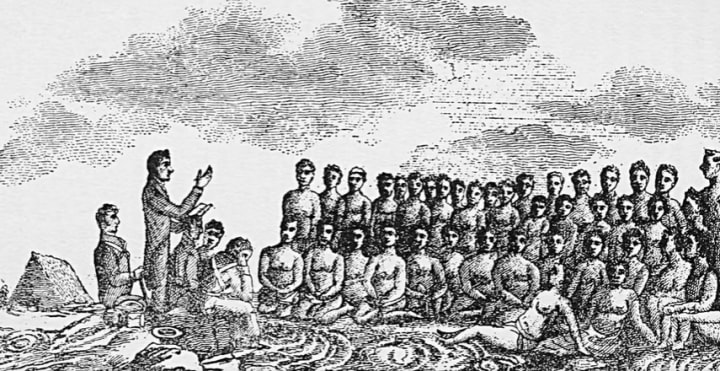
The original missionaries who had come to the island to convert people to their religion years earlier now had grandkids that looked like this. By the end of the 1800s, these Jesus sugar Americans had amassed a significant amount of Hawaii's wealth, and they were eager to remove the government so that they could run the country themselves and help make it more favorable for their own. Keep in mind that these men were born in Hawaii. They identified as Hawaiians. However, they continue to have loyalty for the nation of their ancestors. Practically speaking, they remained Americans. By 1893, Queen Liliʻuokalani's administration, which at the time was led by this local white militia, was poised for a full-scale takeover by their political supporters. Although still a minority, the sugar missionaries would have had a difficult time overthrowing the government on their own. However, they were fortunate to have assistance.

At the time, the American ambassador to Hawaii assisted in organizing the landing of an American military ship and troops in Honolulu, the island of Oahu's capital. Up until this moment, the war in Hawaii was considered to be internal since it involved native Hawaiians and white missionaries who were also considered to be native Hawaiians because they were born there. However, as soon as the US landed in Honolulu to offer military support for a coup, it turned into a full-scale military coup supported by a foreign power, which is a cardinal offense in international relations. However, the overthrow was still supported by the administration. The new Republic of Hawaii's leader was chosen to replace the queen after she was made to relinquish her position. Sanford Dole was the man's name. The sugar industry was dominated by his family. He now served as the president of Hawaii.

Although they did it quietly, the villagers fought back. They protested. A petition opposing the takeover was signed by almost every adult on the islands. There was a discussion over what to do with Hawaii back in Washington, DC. After a group of pro-American missionaries who later became sugar warriors gained control. Dole personally traveled to Washington, DC, to advocate for the US to annex Hawaii. However, some local Hawaiians also took action to protest the American invasion. The deposed queen demanded in a letter to be reinstalled as the rightful ruler of the Kingdom of Hawaii. Before 1898, when the new president surrounded himself with figures who seemed to like war and American expansion, the country was divided about what to do. This was the deciding factor in Hawaii's fate. A superpower with more powerful weapons and an insatiable desire for control stomped on all of the Hawaiian people's displays of vehement, peaceful protest.

The Kingdom of Hawaii's flag was lowered and raised when the US arrived on a summer's day in 1898. It was now official that the United States of America owned Hawaii. These islands had been taken from their inhabitants and given to a rising superpower with the aid of these sugar-loving missionaries. Theft of land is another matter, though. What followed was the actual theft. Even though Hawaii was still still a US territory at this point and not a state, the US started systematically destroying the Hawaiian way of life. Hawaiian was not allowed in schools, and by law, all government and corporate communications must be in English. The US started to develop property, often on sacred sites. To provide the impression that the Hawaiian people accepted the US without resistance, the history itself was also edited. Because it was only recorded in the Hawaiian language, which was in danger of extinction, a large portion of true history became unavailable. Then, in 1959, Hawaii was admitted to the union as the 50th state, and it developed fast into the location it is today.

The Dole food company, which may have benefited the most from this land grab, has grown into a major international conglomerate since then. Hawaii officially became a member of the US by 1993. President Bill Clinton issued an apology during that year. A formal apology to the people of Hawaii was signed by President Clinton at the White House. He was expressing regret on behalf of the US government for its role in the violent overthrow of the independent Hawaiian monarchy 100 years ago. There is some hope here, despite this appalling land grab and the plundering and theft of these islands. Even after the takeover, there was still a spirit of nonviolent dissent similar to the one that inspired petitions and demonstrations in 1893. With proper effort, the Hawaiian language has been delicately preserved. Public schools now offer Hawaiian as a first language. Hawaiian traditions have persisted. Hawaiians showed their unwillingness to give up their sacred sites. They defend a Holy mountain that was going to be developed on, they put on a dramatic protest. Although attempts were made to eradicate Hawaii's culture and the island may have been taken by the Imperials, many important aspects of this lovely culture have survived.

About the Creator
Keep reading
More stories from writers in FYI and other communities.
“It’s All About the Land”: Japan Suspends World’s Largest Nuclear Plant Hours After Restart
Japan’s energy strategy faced renewed scrutiny after authorities suspended operations at the world’s largest nuclear power plant just hours after it was restarted. The sudden halt reignited public debate around nuclear safety, land stability, and Japan’s long-standing struggle to balance energy security with environmental and seismic realities. While officials cited technical and safety concerns, critics argue that the deeper issue remains Japan’s geography itself—fragile land in one of the world’s most earthquake-prone regions.
By Fiaz Ahmed 6 days ago in FYI



Comments (1)
Mahalo for writing your first story on Vocal about the theft of Hawaiian sovereignty. It is a story not widely known (or cared about). Aloha pumehana.