
How does in-flight WiFi work?
In recent years, the service of providing Internet on airplanes via WiFi connection has become increasingly popular. Have you ever wondered how WiFi is available on airplanes?

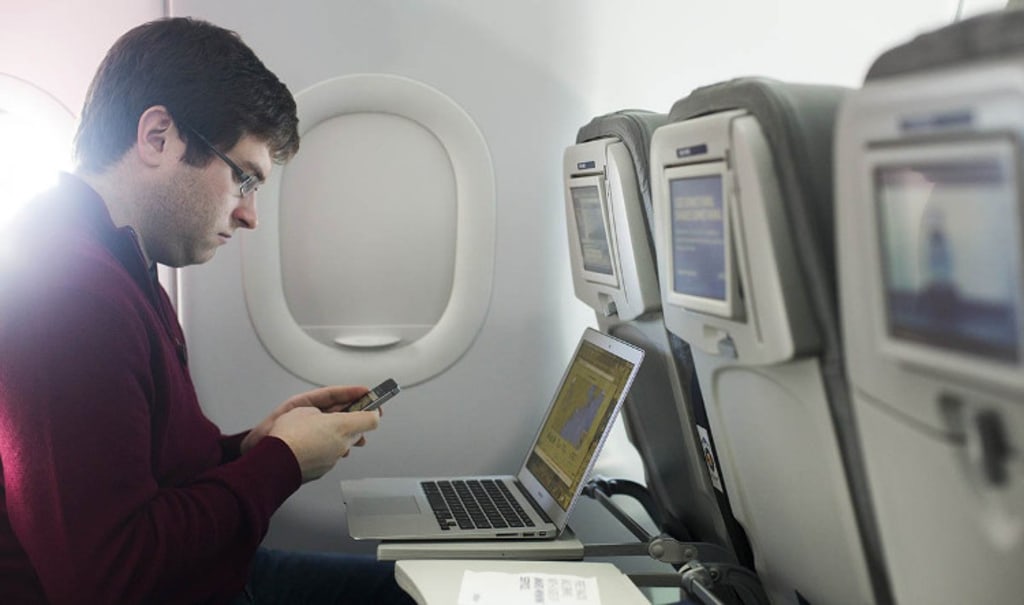
In recent years, the service of providing Internet on airplanes via WiFi connection has become increasingly popular. Have you ever wondered how WiFi is available on airplanes?
As explained by a former employee of the solution provider on Quora, there are two main methods of providing internet on planes: satellite signals and ground-based signals.

There are two ways for planes to connect to the internet: using ground signals (pictured above) and satellite signals.
Ground signals are signals that connect directly between the aircraft and the antennas on the ground. There are a series of transmission stations on the ground, similar to the BTS stations of mobile services but much larger. The receiving antennas are placed under the belly of the aircraft, and when the aircraft flies over different areas, the connection will be transferred (handoff) between the transmission stations, much like a mobile phone. Users will not feel the delay when transferring.
The disadvantage of this technology is that it is relatively slow.
Installing base stations this way is much cheaper than using satellites, but there are limitations in speed and geography. The current maximum speed, such as Gogo's ATG4 service, is only 9.8 Mbps shared among all passengers. At this speed, users can only check email or surf the web lightly, but it is difficult to watch online videos. In addition, the base stations are located on the ground, so this form cannot be used for transcontinental flights. Ground-based signal Internet is mainly applied to domestic flights in the US, currently equipped on about 1,000 aircraft.
Satellite broadcasting is a method of using satellites orbiting the Earth to broadcast signals to aircraft. The satellites orbit about 16,000 km above the ground, and the signals are received by antennas on the fuselage of the aircraft. Currently the best solution provides speeds of about 20 – 40 Mb/s per aircraft, depending on the number of aircraft in use within the satellite range. In the near future, Ka-band broadcasting satellites may provide higher speeds.

A technician installs a satellite communications module onto a Boeing 747.
In addition to high speeds, satellite signals are also the only way to provide internet for flights over the ocean. When flying, the antenna on the plane will automatically change direction to connect to the satellite, and when the flight area is too far, it can switch to a signal from another satellite.
There are two disadvantages to using satellite signals . First , the latency is higher because the signal has to pass through a satellite at an altitude of more than 10,000 km, and the connection to another satellite will also affect the connection, unlike roaming between transmitters. The second disadvantage is that the price is much higher, because the price of renting a satellite is already very high. This leads to very expensive internet prices on planes.
On the plane, WiFi access points (WAP) will broadcast to users' phones, laptops... The number of WAPs depends on the size of the plane, large planes can have up to 6 WAPs. In the past, when WiFi was not popular, planes even had Ethernet ports to plug in computers, but now WiFi is enough for most users.
Despite significant advances, there is still a gap between in-flight and ground Wi-Fi .
“The biggest difference with in-flight Wi-Fi is the complexity of the mobile element. Aircraft often travel at high speeds and over large geographic areas, which requires consistent coverage for a high-quality in-flight connectivity experience,” Don Buchman, vice president and general manager of commercial aviation at Viasat, told CNN.

There is still a certain gap between in-flight Wi-Fi and ground Wi-Fi.
While satellite signals solve some of the limitations faced by cell phone towers, expanding satellite networks to keep up with growing demand is not always simple.
"It's actually much faster and cheaper to deploy new cell towers than it is to launch satellites on rockets ," Jeff Sare said.
According to CNN, representatives of Delta and United airlines said they provide more than 1.5 million in-flight Wi-Fi sessions each month, while JetBlue said their service is used by " millions of customers" each year.
But with a market currently estimated at around $5 billion and expected to grow to more than $12 billion by 2030, according to research firm Verified Market Research, there's still plenty of potential to tap.
In an Intelsat survey last year of airlines, service providers and equipment manufacturers, 65% of respondents said they expected the number of passengers wanting to stay connected while flying to increase.
The two biggest obstacles to increased in-flight Wi-Fi use, the survey found, are high service prices and “poor Internet connectivity.”
To address the problem, service providers like Viasat, Intelsat, and Starlink plan to continue expanding their deployment capacity by launching more satellites each year.
What is Wifi?
To put it simply, Wifi, a wireless Internet connection network, is an abbreviation of Wireless Fidelity, which uses radio waves to transmit signals. This type of radio wave is similar to that of telephone, television and radio waves. And most electronic devices today such as computers, laptops, phones, tablets... can connect to Wifi.
How Wifi works
To create a Wifi connection, a Router is required. This Router takes information from the Internet via a wired connection and converts it into a radio signal and sends it. The wireless adapter on mobile devices receives this signal and decodes it into the necessary data. This process can be done in reverse, the Router receives the radio signal from the Adapter and decodes it and sends it over the Internet.
About the Creator
Ken Daklak
Telling stories my heart needs to tell <3 life is a journey, not a competition
If you like what you read, feel free to leave a tip,I would love some feedback
https://s.shopee.vn/VwwLTGLe9
Keep reading
More stories from Ken Daklak and writers in FYI and other communities.
Why the SaaS Business Model Is Under Pressure in 2026?
In the 2010s, SaaS felt inevitable. Founders pitched recurring revenue. Investors rewarded annual recurring revenue multiples. Customers preferred subscription access over upfront licensing. Cloud infrastructure made deployment frictionless. The model seemed superior to everything that came before it.
By Nick William4 days ago in FYI
I wanted to title this something different, but worried that my chosen title might cause problems entering the United States in the future so this is the new title. It's the greatest title. No one has ever written a title better than this. (All titles unrelated to content).
Let me be honest. I am finding this difficult. Now, I like a challenge, a stretch, a bit of an obstacle course. “Write about the decline of the British Empire in the form of a narrative poem in which your protagonist is an artichoke” I read, and flex my fingers. “Write a haiku to evoke the sensation of sibilance using only the first half of the alphabet.” “Well”, I think to myself, “this should be fun.” But “write about a system that isn’t working”? A system that isn’t working? Now? In 2026? ONE system? My favourite system that isn’t working? The sexiest system that isn’t working? The one giving me the most angst day to day? The one giving me the most existential dread? I am, as I say, finding this difficult. I will own that I have contemplated writing a thousand words on why the steady “all on” setting on my fairy lights is the EIGHTH of seven options which must be sequentially activated to get there, because that is a system that some fool came up with and it definitely doesn’t work, and now who is paying the price, eh? But how can I write about my fairy lights when…. When…. When….
By Hannah Moore5 days ago in Humans




Comments
There are no comments for this story
Be the first to respond and start the conversation.