
How Computer Vision is Redefining Security Surveillance Systems?
Exploring AI Video Surveillance: The Future of Real-Time Threat Detection and Security


Surveillance has become omnipresent. From smarter cities to offices and parking lots, intelligent security systems have changed how spaces are kept and monitored. Moreover, with AI and computer vision, these systems not only monitor us but also analyze the environment in real time, detecting (even predicting) potential threats faster than any human could. Consequently, organizations are chasing AI security cameras and intelligent security systems.
The numbers point to a similar reality: AI in the video surveillance market is expected to reach over USD 12.46 billion by 2030 and over USD 58 billion by the end of 2035.
As more and more organizations embrace these innovations, it's crucial to consider: Are we truly enhancing security, or are we compromising the very freedoms we aim to protect?" This blog explores AI-powered, computer-vision-based security surveillance and how this development is changing the security space.
Shift from Traditional CCTVs to AI Video Surveillance Systems
Traditional surveillance cameras have long been the standard for security monitoring, primarily to record live video streams for later review. However, these systems lacked real-time analysis and the capabilities to detect and respond to threats. CCTV cameras also require consistent monitoring of footage, which can lead to fatigue and an increased risk of missing minute details in real time.
Today, AI video surveillance systems have replaced these older setups, offering real-time data analysis, rapid threat response, and proactive security. AI introduces intelligent capabilities that enable these systems to detect unusual activities, alert operators, scan beyond the visible, and eliminate the need for constant manual review.
How Computer Vision Works in AI Security Cameras and Video Surveillance Systems?
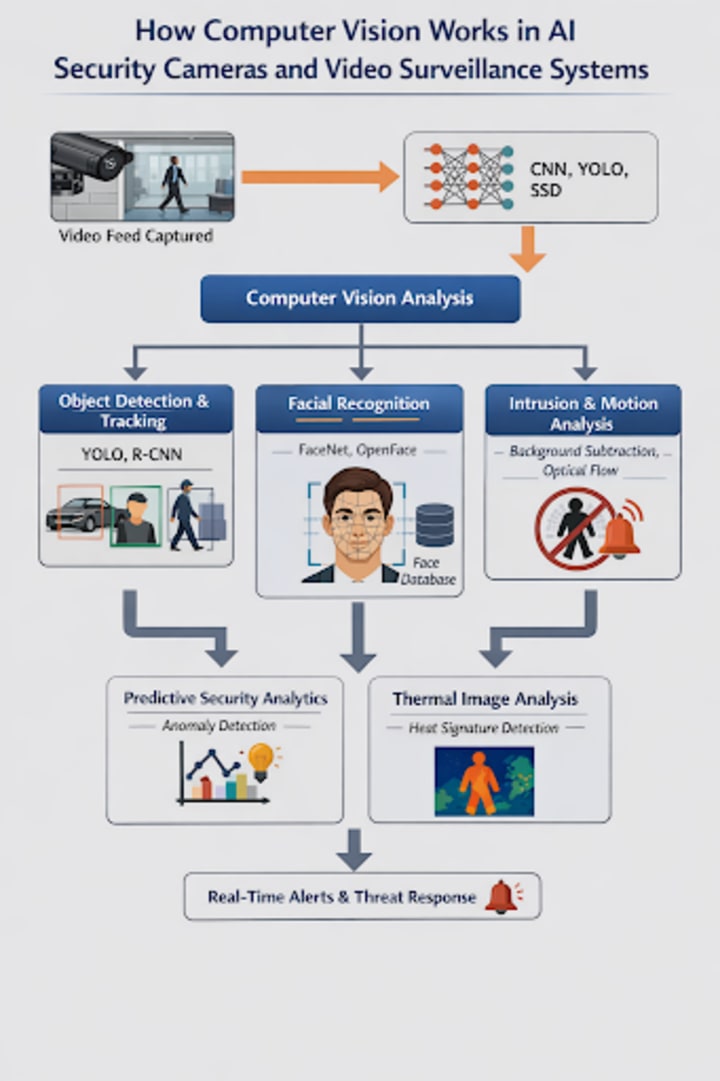
Computer Vision (CV) is the core technology behind AI surveillance systems. It allows cameras to interpret and analyze visual data, much like the human brain processes visual information. At its core is a Convolutional Neural Network (CNN) designed to detect patterns and frame versions of the target object.
When a security camera captures a video feed, the frames are processed by the CNN model, which breaks down the image into features such as shapes, textures, and edges. Region-based CNNs and more advanced models such as YOLO (You Only Look Once), FaceNet, and SSD (Single Shot Multibox Detector) are commonly used in CV for AI video surveillance.
Consider this example of an intrusion detection AI system that continuously monitors a defined area for any unauthorized entry. Using background subtraction techniques, it compares the current frame with a baseline to detect movement and flags any differences that could indicate an intruder. Once abnormal movement is detected, the system uses flow algorithms to track the intruder’s path across the surveillance area.
The Benefits of Computer Vision in Intelligent Security Systems
There are several benefits of integrating computer vision in AI video surveillance systems:
1. Round-the-Clock Monitoring
AI-powered computer vision surveillance systems provide 24/7 monitoring without the need for human intervention. Unlike traditional CCTV systems that require manual review, these systems can continuously analyze footage without fatigue, providing uninterrupted vigilance.
2. High-End Precision and Dependability
Another key advantage of AI video surveillance is its ability to observe and detect with high precision. CV algorithms are highly accurate when trained on appropriate data and can flag with minimal false positives.
3. Rapid Threat Response
Computer vision systems can instantly identify suspicious activity, triggering alerts to security teams without requiring human review for approval. This enables quick decision-making and faster deployment of security measures, reducing response time to potential threats.
4. Large-Scale Security
AI security systems equipped with computer vision can be easily scaled to meet the needs of large organizations or multi-site operations. Whether you’re securing a single building or an expansive corporate campus, AI video surveillance systems can support many more cameras, increasing the number of surveillance points within existing infrastructure.
Read on here to see how a global security solutions provider expanded camera coverage by at least 2X by integrating computer vision in their AI video surveillance systems and without increasing headcount.
5. Evidence Gathering Capabilities
AI-powered surveillance systems cannot only detect threats but also store and categorize footage for later review. They can use data tagging techniques to highlight key elements and timestamp events, making it easier for authorities to retrieve evidence for investigation or legal purposes. This is highly beneficial in compliance audits and criminal investigations.
Applications of Computer Vision in AI Video Surveillance and Intelligent Security Systems
Typical applications of computer vision surveillance systems include:
1. Facial Recognition
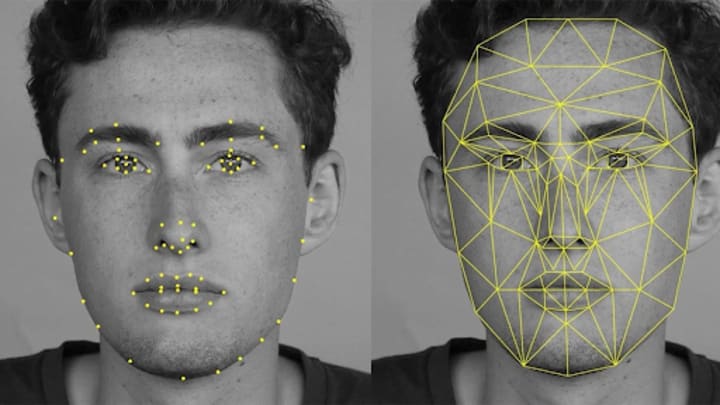
AI security cameras equipped with FaceNet or similar models can match faces to a database, allowing for secure access control and tracking individuals across different areas of a facility.
2. License Plate Recognition (LPR)
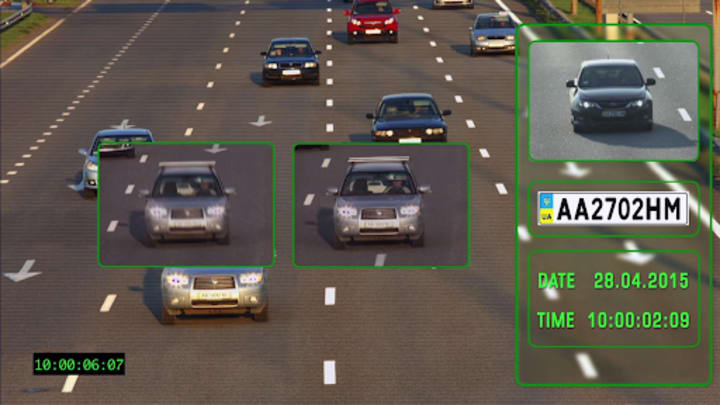
Computer vision surveillance systems can automatically read vehicle license plates and provide automated approvals for entry and tracking vehicles in parking lots, gated communities, or toll booths.
3. Thermal Image Analysis
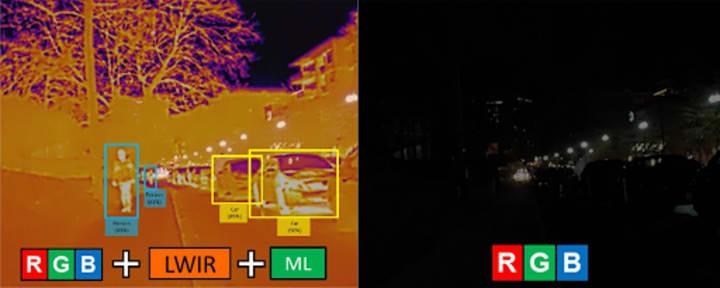
Thermal AI video surveillance cameras with computer vision can detect heat signatures, making them highly effective for security in low-visibility conditions, such as at night or in smoke-filled environments.
4. Behavior Analysis
AI video surveillance systems can integrate sentiment detection models alongside computer vision models. This helps them identify suspicious or abnormal behavior, such as loitering or fighting, through expressions and triggers alerts for immediate action.
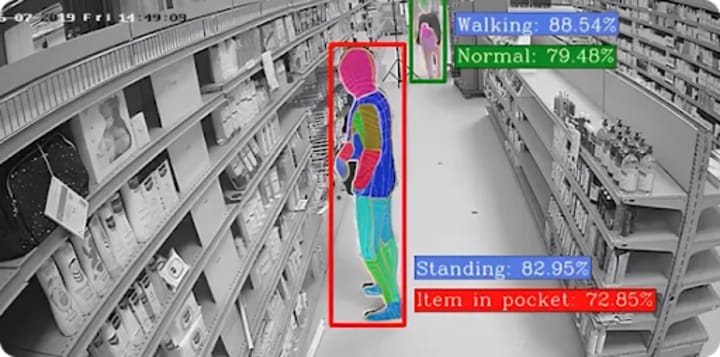
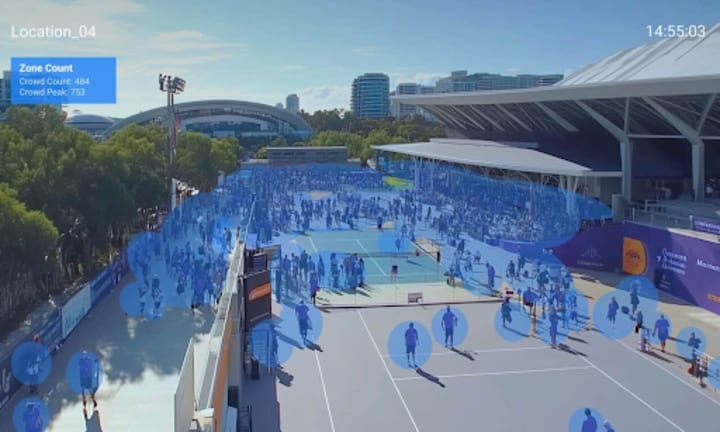
5. Crowd Monitoring
In public spaces or events, AI surveillance systems can monitor crowd density and behavior, detect safety hazards such as overcrowding or panic, and provide early warnings to support crowd control.
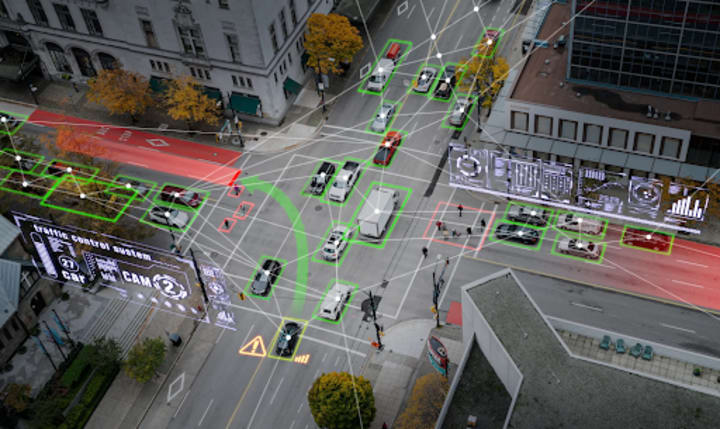
6. Smart Traffic Monitoring
With intelligent security systems, you can also analyze traffic flow, detect accidents, and track violations such as running red lights, illegal parking, or speeding. This helps in automating traffic management and reporting.
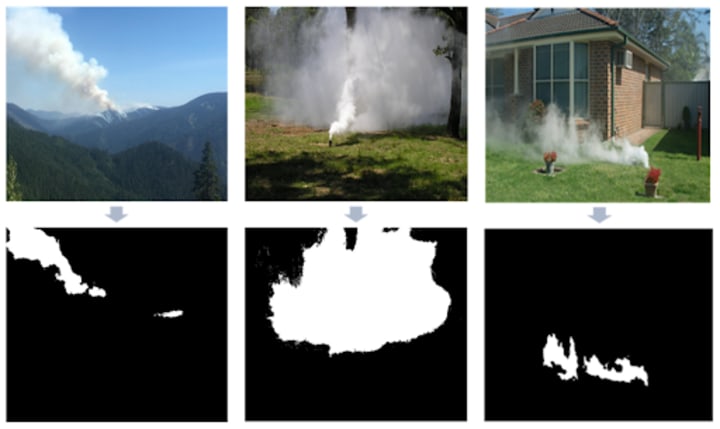
7. Smoke Detection
AI video surveillance systems can also detect smoke by detecting environmental changes, such as the spread of smoke particles. This significantly reduces response times and enables faster fire containment (if any) and evacuation.
8. Remote Surveillance and Mobile Integration
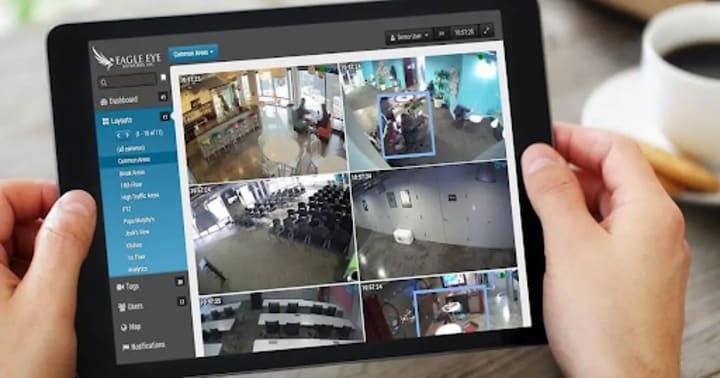
Intelligent security systems can route real-time video to mobile and edge devices, enabling teams to monitor locations remotely. This ensures that security is maintained without being tethered to a fixed location.
Real-World Examples of Computer Vision in AI Video Surveillance Systems
1. Singapore Smart Nation Initiative
Singapore’s Smart Nation initiative employs AI video surveillance across the city for public safety and traffic management. This initiative uses:
- License Plate Recognition (LPR) for toll collection
- Object detection for monitoring pedestrian movement
- Thermal imaging for fire detection
2. Atlanta’s Hartsfield-Jackson Airport
Hartsfield-Jackson Airport in Atlanta uses facial recognition technology in its security process. When passengers check, their scans are verified against a preexisting database. This system, which uses computer vision-based surveillance, accelerates the check-in process, enhances security, and reduces the time passengers spend waiting.
3. UCLA’s Health System
The UCLA Health System uses intelligent surveillance systems to monitor elderly patients in their care facilities. Motion and fall-detection capabilities, combined with computer vision, enable the system to quickly alert caregivers when a fall occurs.
The system also uses thermal imaging to identify elevated body temperatures and to enable staff to detect signs of fever or other reactions.
How to Integrate Computer Vision in Existing Infrastructure?
Integrating AI video surveillance systems into your existing infrastructure requires a deliberate evaluation, careful planning, selecting the right models and technologies, and ensuring compatibility with other systems. Here is a step-by-step if you are planning to execute it on your own:
1. Assess Current Security and Surveillance Setup
- Conduct an audit of your existing security systems (cameras, storage, software).
- Identify what can be utilized and where upgrades are needed.
- Evaluate network bandwidth, hardware specifications, and compatibility with AI tech (computer vision models in particular).
2. Select the Right Computer Vision Software and Hardware
- Choose computer vision models (e.g., YOLO, R-CNN) that align with your needs (e.g., object detection, facial recognition).
- Decide whether to use cloud-based AI solutions or edge AI (on-site processing) based on security and data privacy requirements.
- Upgrade to AI-enabled surveillance cameras, or retrofit existing cameras with additional AI processing units.
3. Data Integration and CV Model Training
- Ensure existing video feeds can be integrated into the computer vision system via secure APIs or a cloud platform.
- Use existing data to train CV models for specific tasks such as intrusion detection or facial recognition.
4. Set Up Real-Time Video Data Processing
Choose between on-site or cloud-based processing.
On-Site (Edge Computing)
To process data locally in order to reduce latency and bandwidth usage, install edge devices (e.g., NVIDIA Jetson nodes) directly within your infrastructure. These devices collect and process video feeds in real time, running computer vision algorithms locally. The data is analyzed at the edge, and only relevant information (e.g., identified threats) is sent to central systems or cloud storage.
Cloud-Based (Cloud Computing)
If you choose cloud computing, video feeds will be sent directly (via APIs) to your preferred cloud provider (AWS, Azure, Google Cloud), where AI services and models will process and analyze the data. This approach is more flexible and reduces load on your local systems.
5. Test and Optimize
Before scaling across the entire infrastructure, run pilot tests on a small set of AI video surveillance cameras under various real-world conditions. Based on this test, optimize for edge cases like low light, high crowd density, foggy weather, etc.
If the process seems challenging and you lack bandwidth, consider collaborating with computer vision consultants. You can either outsource the entire process, from evaluation to deployment, or offload specific tasks such as training computer vision models with custom-annotated datasets.
Challenges and Ethical Considerations of Implementing AI Vision in Security and Surveillance
While AI video surveillance offers several benefits, from reducing manual workload to automating security monitoring, it also raises specific ethical concerns.
- Privacy Concerns: Using facial recognition technology can raise questions about personal privacy. Moreover, as constant monitoring becomes more integrated into AI video surveillance, the line between safety and individual freedom blurs. And without clear guidelines and guardrails, people’s personal lives could be exploited.
- Bias and Accuracy Issues: Computer vision models are often trained on datasets that don’t represent all demographics equally, leading to false positives and false negatives, especially for people of color. This could lead to unfair targeting, over-policing, and, at times, wrongful accusations.
- Data Misuse: Another critical issue is the massive volume of sensitive data that AI surveillance systems collect. If this data isn’t adequately protected, it becomes a prime target for cyberattacks.
- Social Control: With AI and computer vision, the surveillance landscape is changing. When AI-powered surveillance systems are used excessively, they can lead to citizens being constantly monitored, creating an environment of fear and distrust.
- Accountability and Transparency: These issues always accompany AI decision-making. With AI video surveillance analyzing scenes and triggering alerts, there may be no clear answer as to who is responsible when something goes wrong.
- Dependence on Tech: This is becoming a dangerous scenario, as reliance on AI-driven surveillance reaches the point where human reviewers are no longer needed, setting us up for failure.
Ending Note
As AI-powered video surveillance expands, there is immense potential for organizations to enhance their security posture through smarter, more efficient monitoring. Looking ahead, we can expect further advances in AI and computer vision that balance security and privacy, with improved regulations and more transparent, fairer AI systems shaping the future of surveillance.
About the Creator
Nathan Smith
Nathan Smith, Technical Writer at TechnoScore, excels in software docs, API guides, and UX. Skilled in HTML, CSS, JS, JIRA, and Confluence, with expertise in DevOps, AI/ML, QA, Cloud, App Development, and Staff Augmentation services.
Keep reading
More stories from Nathan Smith and writers in FYI and other communities.
How Healthcare Goes Digital with Integration of AI Technologies
Introduction The healthcare ecosystem is rapidly evolving toward a more sustainable and connected future. In this evolution, AI in healthcare has emerged as a key pillar of medical innovation in the 21st century. One of the leading transformative fields of AI is in medical diagnostics, where AI can provide the most accurate and efficient outcomes.
By Nathan Smithabout a month ago in FYI
The Method That Turns Action Into Accuracy
For most of our lives, we are taught a simple rule for success: Ready, Aim, Fire. Prepare carefully. Plan extensively. Wait until the target is perfectly clear—then act. On paper, this sounds wise and responsible. In reality, it often leads to hesitation, overthinking, and missed opportunities.
By Fred Bradford4 days ago in FYI
Getting Serious About Comedy (Part I)
If I were asked to remark on my life and the childhood that paved some road leading me to this point, I would have to say something about all the funny people who surrounded me for the last 26,872 days (and counting). Somewhere along that road, I became a big fan of laughter and the comedy that spawns it – and, I mean not only my own laughter, but the laughter of others, some of which I have actually been responsible for inducing.
By John Oliver Smith7 days ago in Humor


Comments
There are no comments for this story
Be the first to respond and start the conversation.