
Historic Arrest Warrant Issued for South Korean President Yoon Suk Yeol Amid Martial Law Controversy.
South Korea’s first-ever arrest warrant for an incumbent president raises questions about democracy, governance, and accountability in a politically charged environment.

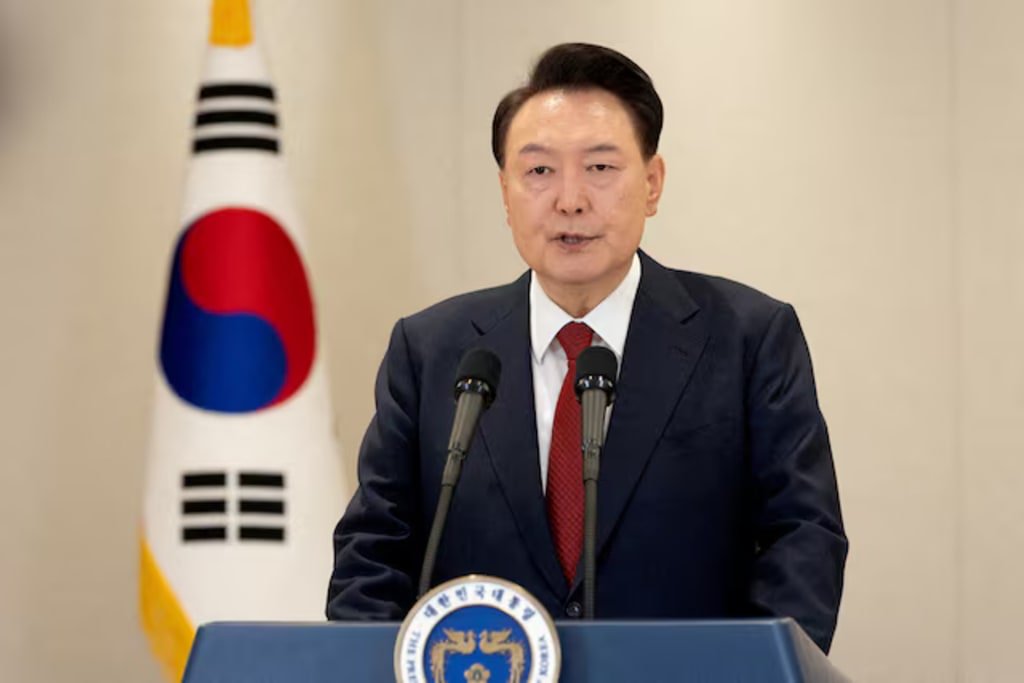
In a historic and unprecedented move, the Seoul Western District Court has approved an arrest warrant for South Korean President Yoon Suk Yeol. This follows an investigation into his controversial decision to impose martial law on December 3, 2024. The warrant, which was granted on Tuesday, marks the first time in South Korea’s history that an arrest order has been issued for a sitting president.
The decision to issue the arrest warrant came after South Korean investigators, including the Corruption Investigation Office for High-ranking Officials, sought legal action against Yoon. The charges revolve around his imposition of martial law, which was quickly revoked but still led to significant political and legal repercussions. Yoon is now facing a criminal investigation that could potentially involve charges of insurrection, a grave accusation given his position as the country’s head of state.
The martial law declaration, which was enacted in response to growing civil unrest following a series of political protests, was viewed by many as an overreach of executive power. Critics have argued that the move was an attempt to suppress opposition and control the ongoing protests. Yoon’s administration has been under increasing pressure, with many questioning the legality and necessity of such drastic measures in the modern political landscape.
Despite the gravity of the charges, the Seoul court has yet to comment on the case, leaving many to speculate on the potential outcomes. The investigation into President Yoon comes at a time of heightened political tension in South Korea, with deep divisions over the handling of national security and democratic freedoms. Yoon’s decision to impose martial law has sparked fierce debates, with opponents accusing him of undermining the democratic foundations of the country.
The arrest warrant against President Yoon comes just weeks after his impeachment, which was based on similar concerns regarding his handling of domestic unrest and his controversial policies. The suspension of his powers has led to a power vacuum, with South Korean officials now grappling with how to proceed in light of the ongoing investigations. It remains unclear how the political situation will evolve in the coming weeks, as the nation watches closely for further developments.
South Korean democracy is facing one of its most critical challenges in recent memory. The impeachment and possible arrest of President Yoon are raising significant questions about the role of the judiciary, the executive, and the legislature in times of crisis. Many in the country are watching closely to see how the political institutions will respond to the threat to democratic norms, especially when the highest office in the land is involved in a scandal of this magnitude.
Yoon’s supporters have argued that his decision to impose martial law was a necessary response to the unrest and that it was a temporary measure aimed at restoring order. However, his critics have strongly disagreed, calling it an abuse of power and a violation of the country’s democratic principles. They argue that Yoon, as president, should have used alternative means to address the protests rather than resorting to the drastic step of martial law, which they view as a throwback to the authoritarian past of South Korea.
The political fallout from this situation is likely to be significant, not only in South Korea but across the region. South Korea, long considered one of the most stable democracies in Asia, now faces a crisis of governance that could have profound implications for its future. International observers are closely monitoring the situation, with many expressing concern over the potential erosion of democratic norms in the country.
The situation is also raising concerns about the potential for political instability in South Korea. With the president’s powers suspended and his future in question, there is a growing fear that the country could face a period of political gridlock. South Korean lawmakers will need to navigate these difficult waters carefully, as the nation is at a crossroads in terms of its political future.
In the coming weeks, it is expected that South Korea’s Constitutional Court will play a key role in deciding the fate of President Yoon. The court’s decisions will not only impact Yoon’s future but also shape the country’s political landscape for years to come. If Yoon is found guilty of insurrection or any other charges, it could have far-reaching consequences for the nation’s leadership structure and its approach to governance.
For now, the future of Yoon Suk Yeol’s presidency hangs in the balance. As South Korean authorities continue to investigate the events surrounding the martial law imposition, the nation is left to navigate a political crisis that could have lasting implications for its democratic institutions. The approval of an arrest warrant for an incumbent president marks a pivotal moment in South Korean politics, signaling a shift in the country’s approach to holding high-ranking officials accountable for their actions.
Despite the uncertainty, the events surrounding Yoon’s impeachment and potential arrest have underscored the importance of accountability in democratic governance. South Koreans, who have fought hard for democratic freedoms over the years, are now faced with the difficult task of preserving those values while addressing the actions of their elected leaders. In the coming days and weeks, the world will be watching to see how this unprecedented situation unfolds and what it means for the future of South Korea.
About the Creator
Muhannad Al-Zanati
I am Muhannad Al-Zanati, a passionate writer dedicated to sharing stories and experiences with the world. With extensive experience in writing, I can transform ordinary moments into inspiring stories that add value to readers' lives.
Reader insights
Nice work
Very well written. Keep up the good work!
Top insights
Compelling and original writing
Creative use of language & vocab
Easy to read and follow
Well-structured & engaging content
Excellent storytelling
Original narrative & well developed characters
Expert insights and opinions
Arguments were carefully researched and presented
Eye opening
Niche topic & fresh perspectives
Heartfelt and relatable
The story invoked strong personal emotions
Masterful proofreading
Zero grammar & spelling mistakes
On-point and relevant
Writing reflected the title & theme
Keep reading
More stories from Muhannad Al-Zanati and writers in FYI and other communities.
Mariana Trench:
The Most Enigmatic and Deepest Frontier on Earth Most people agree that the Mariana Trench is the lowest spot on Earth. It is situated in the Pacific Ocean, east of the Philippines and south of Japan. Challenger Deep, the trench's deepest section, is the lowest point on Earth, plunging about 11,000 meters below sea level. To put this into perspective, the top of Mount Everest would still be more than two kilometers below the surface of the trench if it were positioned at the bottom.
By Muhannad Al-Zanatiabout a year ago in FYI
Asia Pacific Prebiotics Market Size and Forecast 2025
Asia Pacific Prebiotics Market: A Region Poised for Gut-Health Revolution The Asia Pacific prebiotics market is entering a transformative decade. With rising health awareness, aging populations, expanding functional food industries, and rapid advancements in biotechnology, prebiotics have become a central ingredient in modern nutrition strategies across the region. According to Renub Research, the Asia Pacific Prebiotics Market is expected to reach US$ 5.83 billion by 2033, growing from US$ 2.14 billion in 2024, at a robust CAGR of 11.77% from 2025 to 2033.
By Aaina Oberoi4 days ago in FYI



Comments (3)
❤️👍
:)
:)