

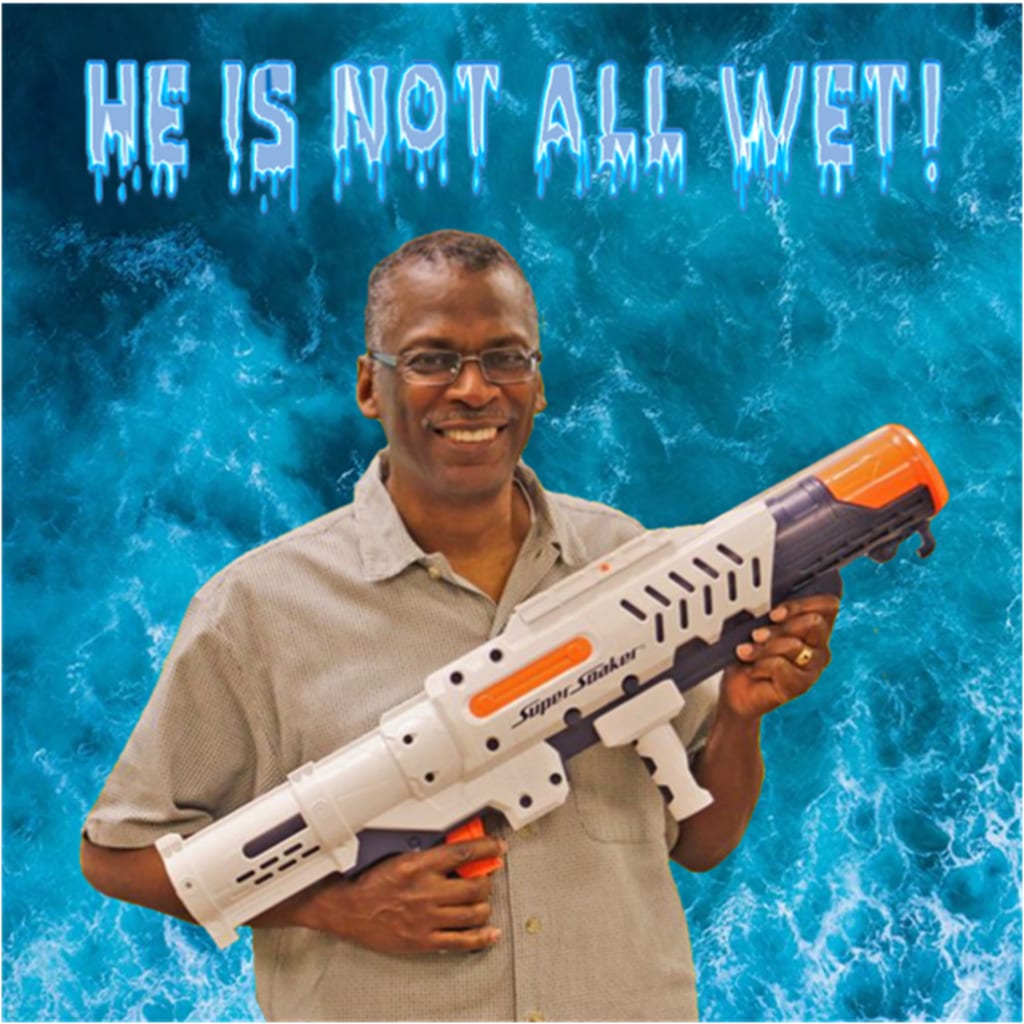
HE IS NOT ALL WET!
THE LONNIE JOHNSON STORY
This story is about the accomplishments of Lonnie George Johnson an engineer, inventor, and businessman, questions he answered, how our lives are similar, and how he inspired me to persevere to accomplish my dreams. But I would be remiss for not mentioning that we should all respect the knowledge and accomplishment of black inventors in America and the world. These contributions were made despite the inequalities and injustices created against Black Americans. Inventions you did not know black men and women conceived that we use every day to make our lives safer and more comfortable. Such as: electric light bulb, heart surgery, refrigerator, gas mask, syringe, heating furnace, car motor, elevator, etc. Of course, this is just a small list of inventions conceived by Black Inventors. This is not the story, to list all of the inventions of Black Inventors, and there are many. Keep in mind, the race of inventors is not recorded, there are many we will never know.
During the enslavement of black people, an enslaved person could not file for a patent in his name because the law in the old south gave ownership of the patent to the enslaver or master. Therefore many patents were stolen for the enslaved black inventors and credit was given to the enslavement master. Many enslavement masters prospered for the inventions of the enslaved population of black people. It is likely many inventions were from the minds of kidnapped and enslaved black inventors.
One of the greatest black inventors in history, electrical engineer Granville T. Woods (1856-1910), never finished elementary school. He was self-taught! Woods patented over 100 electrical and mechanical inventions. Many of his ideas were bought by General Electric, Westinghouse, Bell, and Thomas Edison. It would not be possible to list all of his groundbreaking inventions. However, I would like you to read a passive he wrote in his book "The Plight of a Black Inventor":
In the late 1800s, a popular candidate for Congress remarked that blacks should not be permitted to vote because "none of them had ever evinced sufficient capacity to justify such a privilege," and "no none of the race had ever reached the dignity of an inventor." Blacks generally were thought to lack the mental capacity needed to handle the complicated abstract concepts used in designing inventions. This mode of thinking made its way into the twentieth century. In 1913, lawyer B. J. Nolan of Chattanooga, Tennessee, wrote:
I never knew a Negro to even suggest a new idea. Much less try to patent one. And I have dealt with them all my life.
P.S. I have asked other lawyers around me for data on Negro inventions. And they take it as a joke.
All you need to know, Nolan made that statement in 1913, Black Americans have recorded inventions in 1821; T.L. Jennings modernize the dry cleaning process. Our lives today would be considerably different without the contributions made by black entrepreneurs, inventors, and creators. Our world wouldn't function the same without black engineering, philosophy, and discovery. This leads me to mention the person of interest in this story, one of the great engineers and inventors, currently living among us Mr. Lonnie George Johnson.
Lonnie George Johnson was born October 6, 1949, in Mobile, Alabama. Needless to say, Alabama in the 40s, 50s, and 60s was very difficult for Black Americans and the same can be said for South Carolina. His father was a World War II veteran who worked as a civilian driver at nearby Air Force bases, while his mother worked in a laundry and as a nurse's aid. My father was a Korean War veteran who worked as Head Chef at a popular restaurant. My mother left my father for Philadelphia when I was six months old. During the summers, both of Johnson's parents also picked cotton on his grandfather's farm.
Out of both interest and economic necessity, Johnson's father was a skilled handyman who taught his six children to build their toys. My immediate family consists of two older sisters and myself being the only boy. Many black families, like mine, had to manufacture day-to-day items into toys for their children. When Johnson was still a small boy, he and his dad built a pressurized chinaberry shooter out of bamboo shoots; I used a garden hose and a shaved broom handle and called the pressurized chinaberry shooter a "Plucker". At the age of 13, Johnson attached a lawnmower engine to a go-kart he built from junkyard scraps and raced it along the highway until the police pulled him over. I made many go-karts in my early childhood; however, attaching a lawnmower motor was not financially feasible.
Lonnie dreamed of becoming a famous inventor and, during his teenage years, began to grow more curious about the way things worked and more ambitious in his experimentation—sometimes to the detriment of his family. I began my interest in inventing in my early childhood. I was always curious as to how things work. "Lonnie tore up his sister's baby doll to see what made the eyes close," his mother later recalled. I thoroughly examined my sister's magnetized dollhouse to grasp the concept magnetism and of how the people moved around the house. Another time, Lonnie nearly burned the house down when he attempted to cook up rocket fuel in one of his mother's saucepans and the concoction exploded.
Question: What inspired you to become an inventor?
Lonnie: As far back as I can remember, I was interested in devices and how they worked. I took everything apart.
Questions: How did you get started inventing?
Lonnie: It started with my dad. He gave me my first lesson in electricity, explaining that it takes two wires for electric current to flow – one for the electrons to go in, the other for them to come out. And he showed me how to repair irons and lamps and things like that.
Growing up in Mobile in the days of legal segregation, Johnson attended Williamson High School, an all-Black facility, where, despite his precocious intelligence and creativity, he was told not to aspire beyond a career as a technician. Growing up in Orangeburg early into the end of segregation, I attended Wilkinson High School, a newly intergraded school with some white teachers encouraging blacks to attend a trade school or seek an associated degree. I know with my intelligence and creativity, I would not let any of them persuade me to follow such a course of action. Nevertheless, inspired by the story of famed African American inventor George Washington Carver, Johnson persevered in his dream of becoming an inventor. I was inspired to invent by Booker T. Washington, Eli Whitney, and Garrett Morgan.
Nicknamed "The Professor" by his high school buddies, Johnson represented his school at a 1968 science fair sponsored by the Junior Engineering Technical Society (JETS). I was nicknamed "Quick Draw" by my school buddies, due to being a member of the wrestling team. The science fair took place at the University of Alabama at Tuscaloosa, where, just five years earlier, Governor George Wallace had tried to prevent two Black students from enrolling at the school by standing in the doorway of the auditorium. I was not heavily involved in constructing my invention, during this period of my life. I would only make sketches in notebooks.
Lonnie was the only Black student in the competition, he debuted a compressed-air-powered robot, called "the Linex," that he had painstakingly built from junkyard scraps over the course of a year. The remote-controlled robot was built with a reel-to-reel tape player for a brain and jukebox solenoids controlling its pneumatic limbs. The robot stood at three and a half feet tall with rotating shoulders, elbows, and wrists that could swivel, and the ability to move and pivot on a set of wheels. Much to the chagrin of the university officials, Johnson won first prize. "The only thing officials from the university said to all the contestants during the entire competition, was "Goodbye" and "Y'all drive safe, now." This achievement jump-started Lonnie's desire to invent and change the world.
Question: Why is it so hard for Black Americans to invent a marketable product?
Lonnie: In spite of the things that have been perpetrated on my race; holding us in bondage under slavery, then making it illegal to educate us and then subjecting us to long-term discrimination and criticism; we succeed anyway, to a very large extent. We just need to realize what we’re capable of.
After graduating with Williamson's last segregated class, in 1969, Johnson attended Tuskegee University on a scholarship. After graduating from Wilkinson, I join the Navy Reserve. I aced the Armed Services Vocational Aptitude Battery (ASVAB) is a heavily researched and well-respected aptitude test developed by the Department of Defense. Acing the ASVAB, allowed me to have a choice of the branch of service I wanted to join. Lonnie earned a bachelor's degree in mechanical engineering in 1973, and two years later he received a master's degree in nuclear engineering from the school. As a Reservist, I attended Claflin College, now Claflin University, and received a bachelor's degree in Math and Art and later a master's in business from Strayer University.
Johnson went on to join the U.S. Air Force, becoming an important member of the government scientific establishment. After college, my Naval Officers wanted me to become an officer in the Navy; however, I chose to become a Marine Corps Officer. I was presented with the opportunity to take part in an Inner Service Transfer when three Marine Corps Officer Selection Officers (OSOs) visited by college campus. Lonnie was assigned to the Strategic Air Command working at the Air Force Weapons Laboratory at Sandia, where he helped develop the stealth bomber program. I became a Logistic Officer in the Marine Corps. Johnson moved on to NASA's Jet Propulsion Laboratory in 1979, working as a systems engineer for the Galileo mission to Jupiter, the Mars Observer project, and the Cassini robot probe that flew 740 million miles to Saturn, before returning to the Air Force in 1982. Years later, after leaving active service in the Marine Corps, I received a recruitment letter from NASA, CIA, FBI, and Secret Service. I turned down the offers because I wanted to become a businessman and focus on my inventions. There is a big "WHAT IF" I would have accepted the offer from NASA or chose the Air Force instead of the Navy, after my scores on the ASVAB.
Question: What were the major concerns about the NASA project?
Lonnie: A major concern was that in the event of a short circuit, power to the memory would be lost and the spacecraft would be unable to call home. So I devised an isolation circuit that would maintain power to the computer memories even when power was lost.
Despite his busy days, Johnson continued to pursue his inventions in his spare time. My life became a carousel, moving from a management job to a management job. I was helping others build their business and wanted to start my own and pursue my inventions. One of Lonnie's longtime pet projects was an environmentally friendly heat pump that used water instead of Freon. Johnson finally completed a prototype one night in 1982 and decided to test it in his bathroom. He aimed the nozzle into his bathtub, pulled the lever, and blasted a powerful stream of water straight into the tub. Johnson's instantaneous and instinctive reaction, since shared by millions of kids around the world, was pure delight. Lonnie was on his way with this prototype, and I was not ready to produce any of my prototypes. All of my inventions were just drawing in various notebooks.
Question: How did you invent the Super Soaker?
Lonnie: While I was at the Jet Propulsion lab, I was always tinkering. I was working on a new heat pump that used water instead of Freon because Freon is bad for the environment. I was experimenting with nozzles I’d made that shot a stream of water across the bathroom and I thought they’d make a good water gun.
In 1989, after another seven years of tinkering and tireless sales-pitching, during which he left the Air Force to go into business for himself, Johnson finally sold his device to the Larami Corporation, a company that made knock-off toys, to produce his invention and pay him royalties. The "Power Drencher" initially failed to make much of a commercial impact, but after additional marketing efforts and a name change, the "Super Soaker" became a massively successful item. He moved to Atlanta in 1990 before his Super Soaker invention made him wealthy. In 1991 started his Research and Development Company. Johnson Research and Development Company is a technology company that has the creative culture and radically innovative atmosphere of a toy company. The synergistic effect produced between creativity and technology is the driving force behind Johnson Research and its revolutionary products.
Question: How did you find a company to make the Super Soaker?
Lonnie: It was 1989 and I’d written letters to companies including Hasbro, who dismissed the idea. Eventually, I went to the Toy Fair and I met a guy in the hallway who said I should talk to the folks at Larami, a small company that made knock-off toys. At the fair, I managed to meet with someone there and he said, “If you’re ever in Philadelphia, come and see us and we’ll be happy to talk to you.” He said, “Don’t make a special trip.” So I went to Philadelphia and waited over an hour in the reception area before I got in to see someone. I took the gun out of my suitcase. They asked if it worked and I shot water across the conference room. They turned the prototype into the first Super Soaker.
In conjunction with the startup of his new company Lonnie's Super Soaker topped $200 million in sales in 1991, and went on to annually rank among the world's Top 20 best-selling toys. . New and improved iterations of the Super Soaker would follow year after year, but at the same time, Johnson began to design varieties of Nerf guns. These toys brought in even more royalty checks since they were a toy that was could sell year-round.
Question: Did it catch on with customers right away?
Lonnie: The first year, the gun sold so well, they wanted to expand the product line. It took me a couple of weeks to design a model with two bottles that were more efficient. That was the Super Soaker 100.
Lonnie had the inventions that placed his name on the map of the list of great inventors before him. Lonnie signed an agreement with the toy giant Hasbro in 1996 for the Super Soaker. A second license agreement with Hasbro covered the design, engineering, and development of NERF soft foam dart guns. These toys, like the Super Soaker, have outlasted national trends and the traditional one to two-year life cycle for toys. The NERF product line includes several new items each year and continues to be a staple of summer outdoor toy lines.
Lonnie was on top of the world, but like many of the black inventors before Lonnie, it was not all peaches and cream for the future of the inventor. Hasbro decided to place Lonnie into the false stereotype cast on many of the black inventors before him, thinking a black person is not able to use his head in deep thought, lacking the capability to comprehend the many layers of business. Hasbro wanted Lonnie to think they were doing him a favor; letting a black man sign an agreement with a giant. Lonnie was no average black man or inventor. Johnson Research and Development Co. was thrust into a royalty dispute with Hasbro when the company filed a claim against the giant toy company. According to King & Spalding, which along with the A. Leigh Baier P.C. law firm represented Johnson, Hasbro underpaid royalties for the Nerf line toys from 2007 to 2012.
“In the arbitration, we got everything we asked for,” said Atlanta attorney Leigh Baier. “The arbitrator ruled totally in Lonnie’s favor.” The attorney also said Johnson “is very pleased” with the outcome. The arbitration agreement resolves a 2001 inventors dispute in which Hasbro agreed to pay Johnson royalties for products covered by his Nerf line of toys, specifically the N-Strike and Dart Tag brands, King & Spalding attorney Ben Easterlin said. Johnson Research and Development Co. was awarded nearly $73 million in royalties from toymaker Hasbro Inc., according to the law firm King & Spalding.
Question: It’s been reported that you received $73 million from the settlement of a legal dispute over unpaid royalties from Hasbro.
Lonnie: I settled for less than that. There was too much on the table to take a risk.
In a separate breach of contract suit filed in U.S. District Court in Atlanta, Johnson accuses Hasbro of violating a 1996 agreement to pay him Super Soaker royalties of 2 percent for “three-dimensional products” based on the appearance of the toy and 1 percent for “two-dimensional visual representations.” The suit says Hasbro sold water guns that were “visually similar and based upon the appearance of Super Soaker water guns that incorporate Johnson’s technology.” Johnson also wanted the court to force Hasbro to open its books to determine sales of Super Soaker products from 2006 to 2012.
Question: Are you still collecting royalties on the Super Soaker?
Lonnie: No. The toy is still around but the patents have expired. In hindsight, one of the things I learned was the value of the brand. The Super Soaker name was the result of a discussion between myself and the president of Larami. If I’d understood the value of the brand, I would have put it in my contract, which was just a patent license.
In 2001, I was living in Charlotte, NC. and my life was not as bright as Lonnie's. I began working for a Business Consulting Firm to diversify my knowledge of business, as a result of assisting other businesses in efficiency improvements. The job enabled me to hone my skills in innovations. Solving the problems of other companies through design, engineering, and development, kick-started my desire to create and seek my own development company.
In 2003, while working at the firm I met a friend that was curious about my interest away from the job. I told him I write and conceive inventions. When an inventor makes that statement, the person always wants you to show at least one. I explained an unusual and unique pillow creation. He was very impressed with the overall concept. Unknowingly to me, he was so impressed, he set up a meeting for me with a pillow company. After informing me of the meeting, I visited the company.
At the company, the guy took a look at me and I immediately know something was wrong. My friend is white and the pillow guy assumed I was white. When I asked him to sign my Nondisclosure Agreement, he says no, I should have walked out; knowing his business was located in a racist city of the state. But this was my first big pitch and I wanted to prove the product was great and would be perfect for any pillow company, so I decided to show the product to convince the guy that we could make millions. He told me you will make millions with the product, but he would not be able to help me. He said he wanted to leave his company to his kid; however, none of his kids were interested in the pillow business. Two months received a call from my friend scolding me for not telling him I made the deal. I told him I did not make the deal. He said your pillow product is in one of the big box stores. I visited the store and he was right my invention was on the shelf. Unlike Lonnie, I could not suit. There was nothing signed, no agreement, so I did not have the proof of the meeting. The product is still very profitable today.
That incident taught me several valuable lessons. 1. If the person does not sign the NDA, don't share the information. 2. Try to patent your inventions before showing them to someone that has the "money' or the "means". With the money, the person can afford to make the product and will find someone. With the means, the person can make the product and will find someone with the money. 3. I am a very good inventor with the ability to conceive to total marketability of a product to include the what, who, why, and where that will ensure the product will outlast national trends and the traditional one to two-year life cycle for products. 4. I still have plenty of other products that will be very profitable.
Despite the theft of one of my inventions, I had the pleasure of meeting my new next-door neighbor when he asked me if I was interested in satellite television. He worked for Dish Network as an installer. We felt very relaxed talking and getting to know each other. The conversation led us to a deep dive into our future endeavors. He perked up when I told him I was an inventor. He said he had an uncle who was a successful inventor. His uncle is Lonnie George Johnson the inventor of the Super Soaker. I was aware of the product and not the inventor. Being an inspiring writer, I engage in lots of research about all subjects of interest. I studied the life of Lonnie Johnson and what led him to his success. His story inspired me to never give up, despite my trials and tribulations.
Question: How do you address the importance of tenacity in developing new technologies, despite naysayers or setbacks.
“It is about perseverance. And the disheartening thing is that, when you come up with a really, really different idea that’s really unique, most people won’t get it. They won’t see the vision that you see. And the only way to make the reality is to persevere. You understand better than anybody what the potential could be.”
Question: Why do you like to speak to kids about inventing?
Lonnie: Kids need exposure to ideas, and they need to be given an opportunity to experience success. Once you get that feeling, it grows and feeds itself – but some kids have got to overcome their environments and attitudes that have been imposed on them.
Since the introduction of the Super Soaker water gun in 1991, Johnson Research and Development Co. has become one of the most celebrated entrepreneurial success stories in the toy industry. Through a license contract with one of the world’s largest toy manufacturers, Johnson Research has been a dynamic and influential force behind the technological innovations in the toy industry. Johnson Research continues to contribute breakthroughs in water gun technology, much to the delight of millions of children who can propel "more water further." ''Wetter is better!'' is the slogan for the Super Soaker.
Question: What are you working on now?
Lonnie: Energy technology. I’ve invented a new type of engine that converts heat directly into electricity with no moving mechanical parts. It’s called the Johnson Thermo-Electrochemical Converter, the JTEC.
Question: What sort of uses would it have?
Lonnie: Anywhere you have an existing engine, you could use the device. Converting heat from the sun, converting body heat into electricity, waste heat from machinery.
Johnson Research & Development and went on to acquire dozens of other patents. Some of his inventions, including a ceramic battery and hair rollers that set without heat, achieved commercial success. Others, including a diaper that plays a nursery rhyme when soiled, failed to catch on. Another invention sought to address matters of far greater importance: With the creation of the Johnson Thermoelectric Energy Converter (JTEC), the engineer aimed to develop an advanced heat engine that could convert solar energy into electricity with twice the efficiency of existing methods. He believed a successful version of the JTEC had the potential to make solar power competitive with coal, fulfilling the dream of efficient, renewable solar energy and rechargeable battery technology; the development of an all-ceramic battery that can hold three times the charge as its lithium-ion predecessor, to a converter for solar power plants.
Question: What else are you working on?
Lonnie: My other invention is an all-ceramic battery. Existing batteries use liquid electrolytes. My battery uses glass as an electrolyte. We can hold between two and three times the energy that a lithium-ion battery can. The idea is that the JTEC could convert heat from the sun to electricity and the battery could store the heat until you’re ready to use it. Solar power would be one application. You could also use it in nuclear power plants.
In 2008, Johnson received the Breakthrough Award from Popular Mechanics for the invention of the JTEC. More recently, he has been working with the Palo Alto Research Center (PARC) in California for further development. Since leaving the Air Force, Johnson has been one of a rare breed of scientists: the independent inventor working outside the scientific establishment. Had he retired upon patenting the Super Soaker, Johnson would still go down as one of the most successful inventors and entrepreneurs of his generation.
In the environmental energy area, Johnson Research & Development spin-off companies, Excellatron Solid State, LLC created to commercialize the solid-state thin-film lithium rechargeable battery technology, and Johnson Electro-Mechanical Systems, LLC (JEMS) has invented energy conversion technology that converts thermal energy to electrical energy with significant advantages over alternative energy systems.
However, if he manages to perfect the JTEC, Johnson will carve out a much greater place in history as one of the seminal figures of the ongoing green technology revolution. Paul Werbos of the National Science Foundation said, "This is a whole new family of technology. It's like discovering a new continent. You don't know what's there, but you sure want to explore it to find out. It has a darn good chance of being the best thing on Earth."
Question: How are you financing these projects if you have no customers?
Lonnie: Revenue from past successes. My business model is to take on really innovative, high-risk technical projects and solve them, and achieve breakthroughs. I want to bring the risk down to a level where it would be tolerable for companies. We own the intellectual property and we’re free to make whatever deal we feel is appropriate.
Currently, Lonnie holds more than 80 patents, with more than 20 pending. I, on the other hand, hold 1 patent with 2 pending. I have over 350 inventions that would revolutionize various industries and no funding to bring the products to market. I have conceived a sport that would be of great interest to Stephen Curry and LeBron James, a sport for Katina Adams of the USTA, a unique fast-food restaurant concept for Magic Johnson, a screenplay for Oprah Winfrey and Tyler Perry, and a historic board game that highlights the inequalities and injustices against black and brown people for Black Lives Matter and or the NAACP. If I'm given the opportunity to communicate with any of the individuals or organizations, I'll be able to make any of them richer than they could ever imagine. Meanwhile, I am writing books and other articles to obtain the funding to launch my inventions into the annuals of the great inventors who have made a name for themselves in history. I currently live in Texas. Here is a weird factual coincidence. I live on Laramie Street and Lonnie achieved success, after selling his Super Soaker to the Larami Corporation. It is a weird coincidence but true. Hopefully, one day I will get to meet Lonnie George Johnson to tell him he has been my inspiration after his nephew spoke of him so glaringly in Charlotte NC.
In summary, since the introduction of his Super Soaker water gun in 1991, the gun has captured approximately eighty-five percent of the worldwide water gun market, generated an impressive $200 million in 1992, revolutionized the toy water gun industry currently has generated sales of nearly one billion dollars and has found its place among the top ten best selling toys of the year. Let's not forget his successful NERF product line of toys with the impressive NERF soft foam dart guns. Yes, his toy inventions are great; however, Lonnie has made other great contributions to the world. Lonnie is a brilliant man, a nuclear engineer with a Ph.D. from Tuskegee University. He served in the United States Armed Service, serving in the Air Force assigned to the Strategic Air Command working at the Air Force Weapons Laboratory at Sandia, where he helped develop the stealth bomber program. He moved on to NASA's Jet Propulsion Laboratory in 1979, working as a systems engineer for the Galileo mission to Jupiter, the Mars Observer project, and the Cassini robot probe that flew 740 million miles to Saturn, before returning to the Air Force in 1982. His subsidiary companies of Johnson Research & Development working in the environmental energy area, Excellatron Solid State, and Johnson Electro-Mechanical Systems, projects include advanced battery technology and thermal to electric power generation technology. Lonnie has become one of the most celebrated entrepreneurial success stories in the toy industry and is a dynamic and influential force behind the technological innovations in the toy industry. He currently has a net worth of over 360 million dollars. Despite the majority of the financial success bestowed upon him was a result of the Super Soaker, we all have to say, "HE IS NOT ALL WET!!!"
While the mythical American dream may still elude many, Lonnie Johnson’s can surely serve as inspiration for anyone and everyone who has ever strived for something more, something new, and sometimes even, something fun.
THE END
About the Creator
Fabian Ellis
I have a Master’s Degree in Business and Bachelor in Art and Mathematics. I've proudly served in two branches of the armed forces, the Navy (Enlisted) and the Marines (Officer). I'm a writer and an inventor who enjoys creating new ideas.
Keep reading
More stories from Fabian Ellis and writers in FYI and other communities.
Outside Lands 2026: Music, Memory, and Magic
There is something different about a festival held in a park surrounded by fog. The air feels softer. The sound carries in a strange, beautiful way. Strangers stand shoulder to shoulder, waiting for a song that might stay with them for years. Outside Lands 2026 is already stirring that quiet excitement. Even before the lineup is announced, people are talking about outfits, travel plans, and who they want to see on stage. It is not just another music festival. It is a yearly ritual for thousands who return to Golden Gate Park for three days of sound, food, and shared emotion. Outside Lands 2026 promises more than performances. It promises moments.
By Muqadas khan2 days ago in FYI


Comments
There are no comments for this story
Be the first to respond and start the conversation.