
European Series - The Development of Mycenaean Civilization and the Trojan War
The Development of Mycenaean Civilization and the Trojan War

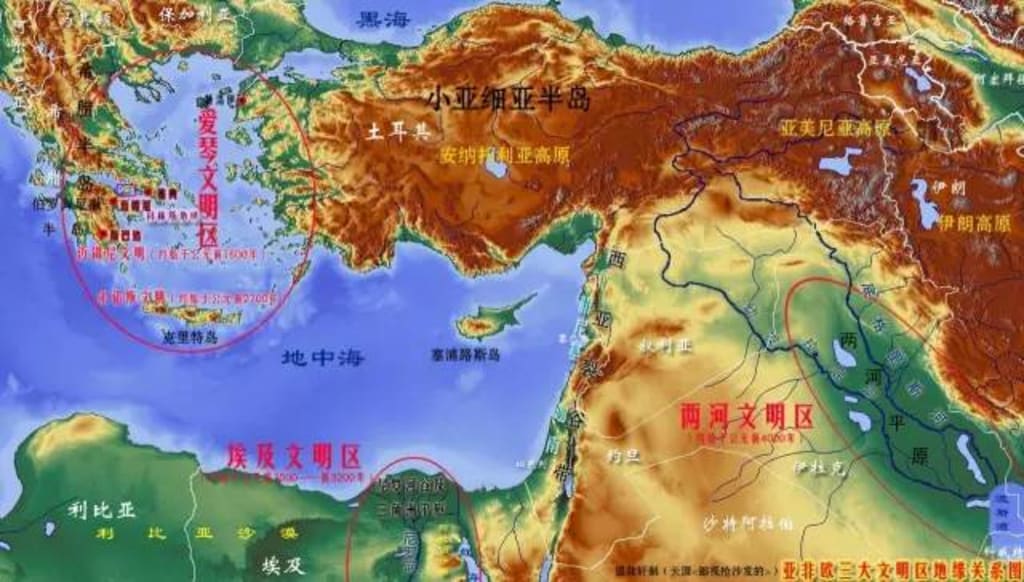
A friend asked before, since the two rivers civilization influenced the Egyptian civilization, is there an early civilization in the “West Asia Rift Belt” where Lebanon and Israel are today, as the connecting corridor between the two? The answer is of course yes. In the Geographical Relationship Map of the Three Major Civilization Areas in Asia, Africa and Europe, the three major civilization areas of the Lianghe, Nile, and Aegean Sea circled by us point to the center of civilization in the region. Affected by them, the tribes living in the surrounding areas will also speed up the progress of civilization. When Crete and even the Greek peninsula began to accept the fire of civilization, the West Asia Rift Belt, the Asia Minor Peninsula, the Armenian Plateau, and the Iranian Plateau, which were connected to the land and the center of the two rivers and the Nile civilization, had no reason to be in a barbaric era. . The Phoenicians, Hittites, and Assyrians were influenced by this and entered the age of nations.
However, everything has advantages and disadvantages. Being on the edge of the Dahe civilization, it is difficult for these marginal plates to become the center of civilization for a while, or to form their own dominant civilization. In contrast, Greece, which faces Eurasia across the sea, has an advantage in this regard. The barrier of the ocean allowed the ancient Greeks to maintain their geographical independence to the greatest extent possible while absorbing civilization factors. At the same time, they have the advantage of civilization relative to the northern European region, and they can also allow themselves to have the hinterland of radiation civilization.
If the Greek peninsula were to extend outward from the West Asian Rift Belt, the above advantages would be lost. Because the Greek peninsula with dense mountains surrounding the Great River Civilization is incomparable in terms of agriculture and population potential. In fact, it is precisely because of this geographical feature that the Greek civilization embarked on a development path that is completely different from the river civilization, that is, the prosperity of the city-state civilization.
City-state civilization is almost a necessary stage in the process of civilization. Initially, the Sumerians and ancient Egyptians were also city-states around the two major river basins. However, the flat terrain, the same closed economic base (subsistence agriculture dominates), and the convenience of transportation brought by the river itself make it easier for the river basin to become a unity, and rely on The power of centralized power pushes civilization to a peak. However, in the Greek peninsula, there is no large river that runs through the whole territory, nor does it have an absolute advantage in the agricultural potential of the large river plain. The river flows from the central mountain alone to the sea, creating a narrow valley and plain surrounded by many mountains.
Since there is no river valley and plain, it has the advantage of overpowering the surrounding areas. In addition, every plate divided by the mountains has the opportunity to enter the sea through the river and has an ocean channel connected to the outside world. From beginning to end, the ancient Greek civilization has shown diversity. The internal power integration of the entire sector is mainly accomplished through national alliances similar to China's "Spring and Autumn" era.
This characteristic of ancient Greek civilization was already established in the Mycenaean era. The difference between it and the Cretan civilization is also due to this. In the initial stage, within Crete, there should also be a city-state stage with a lot of competition. However, the island-type structure makes it much less vulnerable to external invasion. This made Crete more likely to eventually form a unified political body (Minoan Kingdom). In contrast, the Greek peninsula, which is connected to the European continent and faces the sea on three sides, absorbs the maritime features of the Cretan civilization (such as mercantilism), and at the same time has continental features. This is reflected in the fact that, in the northern part of the Balkans, there will always be tribes originating from the European continent, constantly tempted by civilization to go south. And finally make the geopolitical structure of the Greek peninsula, showing variability.
The continental and maritime disputes of Greek civilization were most thoroughly reflected in the later disputes between Athens and Sparta. But before that, we still have to figure out the whereabouts of the Mycenaean civilization. After acquiring Crete, these primitive Indo-Europeans who were the first to use the ocean to receive civilization factors finally had the opportunity to elevate the southern part of the Greek peninsula to the center of regional civilization. When a nation or regime has a comparative advantage over its surrounding areas, the next thing it will do is to expand its sphere of influence. Judging from the position of the Peloponnese, crossing the Isthmus of Corinth to the north and radiating the central part of the Greek peninsula is naturally an option. This kind of expansion cannot simply be understood as territorial expansion. It is the fundamental difference between marine civilization and continental civilization that integrates other geopolitical plates in the hinterland of the Greek peninsula into the trade circle dominated by them.
In this kind of expansion of civilization based on trade, the northern part of the Isthmus of Bercorinth and the central part of the Greek peninsula starting from Athens should begin to receive the radiation of civilization in the Mycenaean era and enter the era of city-states. However, for the Mycenaeans, it was not their natural mission to spread civilization to those plates that were still in the tribal period. In essence, it was just a by-product of market expansion. In this situation, it is as if some people now say that it is thanks to the British that they used gunboats to open the door of the Middle Kingdom. Although from the results, China has indeed been pulled into a new civilization process, but from the point of view of the British Empire, it is not so "noble" (not to mention thankful).
When the Mycenaeans began to become a trade bridge between the European continent (actually limited to the Balkans), and the Eurasian civilization, and thus reaped huge benefits, their competitors appeared. From the perspective of geographical structure, the two major civilization areas in Europe and Asia are not only connected with the Balkan Peninsula by Crete-Peloponnese Peninsula. In theory, goods and civilizations could also be exported to the Balkans through Asia Minor. Of course, we have also mentioned the difficulty of land communication before, that is, the indigenous tribes along the way may become an obstacle to communication. At such times, a unified empire can often guarantee the security of trade.
As we said earlier, when the Mycenaeans infiltrated the Peloponnese, another primitive Indo-European tribe also settled in the Anatolian plateau along the land passage. Before the Mycenaeans were influenced by the Cretan civilization and entered the city-state civilization stage (about 1600 BC). The Hittites had already entered the "state" stage from the tribe under the influence of the Lianghe civilization (about 19th century BC). So did the Hittites begin to compete with the Mycenaeans in trade from the direction of the Asia Minor peninsula? the answer is negative. What follows will help us find out who was the opponent of the Mycenaeans.
Given the complexity of the terrain, the Hittites' "state" in the Anatolian plateau also seems to have difficulty showing unity. However, for the ethnic groups on the fringes of civilization, the economically developed large-scale agricultural areas themselves are the driving force for their unification. Out of a desire for immediate economic gain, marginal tribes that appear to be more "barbaric" tend to unite and attack civilized areas. I believe that we who are in the central country will feel the same (especially when we just finished writing the war between Han and Hungary).
It is precisely because of the direct temptation of the Two Rivers civilization that when the Mycenaeans began to enter the kingdom stage, the Hittites ushered in their own imperial age. In 1595 BC, the Hittites for the first time invaded the center of the Lianghe civilization - the city of Babylon. Before that, the Mesopotamian plains had been the target of invasion by primitive Semitic peoples. The Babylonian Empire achieved by Hammurabi can be regarded as a sign that the civilization of the two rivers has truly entered the era of flash civilization.
It was their breakthrough in iron smelting technology that allowed the Hittites to have the opportunity to break through the technological node from the blockade of the Semitic people. The rich ore resources of the Anatolian plateau are the geographical basis for this technology (later the Assyrian Empire, which took it to the extreme). In later history, Mesopotamia also became the focus of contention between the Indo-European group and the Semitic group. However, although the Hittite Empire continued to invade Babylon, it never really became the master of this land. What hindered them was another Semitic tribe settled in the upper reaches of the Mesopotamia, the Assyrians. Geographically, the Assyrian footprint largely overlaps that of the Kurds, who yearn for independence today. Their existence also became an obstacle for the Hittites to get through Asia Minor and the Lianghe Plain and establish a unified empire.
Due to the presence of the Assyrians in the Armenian plateau (especially in the south), the Hittite Empire's threat to the Two Rivers Plain (Babylon) was mainly accomplished through the territory of today's Syria. That is to say, in order to bypass the Assyrians, who also have mountain attributes, the Hittites occupied the northern part of the West Asia Rift Belt (Antioch Plain, Assi Valley) along the coastline and directly inserted into the Fertile Crescent. joint. Because the kingdom of Egypt at this time also went north along the Rift Valley in West Asia and controlled today's Lebanon and Israel. Therefore, this Indo-European nation that penetrated into Asia not only has the opportunity to invade the two rivers civilization area, but also collide with the Nile civilization.
Obviously, whether for active or passive reasons, the Hittites' energies must be placed on the land of the Eastern Front. This also made the Hittite Empire have a stronghold on the east coast of the Aegean Sea, but did not focus on unifying the entire Asia Minor peninsula. In their opinion, just by unifying the highlands in the middle and east, there is enough power to enter the Fertile Crescent for hegemony.
Although attracted by the Two Rivers civilization, the Hittites lacked interest in expanding in the Mediterranean, but the expansion of the Hittite Empire had an impact on their distant relatives, the Mycenaeans, rising in the southern part of the Greek peninsula. For land lines of communication, unification under one regime usually means the arrival of trade security. More importantly, because the Hittites lacked interest in maritime trade, the Mycenaeans seemed to have the opportunity to land directly on the coastline on the eastern side of the Asia Minor peninsula to extend their trade lines. However, history did not give this opportunity to the Mycenaeans at the beginning, because on the other side of the Aegean Sea, the Trojans had already done business well.
About the Creator
Keep reading
More stories from guanjianwenti001 and writers in FYI and other communities.
European Series - "Rise of Persia": Iranian Plateau, Rise of Persia
Since "Persia" will immediately represent Asia and become a big trouble for Europeans for the first time, it is necessary for us to temporarily turn our attention to the Iranian plateau to see how the "Persian Empire" was formed. In terms of time, the Iranian plateau entered the kingdom era a little later than when the Greeks ended the dark age and returned to the city-state civilization. In the 7th century BC, the "Kingdom of Media", which rose in the northwest of the Iranian plateau, became the controller of the tribes of the Iranian plateau.
By guanjianwenti0013 years ago in FYI
Neutraceutical Packaging Market Size and Forecast 2025–2033
Neutraceutical Packaging Market at a Glance The Neutraceutical Packaging Market is projected to expand from US$ 4.92 billion in 2024 to US$ 7.63 billion by 2033, growing at a CAGR of 4.99% from 2025 to 2033. This steady growth reflects the accelerating global demand for dietary supplements, functional foods, herbal products, and wellness beverages. Rising health awareness, aging populations, sustainability expectations, the rapid growth of e-commerce, and evolving regulatory frameworks are reshaping how nutraceutical products are packaged, protected, and presented.
By Aaina Oberoi5 days ago in FYI
How, Too
Many people wonder how, too. You are not alone, and I am an expert. I will teach you how, too! First, you need to remit a small application fee and fill out an application describing the nature of your financial situation and how often payments will be made, as this will have great bearing on how well I teach you how, too.
By Harper Lewis4 days ago in Fiction



Comments
There are no comments for this story
Be the first to respond and start the conversation.