
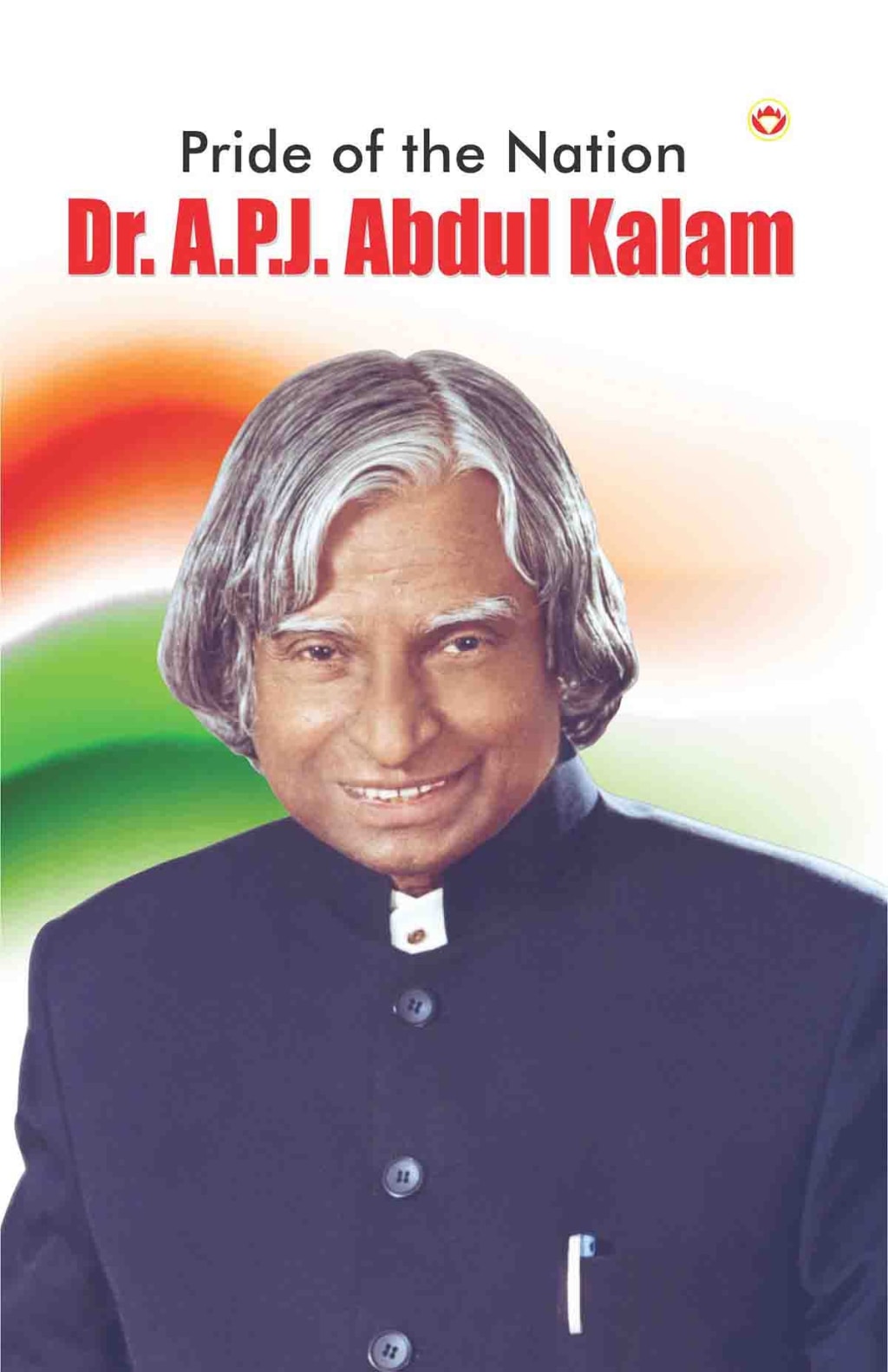
Avul Pakir Jainulabdeen Abdul Kalam, better known as APJ Abdul Kalam, was an illustrious scientist turned statesman who served as the 11th President of India from 2002 to 2007. Kalam spent more than forty years as a science administrator and scientist mainly at the Indian Space Research Organization (ISRO) and Defence Research and the Development Organization (DRDO). He was closely associated with the military missile development efforts and civilian space programme of India. For his work on launch vehicle technology and development of ballistic missile, he was given the pseudonym of ‘The Missile Man of India.’ In 1998, he played a prominent role in Pokhran-II Nuclear Tests.
In 2002, he was elected the 11th President of the country and became widely known as the ‘People’s President.’ After serving his presidential term he pursued what he loved most – teaching, writing and reading. For his achievements and contributions as a scientist, he was honoured with the ‘Bharat Ratan Award,’ India’s highest civilian honour.
He left for the heavenly abode on July 27, 2015, while delivering a lecture at the Indian Institute of Management (IIM) Shillong. He was laid to rest with full state-honours and his funeral was attended by thousands of people including national-level dignitaries.
Early Life
APJ Abdul Kalam was born into a poor Tamil Muslim family in the pilgrimage town of Rameswaram, Tamil Nadu, on October 15, 1931. His mother, Ashiamma, was a housewife and his father, Jainulabdeen, was an imam of a local mosque and a boat owner. He was the youngest in the family with four elder brothers and a sister.
Though, the family was not financially affluent yet all the children were raised in an atmosphere that was full of love and compassion. In order to add to the family’s income, Kalam had to sell newspapers during his early years.
He was an average student during his school, but possessed a strong desire to learn and was very hard working. He loved mathematics and spent hours studying the subject. He pursued his education from ‘Schwartz Higher Secondary School,’ and then graduated from ‘Saint Joseph’s College, Tiruchirappalli,’ in 1954. He wanted to become a fighter pilot but his dream could not be fulfilled as here were only eight positions available in the IAF and he secured the ninth place.
As A Scientist
In 1960, he graduated from the ‘Madras Institute of Technology,’ and joined as a scientist at the ‘Aeronautical Development Establishment,’ after becoming a member of the ‘Defence Research and Development Service.’ Kalam also worked under the eminent space scientist Vikram Sarabhai while he was a part of ‘INCOSPAR’ committee. Kalam was transferred to the ‘Indian Space Research Organization (ISRO)’ in 1969. He became the project head of the country’s foremost Satellite Launch Vehicle (SLV-III). In July 1980, SLV-III deployed the ‘Rohini’ satellite successfully near-earth orbit under Kalam’s leadership.
Kalam was a part of a number of projects, including ‘Project Devil,’ in 1970. Though the project was not successful, yet it laid the foundation for the development of the ‘Prithvi Missile,’ in 1980. He was also associated with ‘Project Valiant.’
In 1983, Kalam returned to DRDO as its chief as he was asked to lead the ‘Integrated Guided Missile Development Program’ (IGMDP).
In May 1998, he played a key role in carrying out ‘Porkhran-II’ nuclear tests by India. The success of these nuclear tests made Kalam a national hero and his popularity went skyrocketing.
As a technical visionary, he made several recommendations in the fields of technological innovations, agriculture, and nuclear energy to make India a developed nation by 2020.
As President
In 2002, Kalam was chosen the Presidential nominee by the ruling National Democratic Alliance (NDA), and he was elected the President. He became the 11th President of India on July 25, 2002 and served the position till July 25, 2007.
He also became the third President of India to have received ‘Bharat Ratna’ before assuming the office of the President.
Due to his style of working and interaction with common people, especially the youth, he was affectionately called ‘The People’s President.’ According to Dr. Kalam, the most arduous decision he had taken during his tenure was that of signing the ‘Office of Profit Bill.’
During his tenure as President, he faced criticism for his inaction in deciding the fate of mercy petitions that were submitted to him. Out of the 21 mercy petitions, he acted only on one mercy plea. In 2005, he recommended for President’s rule in Bihar, which also became a controversial decision.
As An Academician
After the end of his presidential term, he became a visiting professor at the ‘Indian Institute of Management (IIM), Ahemdabad,’ ‘Indian Institute of Management ((IIM), Indore,’ and the ‘Indian Institute of Management (IIM), Shillong.’ He served as a professor of Aerospace Engineering at Anna University, as chancellor at the ‘Indian Institute of Space Science and Technology Thiruvananthapuram,’ an honorary fellow of ‘Indian Institute of Science (IISc), Bangalore,’ and an adjunct at a number of other research and academic institutes across the country. He also taught technology at ‘Anna University,’ and ‘Banaras Hindu University,’ and taught information technology at the ‘International Institute of Information Technology (IIIT), Hyderabad.’
With an aim to defeat corruption and bring efficiency, Kalam launched a program for the youth, called ‘What Can I Give Movement,’ in 2012.
Death
Kalam went to IIM Shillong to deliver a lecture on ‘Creating a Livable Planet Earth,’ on July 27, 2015. While climbing a flight of stairs, he expressed some discomfort, but made his way to the auditorium. Only five minutes into the lecture, around 6:35pm IST, he collapsed in the lecture hall. He was taken to ‘Bethany Hospital’ in a critical condition. He was kept in the intensive care unit but lacked signs of life. At 7:45pm IST, he was declared dead due to cardiac arrest.
Kalam’s body was airlifted in an Indian Air Force helicopter and was flown to New Delhi on July 28. Numerous dignitaries and masses paid homage to him at his residence at 10 Rajaji Marg. Kalam’s body, wrapped in the national flag, was then flown to the town of Mandapam, from where an army truck took it to his home town of Rameswaram. His body was displayed at Rameswaram in front of a bus station to allow people to pay their last respect to the departed soul. On July 30, 2015, the former President was laid to rest with full state honours at Rameswaram’s Pei Karumbu Ground. Kalam’s last rites were attended by more than 350,000 people.
About the Creator
A Failed Artist, A Disillusioned Poet, An Underpaid Game Show Host
I took my son and niece to Gori, a small town in Georgia where Joseph Stalin was born. They talked me into visiting the Stalin's Museum, the largest in the post-Soviet space. I had resisted going there because I just can't stand the monster and know enough about him, or so I thought.
By Lana V Lynx20 days ago in FYI
Autonomy Is The Real Privilege
Good morning, freedom-seekers! Today we’re gonna be looking at autonomy. A strange word, I know; one many would probably look at blankly and run away from on sight. We’re gonna figure out what it actually means, consider how it’s achieved, and decipher just how deeply most of us are tangled up in dependence without realising it.
By That ‘Freedom’ Guy5 days ago in Humans



Comments
There are no comments for this story
Be the first to respond and start the conversation.