
DIWALI
Diwali, also known as Deepavali, is one of the most widely celebrated festivals in India and other parts of the world. It is a five-day festival, celebrated during the Hindu month of Kartik (usually in October or November).
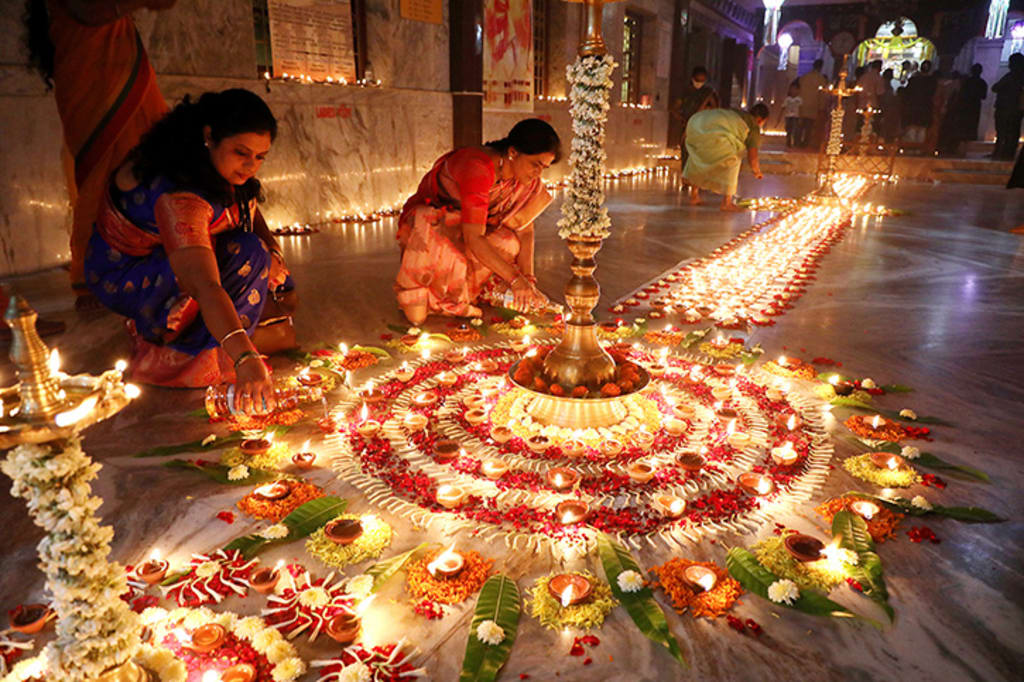
Diwali, also known as Deepavali, is one of the most widely celebrated festivals in India and other parts of the world. It is a five-day festival, celebrated during the Hindu month of Kartik (usually in October or November).
Diwali is often referred to as the "Festival of Lights," as it involves the lighting of lamps and candles, and the display of fireworks. It symbolizes the triumph of good over evil and is celebrated to honor Lord Rama's return to Ayodhya after defeating Ravana, the demon king.
During Diwali, people clean and decorate their homes, prepare special foods and sweets, exchange gifts with friends and family, and light oil lamps and candles. It is also a time for prayers and visits to temples.
In addition to its religious significance, Diwali has also become a cultural festival that is celebrated by people of all religions and backgrounds in India and around the world.
History behind Diwali
The history behind Diwali can be traced back to ancient India and has different religious and cultural significance in various parts of the country.
One of the most well-known stories associated with Diwali is the story of Lord Rama, the prince of Ayodhya who defeated Ravana, the demon king of Lanka, and rescued his wife Sita from his captivity. The story goes that after 14 years of exile, Lord Rama returned to Ayodhya with his wife Sita and brother Lakshmana on the day of Diwali. The people of Ayodhya lit oil lamps to welcome their beloved prince and celebrate his return, which became a tradition and is still followed today.
Another story associated with Diwali is the story of the victory of Lord Krishna over the demon Narakasura, who had imprisoned many princesses. It is said that Lord Krishna killed Narakasura on the day of Diwali and freed the princesses, which is why people celebrate Diwali as a victory of good over evil.
In some parts of India, Diwali is also celebrated as the day when Goddess Lakshmi, the goddess of wealth and prosperity, was born. It is believed that on the night of Diwali, Goddess Lakshmi visits homes that are clean and brightly lit, bringing wealth and prosperity with her.
Overall, Diwali is a festival that celebrates the triumph of good over evil, light over darkness, and knowledge over ignorance. It is a time for people to come together, celebrate, and spread happiness and positivity.
What to do on Diwali?
Diwali is a five-day festival that involves various customs and traditions. Here are some of the things you can do during Diwali:
Clean and decorate your home: People clean their homes thoroughly before Diwali and decorate it with rangolis, lights, and flowers. It is believed that a clean and decorated home attracts wealth and prosperity.
Light lamps and candles: Diwali is known as the "Festival of Lights" and lighting diyas (lamps), candles, and electric lights is an important ritual during the festival. Lighting lamps symbolizes the victory of good over evil and is believed to bring positivity and happiness to homes.
Offer prayers and perform puja: Diwali is a time for spiritual renewal and people offer prayers to deities like Lord Ganesha, Goddess Lakshmi, and Lord Rama. Performing puja and offering sweets and flowers is considered auspicious during Diwali.
Prepare special foods and sweets: Diwali is also a time for feasting and people prepare special foods and sweets like laddoos, barfis, and chaklis. Sharing food and sweets with friends and family is also a part of the festival.
Exchange gifts: Giving and receiving gifts is a common tradition during Diwali. People exchange sweets, chocolates, clothes, and other items as a gesture of love and appreciation.
Burst fireworks: While bursting crackers and fireworks is a popular tradition during Diwali, it is important to ensure safety and minimize noise pollution. You can opt for eco-friendly crackers and limit the use of fireworks to ensure a safe and peaceful celebration.
Overall, Diwali is a time for joy, togetherness, and spiritual renewal. You can choose to participate in the rituals and traditions that resonate with you and celebrate the festival in a meaningful way.
About the Creator
Crude Oil Prices and the Cost of Everyday Survival
Every morning, before most of us check the weather, global markets are already reacting to crude oil prices. The numbers rise and fall quietly on trading screens, yet they shape how we live. They influence how much it costs to drive to work, ship groceries across states, or heat a small apartment during winter.
By Muqadas khana day ago in FYI
I wanted to title this something different, but worried that my chosen title might cause problems entering the United States in the future so this is the new title. It's the greatest title. No one has ever written a title better than this. (All titles unrelated to content).
Let me be honest. I am finding this difficult. Now, I like a challenge, a stretch, a bit of an obstacle course. “Write about the decline of the British Empire in the form of a narrative poem in which your protagonist is an artichoke” I read, and flex my fingers. “Write a haiku to evoke the sensation of sibilance using only the first half of the alphabet.” “Well”, I think to myself, “this should be fun.” But “write about a system that isn’t working”? A system that isn’t working? Now? In 2026? ONE system? My favourite system that isn’t working? The sexiest system that isn’t working? The one giving me the most angst day to day? The one giving me the most existential dread? I am, as I say, finding this difficult. I will own that I have contemplated writing a thousand words on why the steady “all on” setting on my fairy lights is the EIGHTH of seven options which must be sequentially activated to get there, because that is a system that some fool came up with and it definitely doesn’t work, and now who is paying the price, eh? But how can I write about my fairy lights when…. When…. When….
By Hannah Moore5 days ago in Humans




Comments
There are no comments for this story
Be the first to respond and start the conversation.