
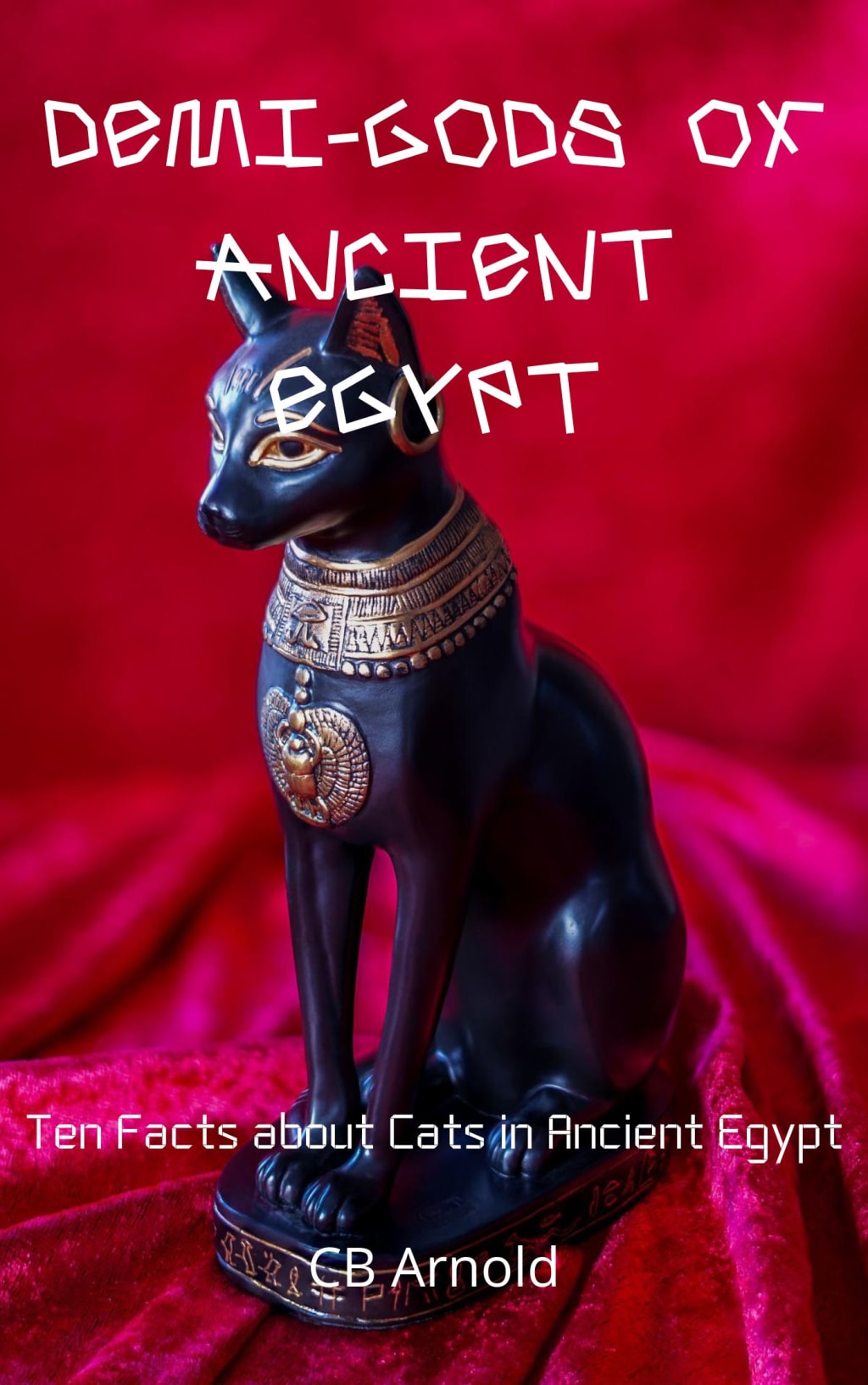
Demi-Gods of Ancient Egypt
Ten Facts About Cats in Ancient Egypt

The Third and Most Powerful Major Feline Goddess
According to Egyptian legend, long ago, the sun god Ra grew angry with the behavior of his human subjects and sent his daughter, Sakhmet, a lion-headed goddess, to punish them (Source 1). Sakhmet, whose name evolved from the Egyptian word for “She who is Powerful,” was mentioned in the Book of the Dead several times as a destructive force and a healing force. In addition, she was the patron goddess for Healers and Physicians and could cure plagues and diseases for those she found favorable (Source 2). In this instance, however, she would be known more as a force for terror than for life. Sakhmet was extremely effective at punishing the humans for insulting her father. She also acquired a taste for the blood of her victims.
Ra realized that perhaps each of them had gone a bit too far and tried to pacify his crusading daughter and stem her thirst for the blood of their subjects. Ra asked Sakhmet to visit him and report on her progress. While dining together, he gave her red beer as a substitute for the blood she’d grown accustomed to. The beer calmed Sakhmet enough that she fell asleep at Ra’s feet, peacefully curled up in a ball like a house cat.
Sakhmet’s duality, being both healer and destroyer, still earned her a place in the hearts of the Egyptians. They admired her strength for her ability to protect them from enemies and her ability to protect them from illness.
Cats Averted Disaster in Ancient Egypt
Ancient Egypt did not have the means to control rodents, pests, and other dangerous critters as we do today. At times, population explosions of scorpions, deadly snakes called Asps, mice and rats plagued cities. Scorpions would crawl into the beds of both parents and children. Asps would hide in jars, waiting for the errant hand to reach inside. Mice would infest stores of grain, ruining them with their excrement. Rats would invade the streets, attack the poor and homeless, spread disease and pestilence, and feast on the refuse inhabitants piled up in heaps throughout the city.
Cats served to stem the tide of these vermin (Source 2). They would prevent mice and rats from defiling food stores and attacking people, kill Asps before they had a chance to hide and destroy poisonous scorpions before they crawled into beds.
Cats earned a place in Egyptian society and eventually in homes as guardians and protectors for the residents and the food stocks necessary for their survival.
The First Major Feline Goddess
Historians considered Mafdet, which meant “the runner,” to be the first of the feline goddesses. She was such a scourge upon venomous creatures that many sought her favor, including Ra. Mafdet is believed to pre-date even Sakhmet as his protector because of his weakness against snakes and scorpions. In public, she often wore the head of a house cat or a cheetah and adorned her hair with the body sections of scorpions with the tip of her braids ending in the stingers. She crowned her head with a bonnet made out of snakes.
Mafdet was also the goddess of justice and execution.
A more gruesome part of Mafdet’s legacy had to do with the way she performed executions. Mafdet would use her claws to either rip out the hearts or decapitate offenders and offer the prize to the Pharoah, much like a cat offering its owner a catch. This earned her another title as “Avenger of the King”.
Eventually, though, Mafdet was replaced by another goddess.
Did Ancient Egyptians Worship Cats?
In a word, no. They did not worship cats, but in a way, they did deify them—sort of.
Ancient Egyptians looked for ways to explain the universe and make it more personal to the individual so they could understand their place in it (Source 3). This is one of the reasons they revered not just cats but all animals, though felines remained in higher regard than any other animal (Source 4). In them, they saw something more than themselves—something divine.
They believed that when the Gods created cats and other animals, they imbued them with a divine spirit. So they were not considered to be Gods themselves so much as Demi-Gods.
In the Valley of Kings, there is more evidence that Ancient Egyptians thought of cats as Demi-Gods. An inscription there calls them “Great Cat” (Source 4) and says they are sovereign entities, governors, and the Gods’ avengers. Those are strong words to be etched in stone by the ancients.
Ancient Egypt was so serious about the special place cats held in their society that even to harm a cat, much less kill one even by accident, was punishable by death (Source 5).
The Second and Most Well Known Major Feline Goddess
Once Mafdet fell out of favor, Bastet, or Bast as she’s more well known, took her place. One of her titles was “The Eye of Ra” because she protected Egypt from invasion by keeping watch over the world for him (Source 6). Sakhmet had the head of a lion and Mafdet the head of a house cat or cheetah. Bast was the only goddess believed to have the power to actually transform into a cat (Source 7).
Bast was one of the most loved of all the gods and goddesses of Ancient Egypt and was the patron of many aspects of Egyptian life, including pleasure, family, fertility, sexuality, and pregnant women, to name a few (Source 7). She had temples in most of the major cities, including Memphis, but none of them came close to the level of reverence she received in Bubastis, the city named after her.
According to the ancient historian Herodotus close to 700,000 people would make their way to Bubastis for the annual festival held in her honor. Much wine was drunk, and many great sacrifices were offered in the name of the goddess Bast.
Later in the history of Egypt, however, as the kingdom faced more threats from both internal and external forces, Bast’s popularity waned, and the people turned to the stronger, fiercer defender, Sakhmet.
Minor Feline Goddesses and One Feline God
Now that we’re finished with the majors let’s talk about the minor league Egyptian deities with feline qualities. Let’s start with the only male in the lineup today.
His name is Maahes, son of Bast, Sakhmet, and Ptah, also known as the God of Wisdom. In case you’re wondering, yes, Sakhmet is also a female god. Don’t ask how it could happen. They’re all Gods; just roll with it. Now we shall continue. Maahes was also a God of War known as “The Lord of the Massacre,” among other titles. Even as a War God, he was known to protect the innocent. He apparently inherited the full-body transformation ability from his mother because hieroglyphs depicted Maahes as a lion. To a lesser extent, hieroglyphs showed him in human form with the head of a young lion.
Next up is Pakhet, Goddess of Motherhood, also known as the Night Huntress. Pakhet’s temperament lay somewhere between Sakhmet and Bast. She wasn’t as fierce as Sakhmet but was a bit wilder than the far more domesticated Bast.
Mekal, the Fierce Devourer, was the Lion Goddess of Pestilence worshipped in the city of Beit She’an in Canaan, conquered by Pharaoh Thutmose III (Source 8).
Last but not least is Menhit. She was a foreign Goddess of Nubian descent. Her name meant “the slaughterer”, a good name for a Goddess of War. She had a lion’s head, much like Sakhmet.
There are more but let’s stop there.
They Did What to Cats?
If you ever doubted that cats once held a very important place in Ancient Egyptian society, know this—they mummified cats. Yes, they mummified not just a few of them, not just the ones who belonged to royalty and the rich. They mummified cats numbering in perhaps the millions!
Archaeologists found hundreds of thousands in catacombs at Tell-Bast and Saqqara alone. Researchers have determined that the mummified felines would be sold to those making the journey to Bubastis for the festival. The pilgrims would use them as an offering to Bast, a way to give back some of the energy she used to help humanity (Source 3).
On a more solemn note, at one point, the relics were so common a find that the British would ship them home, crushed and used as fertilizer. One shipment alone contained over 180,000 cat mummies (Source 1).
Upon examination, experts found that some of the mummies were intentionally killed. Researchers presumed that despite the severe penalties associated with harming felines, sometimes it was necessary to control the cat population. Since they were likely ritual killings, the mummies would have been offered to Bast (Source 4).
Cat smuggling was apparently rampant since, at the time, it was illegal to export Egyptian cats to other countries. Researchers have found court records indicating that those in charge would occasionally dispatch armies to bring the cats back to Egypt (Source 4).
They Looked Different Then Than Now, but Not That Different
When you look at the Egyptian bas reliefs and statues of cats, they looked very bland and monochrome. Pictographs and tomb paintings, however, were vastly different. Most of us had seen those statues in Egyptian exhibits, and to be honest, we might have gotten the idea that most of the cats in Ancient Egypt were hairless and black or had black fur. That was not the case. Time affected those objects more than we imagined.
Archaeologists tell us that artists painted the white marble statues from Greece and Rome to look lifelike, and so were the cat statues of Ancient Egypt (Source 9).
Murals and paintings in the tombs of Sennedjem and Nakht show us that cats of that time had a mackerel tabby pattern similar to the Near Eastern Wildcat. A recent genetic study has shown that all modern domesticated cats descended from that species (Source 10).
The Egyptians Domesticated Cats First, Didn’t They?
For a long time, experts believed that Ancient Egyptians were the first civilization to domesticate cats, but that ended in 2004. On the island of Cyprus in the Mediterranean, researchers found a cat buried with a human. What blew everything up was that the remains were 9,500 years old. This discovery meant that cats and humans lived together long before the Egyptian empire had even been born!
The new theory held for four years until an archaeozoologist found 6,000-year-old remains of domesticated cats on the banks of the Nile in Southern Egypt. This led to a theory that perhaps Egypt did domesticate the cat, only much later but separate from another civilization. A recent genetic study upheld that theory.
The study showed two different genetic strains of domesticated cats. One originated in the area, which is now Turkey, and the other originated in Egypt, signifying that while Egypt was not the first to domesticate cats, they still did it on a parallel track with another civilization (Source 10).
The Love that Ended an Empire
After a period of great prosperity and expansion led by the likes of Hatshepsut, Amenhotep III, Nefertiti, Tutankhamun, and Ramesses, among others, the empire began its decline. Beginning around 1069 BCE Egypt devolved into social instability, civil war, and decentralized government. This led to invasions first by the Nubians and then twice by the Assyrians.
Unified by the Nubians, the Egyptians drove the Assyrians out, but they could not withstand the next attack from the mighty Persians.
When the Persians attacked, the Egyptians held them at bay even when the Greeks betrayed them by not sending troops to help per their agreement. However, the Persian king changed his battle strategy. He directed his army to paint an image of Bast on their shields and drove a herd of animals, including cats, ahead of their front lines.
When the Egyptians saw this, they surrendered without a fight. This act signaled the effective end of Egyptian sovereignty (Source 11).
Sources:
1: https://www.smithsonianmag.com/smithsonian-institution/why-ancient-egyptians-loved-their-kitties-180965155/
2: https://ancientegyptonline.co.uk/sekhmet/
3: https://science.howstuffworks.com/environmental/earth/archaeology/ancient-egyptians-revered-cats-for-divine-energy.htm
4: https://ancientegyptonline.co.uk/cat/
5: http://www.catmuseumsf.org/egyptcats.html
6: https://www.petfinder.com/pet-adoption/cat-adoption/why-did-egyptians-worship-cats/
7: https://kids.nationalgeographic.com/explore/cats-rule-in-ancient-egypt/
8: http://www.landofpyramids.org/mekal.htm
9: https://www.forbes.com/sites/davidanderson/2019/01/29/cats-in-ancient-egypt-didnt-look-the-way-you-think/#87392764ee7c
10: https://www.sciencemag.org/news/2017/06/ancient-egyptians-may-have-given-cats-personality-conquer-world
11: https://www.ancient.eu/article/43/the-battle-of-pelusium-a-victory-decided-by-cats/
About the Creator
Clifton Brown
I am a Father, a Veteran who has seen action, a writer, I drive a truck for a living, a Husband, and most of all, a Grandfather to one of the most amazing kids in the world.
I write BIPOC Scifi and Fantasy, spiced with Romance.
Keep reading
More stories from Clifton Brown and writers in FYI and other communities.
In the Ghost's Shadow
Brick made it back alive from yet another op, but his blood brother didn’t. Some winter break that was, he thought. Still, there he was at the foot of the stairs, staring at the double doors of the science hall at Jarvis University in Colorado Springs, Colorado. The light, seemingly everpresent breeze snatched the puffs of steam from his nostrils, only to freeze his nose hairs upon his next inhaled breath. The crisp, clean, cold air bolstered Brick because it cleansed him of the dark, heavy, dankness of the Myanmar rainforest where Fritz had been slaughtered. He sighed.
By Clifton Brown4 years ago in Fiction
Alabama’s Sunken Secret: The 60,000-Year-Old Forest Hidden Under the Gulf
Imagine diving sixty feet below the surface of the Gulf of Mexico, about fifteen miles off the coast of Alabama. You aren't looking for a shipwreck or buried pirate gold. Instead, as the bubbles clear, you see something much more haunting: the Alabama underwater forest. This is a prehistoric world of giant cypress trees, still rooted in the mud where they grew tens of thousands of years before the Great Pyramids were even built.
By Areeba Umair6 days ago in FYI




Comments
There are no comments for this story
Be the first to respond and start the conversation.