
Alabama’s Sunken Secret: The 60,000-Year-Old Forest Hidden Under the Gulf
How a monster hurricane revealed an ancient world, and what it tells us about our future.
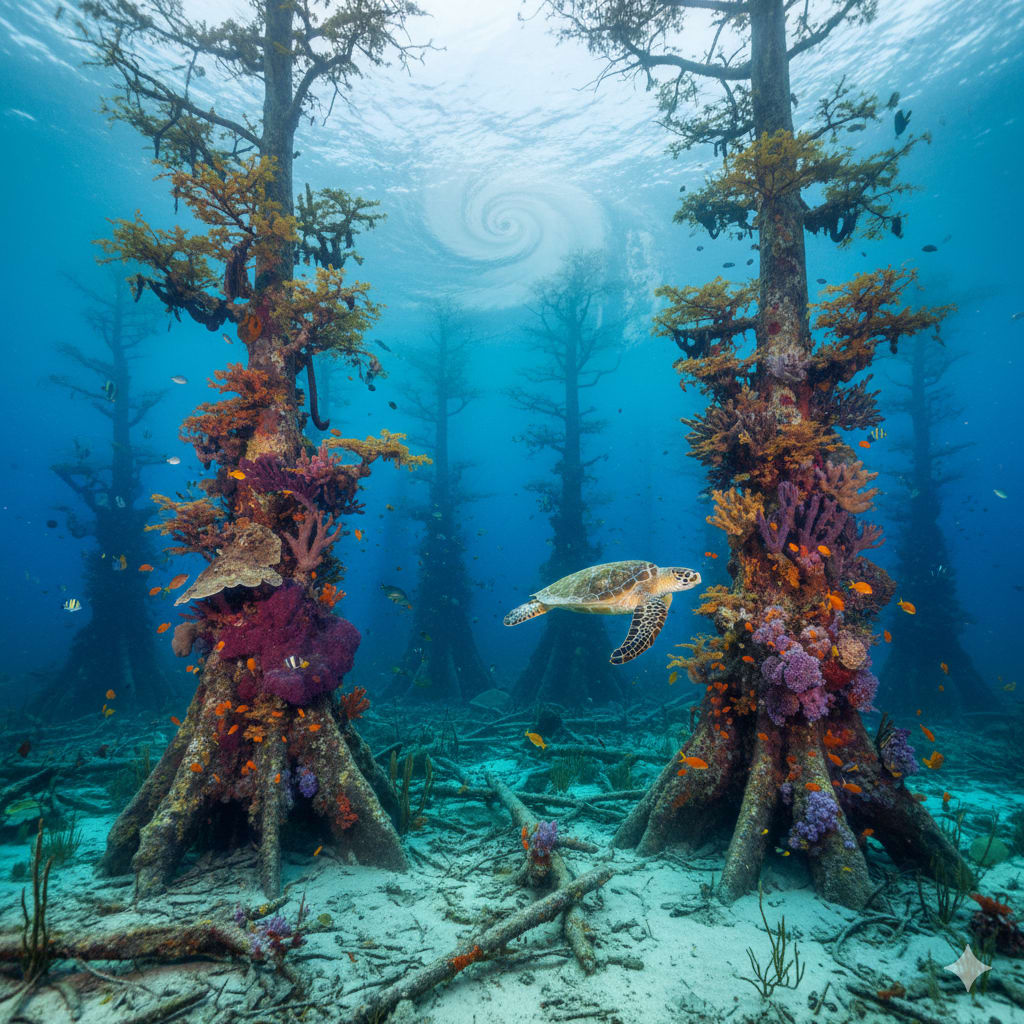
Imagine diving sixty feet below the surface of the Gulf of Mexico, about fifteen miles off the coast of Alabama. You aren't looking for a shipwreck or buried pirate gold. Instead, as the bubbles clear, you see something much more haunting: the Alabama underwater forest. This is a prehistoric world of giant cypress trees, still rooted in the mud where they grew tens of thousands of years before the Great Pyramids were even built.
This isn’t a scene from a science fiction movie. It’s a real-life relic that remained hidden under the seafloor until a monster storm brought it back to light.
The Day the Gulf Revealed Its Past
For millennia, this forest was a secret kept by the ocean. It wasn’t discovered by scientists with high-tech sensors, but by a local dive shop owner, Chaz Bron. Following a tip about a "fish-heavy spot" that wasn't on any charts, Bron rolled off his boat and found himself staring at a prehistoric riverbed.
"It looked like a prehistoric riverbed just running along the sand with trees coming out over it," Bron recalled. In 25 years of diving the Gulf, he had never seen anything like it.
How Hurricane Ivan Uncovered History
How did a freshwater swamp end up at the bottom of the ocean? The answer starts with Hurricane Ivan in 2004. This massive Class 4 storm slammed into the Alabama coast with 140 mph winds and recorded waves nearly 100 feet tall.
The sheer power of the storm acted like a giant underwater pressure washer, stripping away layers of sand and sediment to reveal the stumps and limbs of an ancient world.
The Trees That Refuse to Rot
What’s truly mind-blowing about this site is the preservation. Usually, wood in the ocean is a buffet for marine worms. However, when these trees were swallowed by the rising sea 60,000 years ago, they were quickly buried in thick, silty mud. This created an anoxic environment, a place with no oxygen.
Without oxygen, there is no decomposition. Scientists like Christine DeLong and Grant Harley found that when you cut into the wood today, it still smells like fresh cypress resin. Some samples even have the original bark and evidence of prehistoric beetles!
A New Kind of Reef
While these trees are no longer home to birds or squirrels, they are swarming with life. Today, the forest has transformed into a vibrant, surreal coral reef:
- Anemones cover the stumps like a living carpet.
- Octopuses and Eels hide in the hollows of 60,000-year-old logs.
- Sea Turtles patrol the ancient riverbed once walked by Ice Age animals.
A Warning for Our Future
Beyond the "cool factor," the forest is a time capsule. By studying the tree rings, researchers can see how the ecosystem responded to sea level rise in the past.
For paleontologists like Martin Becker, looking at these stumps 15 miles offshore is a sobering reminder. It shows just how quickly the coastlines we live on today can be reclaimed by the sea. As Becker puts it, it’s a window into a future that might be "an unpleasant one" if we don't learn from the past.
About the Creator
Areeba Umair
Writing stories that blend fiction and history, exploring the past with a touch of imagination.
Keep reading
More stories from Areeba Umair and writers in FYI and other communities.
What If the Oceans Disappeared? The Terrifying Scientific Reality
We take the oceans for granted. They’re just there, a massive, blue background to our beach vacations and sushi dinners. But the oceans cover 70% of our planet's surface. They hold over a billion cubic kilometers of water.
By Areeba Umair8 days ago in FYI
We Shall Never Surrender: The Speech That Turned Britain’s Darkest Hour Into Defiance
There are speeches that explain history, and then there are speeches that intervene in it. On June 4, 1940, Winston Churchill delivered one of the most consequential addresses ever spoken inside the House of Commons. Britain had just pulled off the miracle of Dunkirk—an evacuation that saved more than 330,000 Allied troops from annihilation. But make no mistake: this was not a victory. France was collapsing. Nazi Germany looked unstoppable. Invasion felt inevitable.
By Lawrence Lease7 days ago in FYI
Wild Card Weekend Recap: What Happens Now?
I think I figured out why I love Wild Card Weekend so much. It's because it's the first playoff anything of the calendar year. The NFL season starts in the fall, and once upon a time, the champion was crowned either on or slightly before New Year's. The evolution of the NFL schedule has resulted in the playoffs starting just into the New Year, and currently, the final week of the season falls on the first weekend of the New Year, with Wild Card Weekend coming a week after that. So yes, chronologically, the NFL's Wild Card Weekend serves as the first playoff anything of the calendar year.
By Clyde E. Dawkins6 days ago in Unbalanced



Comments
There are no comments for this story
Be the first to respond and start the conversation.