

A lot of people are unaware of the ethical issues accompanying the consumption of dairy. They assume that since cows need to be milked that there is no harm in consuming the product they provide.
Of course, cows need to be milked, but due to genetic breeding, they produce mass amounts of milk that would otherwise be extremely unnatural.
This selective breeding also results in overly sized udders, which is why most dairy cows face mastitis- a painful inflammation and infection of the udders, regularly in commercial farming.
Pregnant Cows Make Milk
Cows produce milk only when they are pregnant. I didn't know that for a long time until it was brought to my attention in my junior year of college. Cows are impregnated by artificial means starting at only 12 months old.
They are secured into a device called a "rape rack" where a human puts their arm through the cow's anus, sometimes with their fist to loosen the area.
They do this to initially remove any feces so they can maneuver the cervix to insert bull semen into it. They obtain the bull semen by ejaculating the bull repeatedly.
Calf Removal
After the cow gives birth, the baby calf is removed within 24–72 hours from their mama, never to see each other again. If it's a male baby, it is raised for veal, and if it's a female, it goes into dairy production and eventual slaughter, as do all dairy cows.
Cows have a maternal drive, and when their baby is taken from them, they engage in what is called pining, for days or weeks. This is when they cry out for their baby out of desperation, confusion, and sadness.
How Many Births Do Cows Have?
Cows are repeatedly kept impregnated for their entire short-lived lives to keep them lactating, otherwise, they would eventually stop producing milk since it's intended for their young until weaning. This leads to premature aging, exhaustion, and mastitis, as mentioned earlier.
After about 4–5 years of being a milk machine, cows collapse and are referred to as downers. At this point they are then removed by any means possible to bring them to slaughter to beef. But, even if they are still standing after 4–5 years, they'll be sent to slaughter anyway since their milk production naturally declines at this time due to abuse of the body.
A normal lifespan for a cow in the wild is 15- 20 (at max) years. Above all else and especially for vegetarians, it's important to note that the dairy industry is inextricably connected to the meat industry. And there's literally not one good reason to support either of them.
Humane meat does not exist.
What the Media Tells Us
Unfortunately, we hold images of happy cows grazing on green pastures and opt for organic milk or grass-fed beef. I recognize people opt for these slightly more expensive products perhaps for nutritional benefits or animal welfare concerns, if not both.
The grazing lands we see on tv could not be any further from the truth - it's a big fat marketing ploy. Grazing is inefficient for major agribusiness industries because it takes a lot of space and doesn't produce a high volume of milk.
So, the majority of cows, whether organic or not are most often sentenced to a life behind bars, raised on grain-based diets. (Fun fact- more than half of the world's production of soy goes towards feeding livestock, so if you happen to believe that plants feel pain, that actually falls under an argument for veganism. Crazy, right?)
Nutritional Deficiencies in Cows
Since cows' bodies are meant to digest grass and vegetation, when they are only fed grains, they develop a nutritional disease that leads to acidosis. Acute acidosis often results in death. Unfortunately, this is common, since it is the most cost-effective.
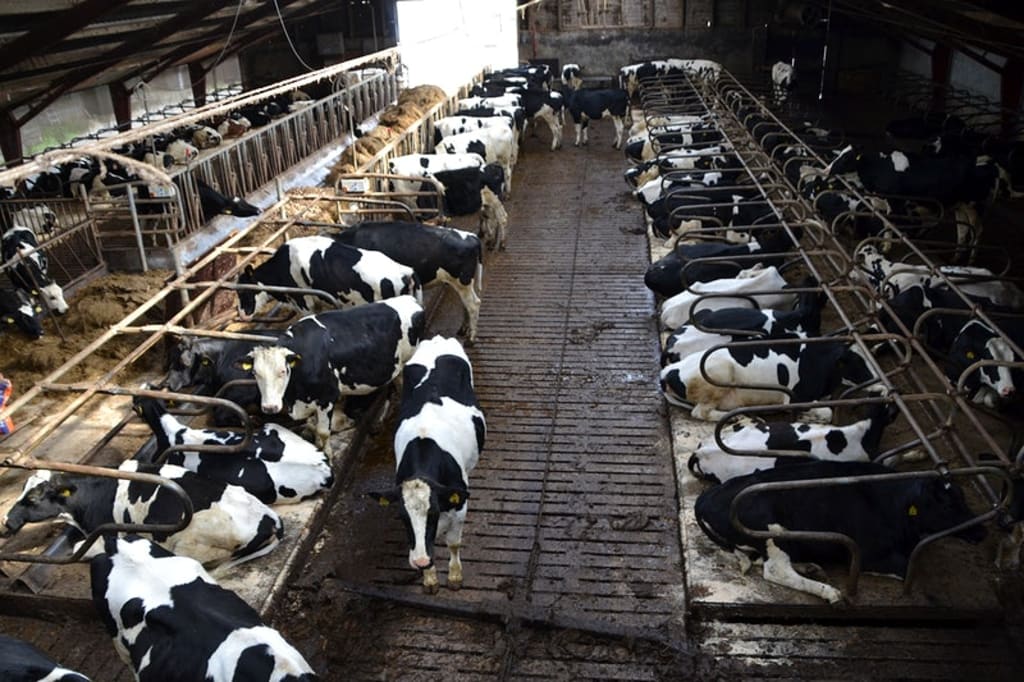
Cows are confined in close quarters where they are housed in individual sectors accompanied by concrete floors and windowless rooms. Their pens are so small they can't even turn around in them. They are chained there 24 hours per day in many cases for milking in smaller or "local" farms as you can see in the feature image.
Painful Protocols
Let us not forget that dairy cows are forced to undergo painful procedures without any anesthetic. Despite what you hear, anesthetic treatments are costly and not required by law in many countries. Routine procedures include ear tagging, dehorning (by use of a hot metal rod,) and in some cases tail docking.
Spent
As mentioned before, when dairy cows are considered "spent," they are prepared for slaughter, which is often at a different location. They are piled into trucks, where most of them see glimmers of sunlight for the first time through metal cracks. In the U.S. it is legal to withhold food and water from animals on their way to slaughter for up to 28 hours. It is common for livestock to die during transport, whether it be from dehydration, extreme temperatures, or health conditions they previously contracted from their living conditions.
After they are forced through the doors of the factory plant, they are sometimes met with a bolt-gun to the temples, which has been proven an ineffective method of stunning by animal experts. After this, they are shackled upside down and have their throat slit by a slaughterhouse worker who may cut them in a way that could cause them a brutal bleed out where they are still completely conscious due to ineffective stunning methods.
Humane meat does not exist.
It took me a good while to wrap my head around how the dairy industry operates, and it was quite hard to believe. After being raised on dairy products for the first eighteen years of my life, I had to work hard to unlearn a lot.
Then I realized you can't love animals and eat them (or their secretions), too. So I went vegan.
And I hope you will too one day. Listen, I didn't go vegan overnight, but cutting dairy is a major step towards reducing your contribution to animal abuse. And aside from cutting dairy for the animals, you would also be doing a favor for our earth and your health.
For more information here's a 5-minute video from an awesome Youtuber, Erin Janus called "Dairy is Scary."
Xo, Susie
〰〰〰〰〰〰〰〰〰〰〰〰〰〰〰〰〰〰〰〰〰〰〰〰〰〰〰〰〰〰〰〰〰
If you enjoyed this piece, please consider leaving a tip. Thanks!✌️😊
About the Creator
Susie Pinon
Italian chick with a New Yorker attitude. Free-spirited, eclectic by nature, vegan. I'm fueled by my passion for the art of words. I'm addicted to chocolate + love to heal through the sun's rays. Let's talk words
https://linktr.ee/xosusiep
Keep reading
More stories from Susie Pinon and writers in FYI and other communities.
An Introduction to How Thoughts Create Things
Have you ever heard of the law of attraction? If you haven't, you're in luck. If you are ready and willing, your life is about to drastically change for the better. No, this is not too good to be true. It is a very real ideology that has been practiced for thousands of years - a philosophy supported by quantum physics and by experts in various fields.
By Susie Pinon4 years ago in Lifehack
I was in a Toxic Relationship, with my Workplace
“You got that?” My ex yelled. His hands were balled into fists at his side. At six foot three, he towered over me. A normal person would have been afraid, but I looked up a video of George Lopez repeatedly saying, “I got this,” and showed it to him. I had grown used to this treatment, so much so that I didn’t blink when he ripped the phone from my hand and threw it across the room.
By Jade M.4 days ago in Confessions




Comments
There are no comments for this story
Be the first to respond and start the conversation.