
Cholangiocarcinoma: Bile Ducts Cancer
Are your bile ducts as safe as you think they are?

Have you ever heard of the word ‘Cholangiocarcinoma’? I’ve never heard before this and I have no idea how to even pronounce it.
Apparently, it’s the term used for the cancer of the bile ducts. And now comes the question of ‘What are bile ducts?’
This question can be answered by the mechanism that is pictured in the image below which also involves the liver and gallbladder.
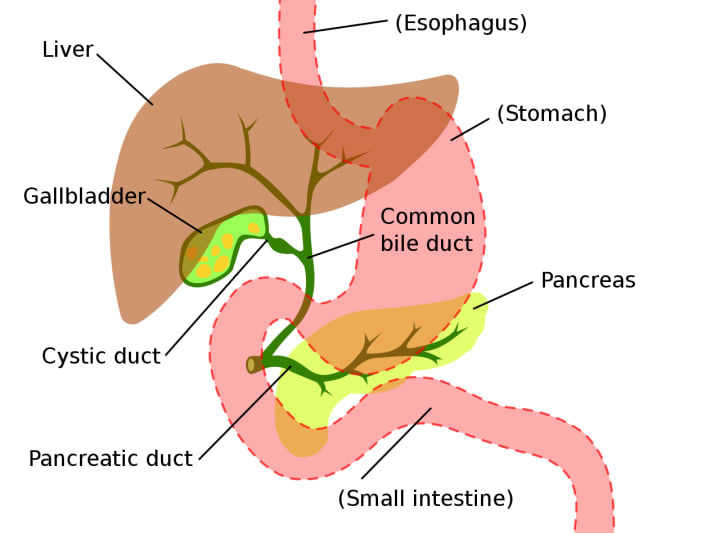
The bile duct is actually a 4-inch to 5-inch tube that connects the liver and gallbladder to the small intestine. The bile duct allows bile, which is made in the liver and stored in the gallbladder, to flow into the small intestine.
Now arises the question of ‘What is bile?’
Bile is a liquid that helps to both break down fats found in the foods that we eat. Other than that, it also helps the body to get rid of waste material that the liver filters out of the bloodstream.
Inside the liver, smaller tubes will drain the bile from the liver into larger branches which is the common bile duct. Outside of the liver, the bile duct drains into the small intestine.
And now, introducing our next character, the gallbladder.
The gallbladder is a reservoir that holds bile until food reaches the intestines. It is attached by a small duct, called the cystic duct, to the common bile ducts. The end of the bile duct empties into the small intestine.
Now that we understand the mechanism behind the bile ducts, liver and gallbladder, let’s move on to the cancer. This can be easily understood with the aid of the image below.
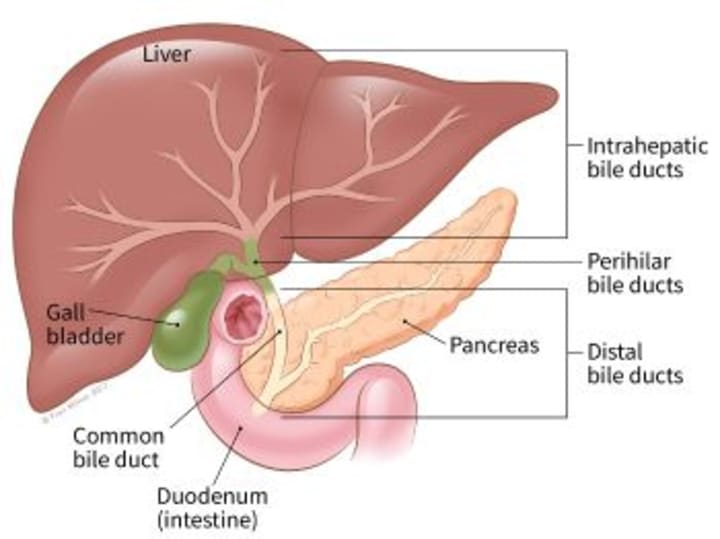
Cancer can occur in any part of the bile duct.
The part of the tube that is outside of the liver is called extrahepatic and inside the liver is called intrahepatic. Extrahepatic cancers are the most common whereas intrahepatic is least common.
Perihilar cancer begins at the point where the bile duct leaves the liver.
Distal cholangiocarcinoma occurs where the bile duct empties into the small intestine.
Prominent symptoms of cholangiocarcinoma include abnormal liver function tests, abdominal pain, jaundice, weight loss, and sometimes generalized itching, fever, or changes in stool or urine color.
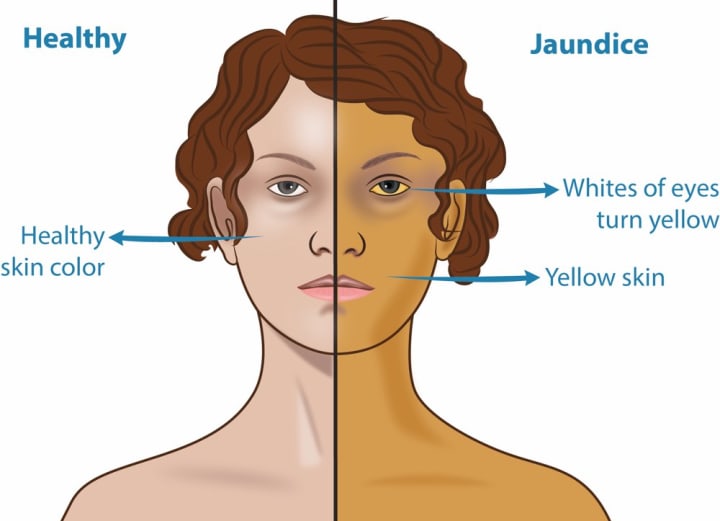
Jaundice is the yellowing of the skin and the whites of the eyes as portrayed by the image below.
The cancer is diagnosed through a combination of blood tests, imaging, endoscopy, and sometimes surgical exploration.
Known risk factors for cholangiocarcinoma include primary sclerosing cholangitis (an inflammatory disease of the bile ducts), congenital liver malformations, infection with the parasitic liver flukes Opisthorchis viverrini or Clonorchis sinensis, and exposure to Thorotrast (thorium dioxide), a chemical formerly used in medical imaging.
Cholangiocarcinoma is considered to be an incurable and rapidly lethal disease unless all of its tumors can be fully cut out surgically.
Patients with cholangiocarcinoma can only be managed with chemotherapy or radiation therapy as well as palliative care measures.
As suggested by recent clinical research, nutrition plays a humungous role in cancer prevention, treatment, recurrence and quality of life for cancer patients.
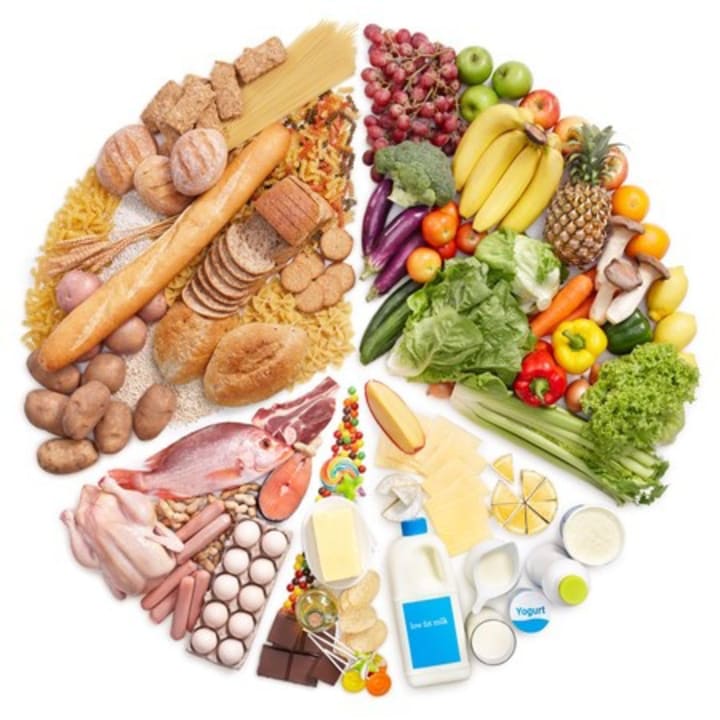
A diet high in vegetables, fruits, whole grains and legumes, and low in red meat, saturated fats and alcohol, paired with daily physical activity is ideal for health and longevity.
Foods should be prepared from scratch whenever possible. Seasoning should only consist of fresh or dried herbs as salt intake should be minimized.
Intake of saturated fats, found primarily in red meat and dairy should be limited. Refined flours and sugars should be reduced.
All processed foods such as snack chips, crackers, cookies and sugary drinks like soda, sport drinks and even fruit juice should be avoided at all costs.
Copious amounts of water should be consumed to keep the body sufficiently hydrated.
__________________________________________
Thank you so much for reading this! 🥰 If you liked my writing, please leave a comment, click the heart and subscribe for free!
About the Creator
Dharrsheena Raja Segarran
🥇 Vocal Creator of the Year (2023) 🏆
❤️ Erythrophile ❤️
✨️ Glitteringly Savage ✨️
🖤 Elegantly Disturbed Mind 🖤
Instagram 🤍 Facebook 🤍 Threads
Reader insights
Outstanding
Excellent work. Looking forward to reading more!
Top insights
Expert insights and opinions
Arguments were carefully researched and presented
On-point and relevant
Writing reflected the title & theme
Easy to read and follow
Well-structured & engaging content
Eye opening
Niche topic & fresh perspectives
Masterful proofreading
Zero grammar & spelling mistakes
Keep reading
More stories from Dharrsheena Raja Segarran and writers in FYI and other communities.
A Failed Artist, A Disillusioned Poet, An Underpaid Game Show Host
I took my son and niece to Gori, a small town in Georgia where Joseph Stalin was born. They talked me into visiting the Stalin's Museum, the largest in the post-Soviet space. I had resisted going there because I just can't stand the monster and know enough about him, or so I thought.
By Lana V Lynx6 days ago in FYI
Venezuela, Greenland, and the Rules-Based Order’s Autopsy
In the immediate aftermath of the U.S. raid that captured Venezuelan president Nicolás Maduro, the global reaction split almost exactly the way you’d expect. Governments with ideological or geopolitical ties to Caracas rushed to condemn the move. Brazil’s Lula called it an “extremely dangerous precedent.” Colombia’s Petro and Chile’s outgoing president Gabriel Boric echoed the concern. Russia, without a trace of irony, warned of a “return to lawlessness.”
By Lawrence Leasea day ago in FYI


Comments (14)
I most certainly failed at trying to pronounce cholangiocarcinoma. Oh my gosh, why does it have so many letters? Amazing how the bile ducts connect the liver and gallbladder to the small intestine. I am okay with seeing an image of it, but not okay with the thought of cancer coming to interrupt the way it functions. Ooh, so it's most common outside of the liver. 'Fully cut out surgically' sounds painful. Fresh or dried herbs (Checkmark emoji for list item) 'No refined flour,' got it. Oh, now this part makes me want to cry. No chips 😭 No cookies 😭 No soda 😭 No fruit juice 😭 Copious amounts of water. Oh, I already don't drink enough water. That part would be extra hard. This was well presented. I learned a lot. Nicely done, Dharr 🤗 ❤️ 🖤
It’s frightening isn’t it ⭐️⭐️⭐️
A helpful article. I had two brothers who passed away from liver problems, as it runs in my family, so I never drink alcohol anymore.
My father passed way from jaundice. He kept is secret, but it was alcoholism.
Coincidence that I saw this as I was scrolling through your feed. I knew someone with this illness...but he sadly passed before medical science could advance. Thanks for sharing, Dhar!
The bile ducts play a crucial role in transporting bile, Cholangiocarcinoma is a serious condition, your work is very important information, thank you for sharing!
Felt like I was in biology class again 😁 I enjoyed that review and YES, I am scrolling your profile for all the UN-scary/NON-gory stories 😂😂😂
Wow that was gross and informative lol. Thanks Dharr loved it
This was interesting for me to read seeing as I don't have a gall bladder anymore
This was a bit different, glad I stumbled on it! Shows your range 😁
I was going to say that with the Ojibwe language it sometimes helps to start from the back of the word and say it from the back a bit at a time first to then pronounce the entire word. We have many long words in the Ojibwe language too.
Thank you! I was hoping you didn't have this scary-sounding cancer!👍🏾
It helps to read this information as I recently made changes to my diet and trying my best to lead a healthy lifestyle. Your information is always so helpful.
Excellent information!💖😊💕