


Whenever black history is taught in schools we only cover certain topics or even people such as Harriet Tubman, Martin Luther King Jr, and Rosa Parks because they are considered safe to teach about. Slavery is rarely taught and it usually goes straight to the civil rights movement of the 60’s. Black history is more than that because every aspect of American history has been touched and built up on by a black person. Come along with me on this wild ride and let me introduce to you several people.
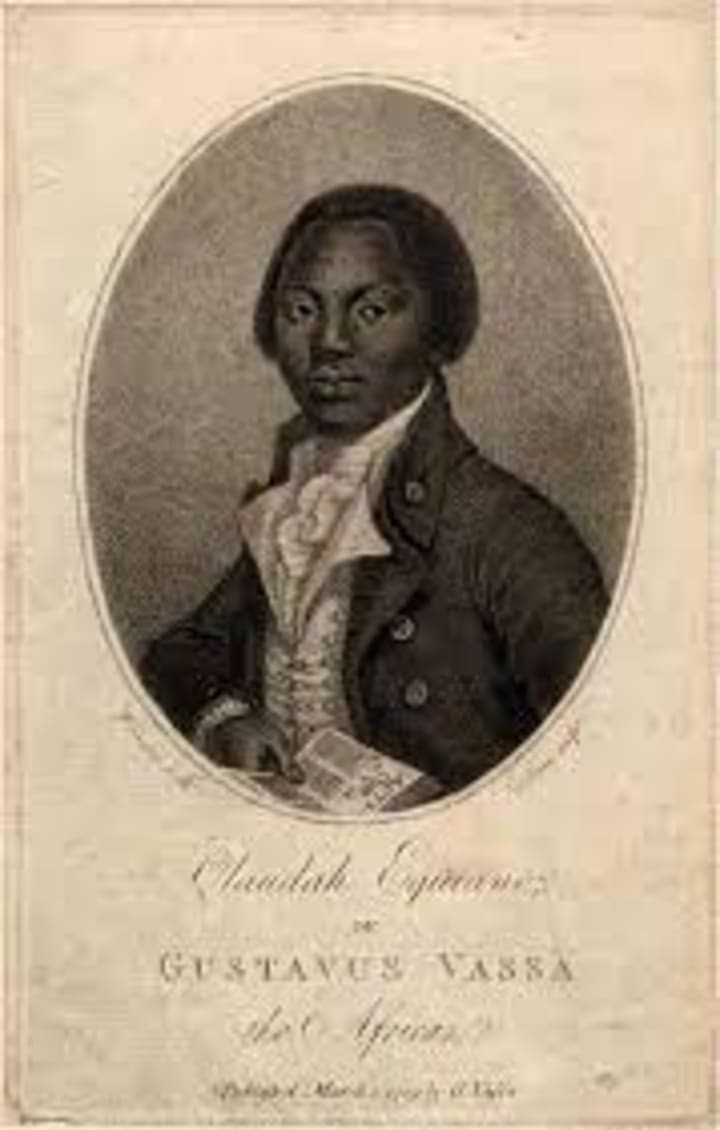
Olaudah Equiana was born in 1745 in what we now call Nigeria.. Around the age of eleven, Equiano was kidnapped and sold to slave traders heading to the West Indies. A brief period was spent in the state of Virginia, but much of Equiano's time in slavery was spent serving the captains of slave ships and British navy vessels. Henry Pascal,one of his masters and the captain of a British trading vessel, gave Equiano the name Gustavas Vassa, which he would use throughout his life, even though he published his autobiography under his African name. In service to Captain Pascal and subsequent merchant masters, Equiano traveled extensively, visiting England, Holland, Scotland, Gibraltar, Nova Scotia, the Caribbean, Pennsylvania, Georgia, and South Carolina. In 1763, He was purchased by Robert King, a Quaker merchant from Philadelphia, for whom he worked as a clerk and on his trading sloops. Equiano, who was allowed to engage in his own minor trade exchanges, saved enough money and purchased his freedom in 1766. In 1767, after settling in England attending school and working as an assistant to scientist Dr. Charles Irving, he briefly was commissary to Sierra Leone for the Committee for the Relief of the Black Poor. Equiano continued to travel, making several voyages aboard trading vessels to Turkey, Portugal, Italy, Jamaica, Grenada, and North America. In 1773 he accompanied Irving on a polar expedition in search of a northeast passage from Europe to Asia. In 1789, Equiano published his autobiography, The Interesting Narrative of the Life of Olaudah Equiano, or Gustavus Vassa, the African, as a two-volume work. It went through one American and nine British editions as well as being translated into Dutch, German, and Russian during his lifetime. Following the publication of his Interesting Narrative, Equiano traveled throughout Great Britain as an abolitionist and author. He married Susanna Cullen in 1792, with whom he had two daughters. Equiano died in London in 1797.

Juanita Harrison was born in 1891 in Columbus, Mississippi. Her formal schooling ended by the time she was ten, at which point she began doing household labor to help support her family. She began her travels at age sixteen, finding employment in Canada and Cuba. During this time she took classes in conversational Spanish and French at the Young Women’s Christian Association, gaining skills that would prove a great asset in her future travels.For the next twenty years Harrison saved her earnings, and at age thirty-six she set out from California, traveling through twenty-two different countries from June 1927 to April 1935. During that time Harrison was involved in the September 10, 1928 Zaječí-Břeclav train accident in Czechoslovakia. Harrison wrote of comforting a young German woman who was mortally injured and died in her arms. She was able to turn her most dangerous experience into profit; she asked for compensation for a black eye and received $200. In France, her employer, Felix Morris, suggested that she write a book about her experiences. Morris’s daughter, Mildred, helped Harrison approach the Macmillan publishing firm, and My Great, Wide, Beautiful World was born. The book was dedicated to Harrison’s employer in Los Angeles, Myra K. Dickinson, and her husband, who helped Harrison invest and save her money to finance her travels. Juanita Harrison’s only book, My Great, Wide, Beautiful World (1936), is one of the earliest examples of autobiographical travel writing by an African American woman..It was rare for an African American writer to accomplish such lofty goals at the height of the Great Depression but Harrison refused to be bound by conventions of gender and race. My Great, Wide, Beautiful World was initially serialized in the March and November 1935 issues of Atlantic Monthly. Its publication in book form in 1936 garnered warm reviews from the New Republic, the Saturday Review of Literature, and the New York Times. The book fell out of print until 1996, when it was reissued with a critical introduction by Adele Logan Alexander as part of Henry Louis Gates Jr.’s series, African American Women Writers, 1910–1940. Harrison died in 1967 and was laid to rest at The Valley of Temples in Oahu.

Lewis Grandison Alexander was an American poet, actor, playwright, and costume designer who lived in Washington, D.C. with strong ties to the Harlem Renaissance. Alexander was born July 4, 1898? 1900?, in Washington D.C. As a child, he was educated in the Washington public school system. Alexander, at the age of 17, began writing poetry and taking a special interest in Japanese forms including haiku, hokku, and tanka becoming one of the few African American poets who did so. Alexander studied at Howard University in Washington D.C. where he was an active member of the Howard Players, before continuing his studies at the University of Pennsylvania. Throughout his career, he was published regularly with other major Harlem Renaissance figures such as Langston Hughes, Gwendolyn Bennett, and Countee Cullen.Alexander also published literary works outside of the United States. Alexander wrote an article on the topic of Japanese hokku that was published, along with two of his poems, in the December 1923 edition of The Crisis. He was published several times in Opportunity: Journal of Negro Life, a popular literary magazine associated with the Harlem Renaissance edited by Charles S. Johnson, from 1925 to 1929. In October 1926, he appeared in a special issue of The Palms, a poetic journal based in Guadalajara, Mexico. This special issue, edited by Countee Cullen included two poems by Alexander, “A Collection of Japanese Hokku” and “Dream Song”.In 1927, Alexander, along with many other poets (most notably Langston Hughes) and writers set out to create a literary quarterly expressing the Black experience in America. Unfortunately, Fire!! only produced one issue due to the burning of the magazine's headquarters. In this one issue, Alexander published two poems: "Little Cinderella" and another short verse entitled "Streets". He died sometime in 1945 but no information has been found stating exactly when.
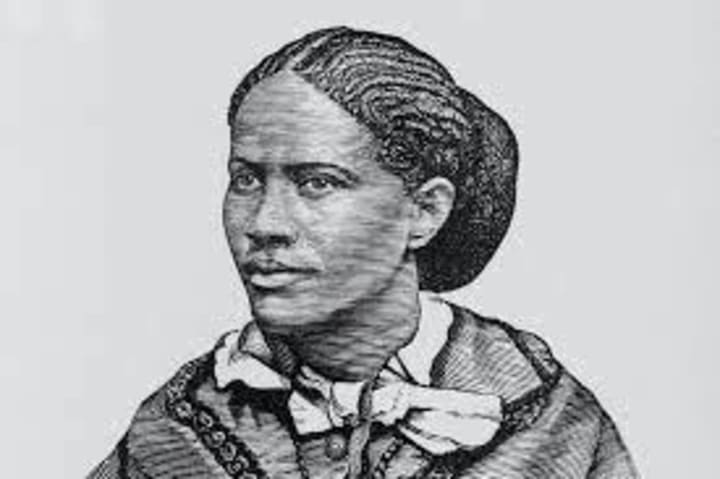
As a poet, author, and lecturer, Frances Ellen Watkins Harper was a household name in the nineteenth century. She was the first African American woman to publish a short story,as well as an influential abolitionist, suffragist, and reformer that co-founded the National Association of Colored Women’s Clubs.
Frances Ellen Watkins Harper was born on September 24, 1825 in Baltimore, Maryland to free African American parents. Unfortunately, by the time she was three years old, both parents died and she was raised by her aunt and uncle. Her uncle was an outspoken abolitionist, practiced self-taught medicine, organized a black literary society and established his own school in 1820 called the Watkins Academy for Negro Youth. Frances Harper learned from her uncle’s activism and she attended the Watkins Academy until she was thirteen years old. She then took a job as a nursemaid and seamstress for a white family that owned a bookshop. Her love for books blossoming with any free time she had in the shop. By age twenty-one, Harper wrote her first small volume of poetry called Forest Leaves. When she was twenty-six years old, Harper left Maryland and became the first woman instructor at Union Seminary, a school for free African Americans in Wilberforce, Ohio where she taught a year before moving to a school in York, Pennsylvania. Unfortunately, her home state of Maryland passed a law stating that free African Americans living in the North were no longer allowed to enter the state of Maryland.Harper was now unable to return to her own home and decided to devote all of her efforts to the antislavery cause. Harper moved in with William and Letitia George Still who were abolitionists and friends of her uncle. Supported by the Stills, Harper began writing poetry for antislavery newspapers. Her poem “Eliza Harris,” was published in The Liberator, and in Frederick Douglass’ Paper. By the time Harper left Philadelphia in 1854, she had compiled her second small volume of poetry called Poems on Miscellaneous Subjects with an introduction by abolitionist William Lloyd Garrison. For the next eight years, Harper traveled across the United States and Canada as a lecturer. After her first speech entitled, “The Elevation and Education of our People,” she was hired as a traveling lecturer for various organizations including the Maine Anti-Slavery Society and the Pennsylvania Anti-Slavery Society. In addition to her antislavery lectures, Harper was committed to the struggle for women’s rights and the temperance movement. She included her observations in her writings and began to publish novels, short stories, and poetry focused on issues of racism, feminism and classism. In 1859, Harper published a short story in the Anglo-African Magazine called “The Two Offers.” This short story about women’s education was the first short story published by an African American woman. On November 22, 1860, Frances married Fenton Harper and the couple had a daughter named Mary, but unfortunately she became a widow four years later. In 1864, Frances Harper began touring again and formed alliances with prominent women’s rights activists. In 1866, Harper spoke at the National Woman’s Rights Convention in New York. Her famous speech entitled, “We Are All Bound Up Together,” urged her fellow attendees to include African American women in their fight for suffrage because they were facing the double burden of racism and sexism at the same time. The next day, the Convention held a meeting to organize the American Equal Rights Association to work for suffrage for both African Americans and women. However, the organization soon split over the decision to support the fifteenth amendment. Harper, along with Frederick Douglass and many others supported the amendment and helped to form the American Woman Suffrage Association. Harper spent the rest of her career working for the pursuit of equal rights, job opportunities, and education for African American women. She was a co-founder and vice president of the National Association of Colored Women’s Clubs, and the director of the American Association of Colored Youth. She was also the superintendent of the Colored Sections of the Philadelphia and Pennsylvania Women’s Christian Temperance Unions. Frances Ellen Watkins Harper died on February 22, 1911 in Philadelphia, Pennsylvania. She was preceded in death by her only child, Mary Frances Harper who died in 1908.
About the Creator
Kia T Cooper-Erbst
Writer, poet, author. submissive. Mom of three wonderful human beings. These are the first things that come to mind when I think of myself besides being the obvious.... which is daughter, wife,etc.
Keep reading
More stories from Kia T Cooper-Erbst and writers in FYI and other communities.
Black entertainers-Actors/ess
Whenever black history is taught in schools we only cover certain topics or even people such as Harriet Tubman, Martin Luther King Jr, and Rosa Parks because they are considered safe to teach about. Slavery is rarely taught and it usually goes straight to the civil rights movement of the 60’s. Black history is more than that because every aspect of American history has been touched and built up on by a black person. Let me introduce to you several people.
By Kia T Cooper-Erbst4 years ago in FYI
Bomb Scare
It was 2027, and the world never thought it would happen. A missle hit the United States, but it wasn't where they had anticipated. A little town in the northeast was hit by a missile strike, they didn't know why, and they didn't know exactly where it hit, but they did know it was a coastal community, somewhere between Maine and Delaware.
By Gregory Payton5 days ago in Fiction


Comments
There are no comments for this story
Be the first to respond and start the conversation.