
Big Eater? These 8 Animals Hunt Prey Larger Than They Are!
Could you swallow something double your size?


Have you ever seen a mukbang or a hotdog eating contest?
Participants in these events might put away a staggering amount of food... but they can't hold a candle to ravenous killers like:
- The Mice That Dine on Albatross
- The Expansive Black Swallower
- The Bat-Eating Amazonian Giant Centipede
- The Whelks That Eat Lobster
- The Frog-Feasting Beetle
- Gans' Egg-Eater
- Haast's Moa-Hunting Eagle
- The Reindeer-Eating Wolverine

The Mice That Dine on Albatross: Kuaihelani (or Midway Atoll) plays host to over a million albatrosses each year - it's the biggest albatross colony in the world, with its isolation making it the perfect nesting ground... or at least it used to be.
Creeping through the undergrowth and burrowing through the base of nests, the humble house mouse (introduced by humans after hiding in cargo) has made a habit of attacking, maiming and even killing these goose-sized birds.
Researchers discovered that the mice were crawling onto the backs of nesting albatrosses, then gnawing into their flesh. For their part, the birds seemed to not know how to respond - they've virtually never had to deal with ground predators before.
This isn't actually a unique situation - similar mice attacks have occurred on Gough Island in the South Atlantic and Marion Island in the Indian Ocean.

The Expansive Black Swallower: The deep sea is home to all kinds of weird (and arguably horrible) creatures, but the black swallower fish doesn't look that strange... until it eats.
Slender and only reaching about 20cm in length, this fish has a stomach that can expand to an extraordinary degree. They can swallow prey twice their size and up to ten times their body mass, grabbing victims by the tail and slowly working their backwards-hooked fangs up the body.
The difficulty of finding prey in the lightless depths makes this a useful talent - it means you can eat almost anything you can sneak up on, but this trick can also doom the fish. Sometimes the consumed prey is so large that it rots before it can be properly digested, filling the stomach of the swallower with gas. The resulting increase in buoyancy can drag it to right to the surface, a trip that this deep sea fish cannot survive.

The Bat-Eating Amazonian Giant Centipede: Reaching 12 inches in length, the Amazonian giant centipede is a specialist bat hunter that takes down prey with a venomous bite. The centipede can climb up the walls of a cave to reach a roosting bat, or hang from the ceiling and snatch unfortunate prey as it flits past.
The centipede is often significantly smaller and lighter than a bat, relying on stealth and venom to secure a catch. Researchers have observed the centipede slowly working its way into prey as it eats - sometimes while the victim is still alive.
Perhaps the most worrying thing about this ambitious arthropod is their interactions with humans. Their venom is dangerous to us (supposedly killing a child in one case) and the centipede has also been seen feeding from a human corpse. Let's hope it never puts two and two together!

The Whelks That Eat Lobster: Did you know that whelks are predatory? Rock lobsters in the waters surrounding Marcus Island on the west coast of South Africa found this out the hard way.
The Marcus and Malgas islands sit in close proximity, but have very different benthic (seafloor) communities. Malgas is dominated by seaweeds and rock lobsters, with the later feeding on mussels and whelks as they try to colonize the area. In contrast, Marcus has extensive mussel beds and a surfeit of whelks, but almost no seaweed or lobsters.
Curious, the researchers transported some lobsters to Marcus to see what would happen... and watched in horror as the whelks swarmed, overwhelmed and consumed the would-be predators. The lobsters were literally hollowed as the whelks injected enzymes through their eyes and shell joints, then sucked out the resulting meat slurry!

The Frog-Feasting Beetle: Did you know that there's a beetle that hunts frogs? Both the Epomis circumscriptus and Epomis dejeani beetles have learned to turn the tables on amphibian predators - though the grubs and adults do it in rather different ways.
The grub hunts using a honey pot scheme. It does everything it can to seem delicious to an amphibian, writhing and waving antennae to get the attention of a "predator." When the tempted amphibian flicks out its tongue, the grub sinks mandibles into the face of its would-be-killer. Even if the grub ends up in a mouth (or in one case, stomach) it soon gets spat back out... and immediately attacks.
Once latched on, a grub siphons off bodily fluids like a leech before chewing the flesh from the weakened host. The adult beetle takes a more direct approach, crawling onto the back of prey like a rodeo and biting into flesh. Researchers suspect that this lets the beetle paralyze the hind legs of an amphibian, rendering it unable to shake the predator off.

Gans' Egg-Eater: While the Gans' Egg-Eater may not be consuming prey bigger than it is, this little snake still manages to eat whole eggs several times larger that its own head. I think that earns it a place on this list.
The snake has a soft mouth containing few teeth, with stretchy skin between the left and right lower jawbones. This allows the snake to engulf whole bird eggs - with the resulting bulge looking like something out of a cartoon.
Once the egg is safely swallowed, the snake starts to contort until the eggshell breaks. As a result, not a single drop of the meal is wasted!

Haast's Moa-Hunting Eagle: The now extinct Haast's eagle lived in New Zealand until around 700 years ago (anecdotal evidence suggests they may have survived a few centuries longer) with researchers believing that it hunted moa - flightless birds that could reach four meters in height and 250 kilograms in weight. That's quite impressive, given that the eagle is thought to have clocked in at around 15 kilograms.
The eagle probably struck the moa with talons to knock it down and stun it, before closing and ripping at the neck with a vicious beak. Since the moa was so big, the hungry raptor gorged itself on internal organs at the kill site rather than trying to lug it away.
What makes this particularly interesting is the fact that humans inhabited New Zealand at the same time as Haast's eagle, at least for a few decades. No only do they seem to feature in contemporaneous Māori cave art, oral tradition suggests they may have hunted humans as well!

The Reindeer-Eating Wolverine: The wolverine is closely related to the weasel and is about as big as the average dog. They normally eat small animals and carrion... but some of them get a bit more ambitious.
Reindeer in contrast, can weigh as much as 250 kilograms. That didn't deter a hungry wolverine from attempting to eat one in 2017 Norway, an event partially captured on video by Nikolai Hagensen Eide.
The wolverine repeatedly grabbed the face and neck of its gargantuan mark, inflicting savage wounds before being thrown clear. It eventually fell back, with Eide suspecting that the reindeer would succumb to the injuries while the wolverine watched and waited.
This isn't some freak, isolated incident either - researchers have found confirmed wolverine kills of adult reindeer (sometimes even finding the predator resting beside the fresh body of the prey.) Apparently the smaller animals run their prey to exhaustion before making the kill!
Thanks for reading - perhaps you'd also be interested in...
Sources and Further Information:
- Pathology of House Mouse (Mus Musculus) Predation on Laysan Albatross (Phoebastria Immutabilis) on Midway Atoll National Wildlife Refuge
- This bizarre ‘black swallower’ balloon fish can eat an insane amount of food
- What's the biggest centipede in the world? Meet the stuff of nightmares, venomous enough to kill a bat - and possibly a small child
- Predator-Prey Role Reversal in a Marine Benthic Ecosystem
- Beetle larva lures and kills frogs, while the adult hunts and paralyses them
- A big gulp for a little snake
- The world's largest eagle hunted unlike any other bird of prey
- Insane blizzard battle: Wolverine vs reindeer in Norway
- Predation on Caribou (Rangifer tarandus) by Wolverines (Gulo gulo) after long pursuits
About the Creator
Bob
The author obtained an MSc in Evolution and Behavior - and an overgrown sense of curiosity!
Hopefully you'll find something interesting in this digital cabinet of curiosities - I also post on Really Weird Real World at Blogspot
Water wells the key of our future
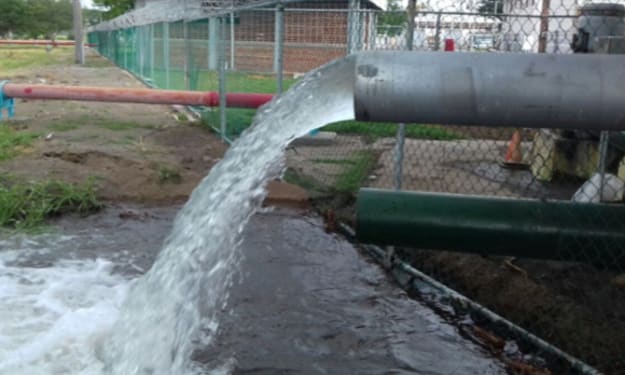
The average lifespan of a water well ranges from 25 to 40 years if it has carbon steel piping. Other steel alloys can increase the well's durability; however, a crucial point is sustainability. This means that over the years, the well continues to provide a constant and sustainable flow of water. To achieve this, it largely depends on the underground aquifers not being overexploited and on the recharge rate being greater than or equal to the extraction volume. However, today most aquifers are overexploited due to the large amount of water extracted each year. Another important factor that will ensure the sustainability of water wells is the periodic maintenance that the user must perform to keep them free of sediment and at their full depth. This includes minimizing corrosion of the steel casing pipe, thus extending its lifespan. Continuous monitoring of static and dynamic water levels in the well is also crucial, as is annual water quality analysis to identify any potential partial or total aquifer contamination.
By Ximena Ramirez2 days ago in FYI



Comments
There are no comments for this story
Be the first to respond and start the conversation.