
3I/ATLAS Impact or Invasion?
The Third Interstellar Visitor and the "Alien Spaceship" Debate

A New Messenger from Beyond
Imagine a cosmic wanderer, an ancient relic from another star system, streaking through our cosmic backyard. That's 3I/ATLAS, and it's got astronomers buzzing – and one Harvard physicist raising eyebrows with an out-of-this-world theory.
Discovered on July 1, 2025, 3I/ATLAS is the third confirmed interstellar object (ISO) to visit our Solar System. Each of these objects is special because it is a direct sample of material from another star system, and 3I/ATLAS has brought with it some perplexing mysteries. Are we merely observing a chunk of ice and rock expelled from a distant planetary system, or could there be something more?
A Brief History of Interstellar Guests

Before 3I/ATLAS, there was 'Oumuamua (2017), the enigmatic first interstellar visitor. Its highly elongated, cigar-like shape, coupled with the absence of a typical cometary coma, ignited the imaginations of scientists and the public alike. Theories abounded, ranging from a fragment of a shattered planet to, most famously, Avi Loeb's suggestion that it could be an alien lightsail. Then came Borisov (2019), the first unambiguous interstellar comet. It behaved much more predictably, sporting a visible coma and tail.
3I/ATLAS joins this exclusive club, further suggesting that these interstellar visitors are more common than we once thought. Do their prevalence challenge our understanding of star system formation and the frequency with which planetary debris is ejected into interstellar space?
Meet 3I/ATLAS: The Speedy, Ancient Comet
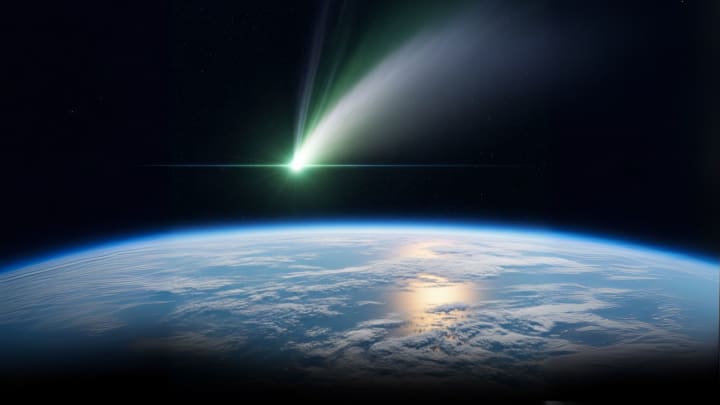
3I/ATLAS was discovered by the ATLAS survey in Chile on July 1, 2025, with some pre-discovery observations found in data from other telescopes. It's classified as a comet, exhibiting cometary activity such as a coma and emissions of dust and gas, even at a considerable distance from the Sun.
This comet is a record-breaker. It is the fastest ISO ever recorded, hurtling through space at speeds up to 68 km/s (152,000 mph!). It's also potentially the oldest comet ever observed, with an estimated age of 7-11 billion years, predating our Solar System. Its origin likely lies within the Milky Way's "thick disk," a region populated by older stars. Initial size estimates were dramatic, suggesting a colossal object of 15-20km. However, Hubble observations have revised this figure, suggesting a more likely size of 0.32-5.6 km (less than 1km most likely).
3I/ATLAS poses no threat to Earth, with its closest approach being ~1.8 AU in December 2025. Perihelion, its closest approach to the Sun, will occur on October 29, 2025, positioning it between Earth and Mars. It will also make close passes to Mars, Venus, and Jupiter. While not visible to the naked eye, 3I/ATLAS offers a tantalizing target for those equipped with large amateur telescopes.
The Elephant in the (Cosmic) Room: Avi Loeb's Theory

Dr. Avi Loeb, a Harvard physicist, has once again stirred the pot with his controversial theories regarding interstellar objects. Why is he so suspicious of 3I/ATLAS?
Loeb points to its seemingly "fine-tuned" trajectory, which aligns surprisingly well with the ecliptic plane and includes close passes to multiple planets (Mars, Venus, Jupiter). He calculates a mere 1 in 20,000 chance for this alignment to be random. Further fueling his suspicion is an anomalous brightness or "glow" observed in front of the object, rather than the typical trailing cometary tail. Loeb speculates that it might be generating its own light, potentially through nuclear power. The initial lack of clear spectral signatures of cometary gas, despite the presence of a coma, further piqued his interest.
These observations have led Loeb to hypothesize that 3I/ATLAS could be an artificial object, perhaps an alien reconnaissance probe or even a "mothership" carrying smaller probes, powered by a nuclear reactor of alien design. He has even proposed the "Loeb Scale" for ranking ISOs from natural rock (0) to definite technology (10), placing 3I/ATLAS at a "four."
However, the broader astronomical community remains highly skeptical, dismissing Loeb's claims as "nonsense" and "irresponsible." Scientists emphasize the comet's consistent cometary activity and propose natural explanations for the observed properties. They also point to Loeb's history of making similar controversial claims about 'Oumuamua. It's important to note that Loeb's paper on 3I/ATLAS is currently a preprint and has not yet undergone peer review.
The Future of Interstellar Object Hunting

The study of 3I/ATLAS continues. Current telescopes like Hubble, the James Webb Space Telescope (JWST), and the Vera C. Rubin Observatory (LSST) are actively observing it. Amateur astronomers also play a role in collecting valuable data. Visibility will resume after its solar conjunction in early December.
An exciting, though challenging, proposal involves repurposing NASA's Juno probe to fly by 3I/ATLAS near Jupiter in March 2026. This would mark a historic first encounter with an interstellar object. ESA's Comet Interceptor mission, slated for launch in 2029, is designed to "loiter" in space, ready to chase down a newly discovered comet or ISO.
The Vera C. Rubin Observatory is expected to revolutionize our understanding of ISOs, potentially discovering dozens annually. This will enable statistical studies and rapid-response missions. Looking further ahead, concepts for dedicated ISO interceptors, such as Project Lyra, and even a lunar optical interferometer for high-resolution imaging are being explored.
A Universe Full of Wonders (and Maybe a Few Surprises)

3I/ATLAS is a fascinating, ancient interstellar comet offering invaluable insights into other star systems. Is it merely a frozen relic, or is there something more?
While the scientific consensus leans towards a natural explanation, the "alien spaceship" theory adds a spicy element of speculation and encourages thorough investigation. Such speculations, while often met with skepticism, serve as a vital reminder to keep an open mind and to challenge our preconceived notions about the universe. These interstellar visitors are cosmic time capsules, pushing the boundaries of our understanding of planetary formation, galactic dynamics, and potentially, life beyond Earth. The universe, after all, has a habit of surprising us. Keep your eyes on the skies – and the headlines!
About the Creator
Francisco Navarro
A passionate reader with a deep love for science and technology. I am captivated by the intricate mechanisms of the natural world and the endless possibilities that technological advancements offer.
Keep reading
More stories from Francisco Navarro and writers in FYI and other communities.
The Eye of Sauron Has Been Found
The Eye of Sauron: From Myth to the Cosmos In J.R.R. Tolkien’s The Lord of the Rings, the Eye of Sauron is more than just a symbol—it is an ever-watchful presence, a flaming orb wreathed in shadow, representing absolute power, surveillance, and the inescapable pull of destiny. Perched atop the dark towers of Mordor, this malevolent gaze sweeps across Middle-earth, unblinking and omniscient, striking fear into all who sense its attention. It is not merely a physical eye, but a manifestation of evil consciousness—an unrelenting force that sees all, senses all, and demands obedience.
By Francisco Navarro7 months ago in FYI
Top 10 Luxury Travel Experiences Around the World for 2026
Luxury travel in 2026 is no longer just about opulence; it’s about immersive, transformative experiences that combine comfort, adventure, and cultural depth. For seasoned travellers seeking something beyond ordinary vacations, the world offers a rich tapestry of unique journeys—from private islands to cultural explorations with personal guides. Below, we explore ten luxury travel experiences that promise exclusivity, personalization, and unforgettable memories.
By All 4 Season4 days ago in FYI


Comments
There are no comments for this story
Be the first to respond and start the conversation.