
Your Smart Fridge Might Testify Against You. Here’s How That’s Legal
Smart Fridge Snitch No Warrant Needed

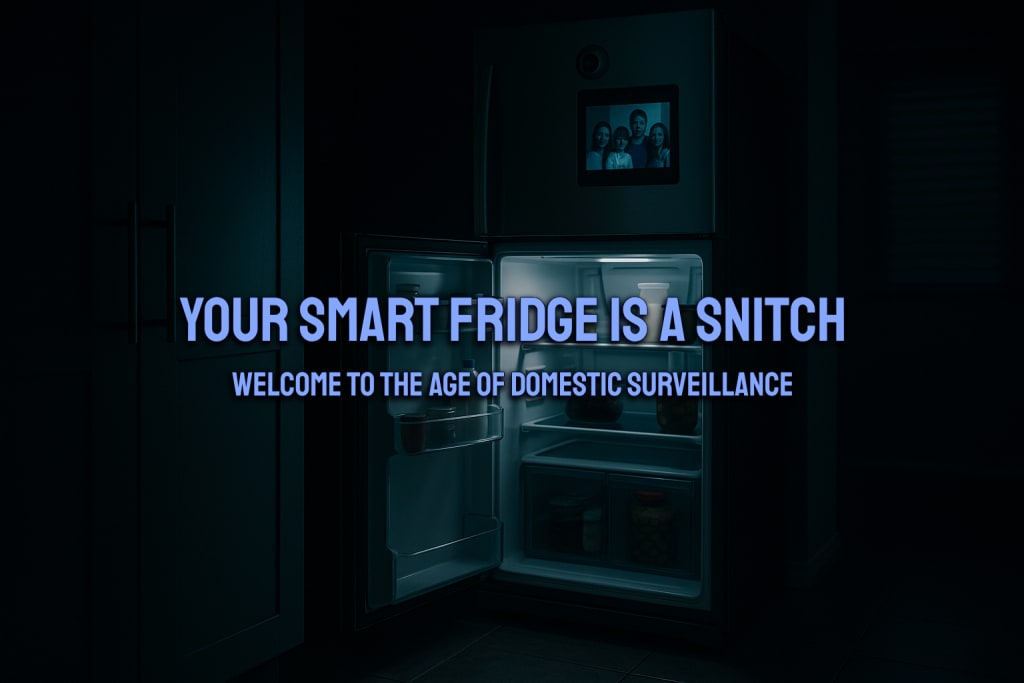
Why Your Smart Fridge Might Testify Against You Someday
You probably didn’t think twice about it when you connected your fridge to Wi-Fi. Maybe you liked the convenience: remote temperature settings, restocking reminders, or the little screen that shows family photos. But under that sleek surface is a machine that never forgets. And someday, it might be the one turning evidence against you.
This isn’t sci-fi. It’s legal precedent in the making.
Your Smart Devices Are Watching
Smart devices, including your fridge, thermostat, TV, and even light bulbs, are collecting real-time data about your behavior. Amazon’s Ring doorbells, Google Nest thermostats, and Samsung’s Family Hub refrigerators aren’t just household brands, they’re quiet informants with corporate handlers.
Samsung’s Family Hub line, for example, includes interior cameras, shopping list logging, screen-based activity tracking, and cloud syncing through its SmartThings ecosystem. According to Samsung’s own privacy policy, data may be shared with third parties, including law enforcement, under legal obligation or in cooperation agreements. [Samsung SmartThings Privacy Policy]
When you open the door. What’s inside. How often you shop. What brands you prefer. Even patterns in how often your freezer door is opened at 2 a.m. That data isn’t just sitting in some local cache. It’s being stored, synced, and in many cases, shipped off to cloud servers owned by tech giants with a long history of sharing information with law enforcement, when asked or when it’s profitable.
Let’s be blunt: you don’t own your smart device’s memory. The company does.
Your Devices Can Testify Against You
And in legal terms, that means you don’t control what it says about you if it’s subpoenaed. This has already happened with smart speakers, where voice logs were handed over in murder investigations. Fitbits and pacemakers have been used in court to contradict alibis, such as in the 2015 Connecticut case where Fitbit data was used to challenge a widow's account of her husband's murder, revealing movement when she claimed to be asleep.
What happens when your fridge becomes the next surprise witness?
In 2023, a leaked partnership memo between a smart home tech provider and a major insurance group revealed exploratory use of appliance interaction data to create behavior-based risk profiles. If it opens and closes at night, what else are you doing? If your diet suggests cardiac risk, does your health premium go up? That’s not surveillance. That’s preemptive judgment.
The Data Marketplace and Profiling
Consider this: a future where prosecutors can pull up your dietary habits to prove lifestyle inconsistencies in an insurance case. Or your smart fridge’s log file used to verify you were home at a specific time. Or worse, to contradict your testimony.
Now imagine the same ecosystem tied to advertising data. In 2022, a Nevada man was denied a life insurance policy after predictive models flagged "inconsistent lifestyle choices" based on smart device and consumer data, including grocery trends. The global smart home surveillance market is already worth over $40 billion, and it’s not slowing down.
Surveillance Is the New Normal
The line between convenience and surveillance is razor thin. And we’ve already stepped over it.
This isn’t about paranoia. It’s about power, specifically the kind you give away when you trade privacy for ease. Tech companies bank on the idea that you’ll accept trade-offs if the device feels helpful enough. But those trade-offs are stacking up. And they’re permanent.
Who’s Watching You? Everyone.
So, who’s actually collecting all this data, and what the hell are they doing with it? The manufacturer? Sure. The data brokers? Absolutely. But how about your home insurance company? Or your employer? If the data ecosystem becomes a marketplace, and it already has, then anything trackable becomes sellable. And your smart fridge doesn’t just monitor you. It makes you legible, sortable, and profiled.
Some people love to say, "If you’ve got nothing to hide, what’s the problem?" That argument misses the point. Surveillance isn’t just about catching wrongdoing. It’s about shaping behavior. When you know you’re being watched, you change. You self-censor. You defer to the system. You stop experimenting, stop rebelling, stop being unpredictable.
The danger isn’t just what your fridge might say. It’s what it silently conditions you to stop doing.
You can’t even use the product you bought unless you agree to surveillance. That’s the bait and switch. You’re not choosing to opt in. You’re being forced to, or else you waste your money. That’s not consent. That’s coercion.
The legal framework hasn’t caught up, but corporations don’t wait for laws. Just look at the unchecked spread of facial recognition tech, or the quiet harvesting of biometric data by apps long before any serious regulation was in place.
This isn’t a glitch in the system. It’s the system working exactly as intended.
They push boundaries. If your smart fridge’s data can be used to infer your lifestyle, your religion, your medical conditions, your relationships, all from what you stock and when, then it becomes a data goldmine. And once it’s out, it’s out forever.
Behavioral Conditioning by Design
Behind the scenes, these systems don’t just record. They judge. Artificial intelligence powers the models that process your habits and assign probability scores to your behavior. Your smart fridge isn’t making guesses; it’s participating in an algorithmic evaluation. Whether it’s your late-night eating pattern, your shopping frequency, or the types of items you buy, machine learning systems are interpreting that data to predict risks, score reliability, and silently flag anomalies. This isn’t just surveillance. It’s automated suspicion.
We’re approaching a future where in-home surveillance isn’t some dystopian nightmare. It’s a default setting, and worse, it’s by design. This isn’t just about convenience or safety anymore. It’s about obedience.
These devices weren’t made to make life easier. They were made to make you easier, to predict, to control, to train. Your smart home is the testing ground for soft behavioral governance. The digital leash doesn’t come with a warning label. It comes with a Wi-Fi signal and a Terms of Service checkbox.
And while you’re asking those questions, ask this too: Why is there no opt-out for any of it? Why are we forced to accept hidden microphones in our televisions, or surveillance cameras in our refrigerators? What rational need does a light bulb have for a microphone? The truth is, it doesn't. Are they voice-activated bulbs? No, they’re not. So why the hell is there a mic in them? These aren’t functional features. They’re surveillance defaults hiding in plain sight. But the system has normalized it so effectively, you’d sound paranoid for objecting.
That’s how deep the conditioning goes.
And maybe you reconsider whether your kitchen really needs to be "smart" at all. Is convenience worth the erosion of personal sovereignty? Are a few saved clicks worth giving a corporation, or a prosecutor, a front-row seat to your private life?
Final Thought: It’s Listening
The truth is, we’re not just training machines to serve us. We’re grooming our own digital informants. What happens when the tools we trusted become the judges of our lives? We’re teaching them to watch us, to learn us, and eventually, to report on us. Your smart fridge isn’t neutral. It’s a witness, a historian, and potentially, a snitch.
So next time you open that door at 2 a.m., just remember, it’s not just light spilling out. It’s evidence. It’s listening. And if that data gets corrupted, misread, or sold off with your name on it?
Congratulations. Your fridge just accused you of a crime you didn’t commit.

About the Creator
MJ Carson
Midwest-based writer rebuilding after a platform wipe. I cover internet trends, creator culture, and the digital noise that actually matters. This is Plugged In—where the signal cuts through the static.
Saudi Arabia Cold Pressed Juices Market: Rising Health Awareness, Clean-Label Beverages and Premium Juice Offerings
The Saudi Arabia cold pressed juices market size was valued at USD 12.1 Million in 2025. Looking forward, IMARC Group estimates the market to reach USD 24.7 Million by 2034, exhibiting a CAGR of 8.28% from 2026-2034.
By Kishan Kumar3 days ago in Futurism
A Signal From Earth
The signal arrived at 02:17 ship time. At first, I assumed it was interference. Out here, space was never silent. It hummed with radiation storms, dying satellites, fragments of old civilizations drifting endlessly through vacuum. The receiver panels aboard the exploration vessel Aurora picked up thousands of meaningless transmissions every day—ghost echoes bouncing through the dark.
By Stephanie Edwards2 days ago in Futurism




Comments
There are no comments for this story
Be the first to respond and start the conversation.