
Fusion for Sale: What Canada’s Mini-Sun Really Means
The Future of Fusion Isn’t Free, It’s Licensed

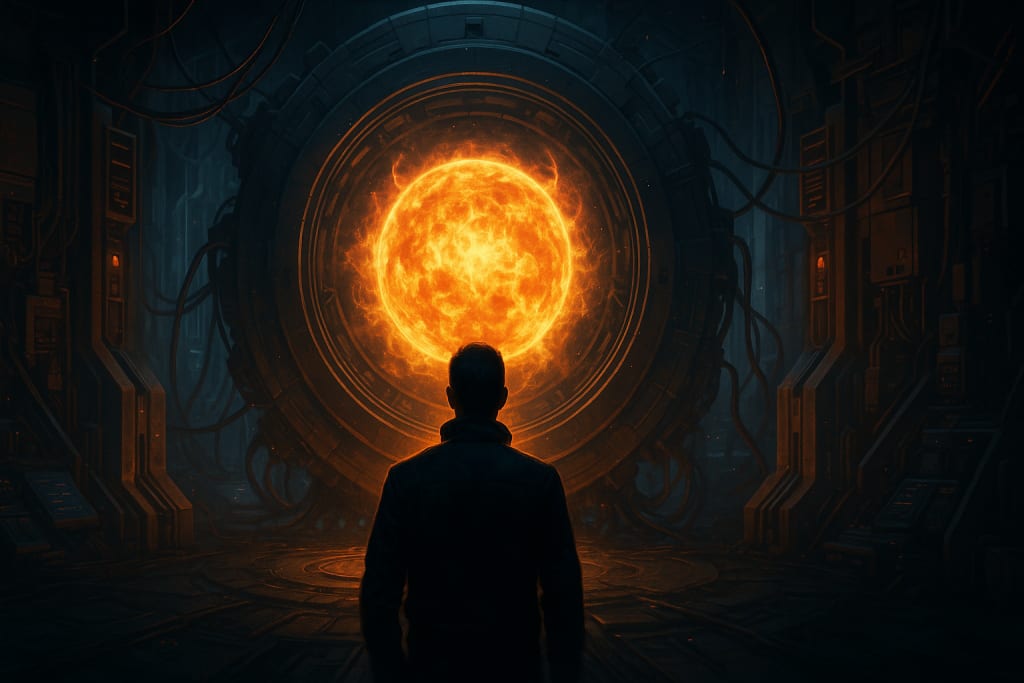
Somewhere in British Columbia, a machine just lit a miniature sun. And nobody’s talking about what happens next.
The Milestone
Before diving into ignition milestones, follow the money. General Fusion isn’t just a Canadian tech startup. It’s backed by a shadowstack of global capital. Amazon’s Jeff Bezos is a primary investor. So are energy funds tied to Canadian pension giants, tech-aligned venture firms, and even foreign sovereign interests. The result? LM26 isn’t just a prototype. It’s a beta test for how private empires might privatize a planetary breakthrough.
On February 28, 2025, General Fusion fired up the LM26, a full-scale prototype reactor built in just 16 months. They hit "first plasma," a key threshold in fusion development, using a process called Magnetized Target Fusion (MTF). The target by year’s end? Sustain ignition at 100 million degrees Celsius. That’s hotter than the core of the sun, and they’re doing it in Richmond, BC.
This isn’t your standard fusion experiment either. LM26 isn’t run by a bloated intergovernmental committee. It’s a hybrid, privately funded with backing from the Canadian government, built to move fast and scale faster. While the rest of the world is still in theory mode, Canada has a glowing plasma ball spinning in a lab.
While legacy media gushed over the science, the implications, geopolitical, economic, and technological, were left to rot in the shadows.
Canada’s Underdog Power Move
Canada wasn’t supposed to win this race. It wasn’t even in the race by most global accounts. But while China, the U.S., and the EU were burning trillions on fusion white elephants, the Canadians just did it. Quietly. Efficiently. In a warehouse not far from the Pacific.
Their model skipped red tape and burned through obstacles. Public-private funding means there’s no UN panel deciding where the energy goes, and no obligation to share the tech. They aren’t bound by NATO treaties or green agenda timelines. They can do what they want, and that’s exactly what should scare everyone else.
The polite neighbor just jumped the line and built a sun. Now they hold the fuse.
The Real Race Isn’t Technical, It’s Economic and Political
And the timeline isn’t theoretical. Industry insiders project that by 2028, Canada could license modular fusion nodes for export, but only to 'aligned' nations or corporate partners. Fusion becomes the new semiconductor: gatekept, sanctioned, strategically priced.
Canada’s tech doesn’t just threaten oil. It threatens the very shape of the world economy. Fusion isn’t just about lighting a star. It’s about controlling what comes next. If Canada controls viable fusion, what’s to stop them from becoming the OPEC of clean power? Or worse, the Microsoft of energy?
Here’s what nobody’s saying out loud: fusion will be paywalled. Not shared. Not free. Not open source.
Imagine your local power supply becomes a subscription service. No access without approval. Cloud-based billing. AI-managed consumption caps. Want to cook dinner during peak hours? Better have credits.
This isn’t theoretical. The model already exists. Software-as-a-service becomes sun-as-a-service.
The Surveillance Layer Nobody’s Talking About
Let’s play it out. You wake up. Your home fusion node pings the cloud. Your usage the night before? Flagged. You ran a space heater past curfew. Your carbon index drops. Your rates tick upward. Your smart oven refuses to preheat. At lunch, your workplace power is throttled. Your social energy credit didn’t replenish. By 2030, your energy usage profile could be tied to health insurance, employment eligibility, even dating algorithms.
Fusion might free us from oil, but it could handcuff us to behavioral algorithms. Fusion isn’t just energy. It’s data. Smart tech already knows your thermostat setting and how often you open your fridge. With fusion, the power supply becomes the surveillance tool. Every outlet becomes an ID point. Every appliance becomes a metric.
Real-time behavior scoring tied to power consumption. Energy access throttled based on ESG compliance, carbon scoring, even social credit models.
Fusion might free us from oil, but it could handcuff us to behavioral algorithms.
Grid Killer Potential
And in that new grid-less world? Not everyone gets a node. Fusion-enabled smart communities may form a new caste system, the plugged-in elite versus the blacked-out rest. Remote areas, indigenous lands, low-income zones? Deliberately deprioritized. Energy apartheid. Quietly enforced by algorithm, not policy.
Control the sun, control the socket. Control the socket, control the citizen. The grid doesn’t need upgraded. It needs a funeral.
Fusion’s biggest threat isn’t to coal or gas. It’s to the grid itself. Decentralized reactors mean the old monopolies die. You don’t need a legacy utility when your campus or town runs its own fusion node. But what replaces them?
Private fusion silos? Corporate-run power enclaves? The tech may decentralize power physically but centralize it politically.
Control the sun, control the socket. Control the socket, control the citizen.
Cold War 2.0: The Plasma Version
Don’t think Canada isn’t aware. Fusion tech is already being buried under export controls. LM26’s core reactor specs are sealed behind IP vaults tighter than AI weapon code. The fusion arms race will be about patents, not bombs. And Canada’s nice-guy persona won’t stop it from playing hardball with licensing, access, and enforcement.
Fusion becomes geopolitical leverage. Not peace, but pressure. The next Cold War won’t be about missiles. It will be about who controls the sun. This isn’t just Canada lighting up a reactor. It’s Canada flipping the board.
China won’t tolerate it. Neither will the U.S. Europe is too slow to keep up. What’s next is a fusion arms race. Sabotage, cyberwarfare, patent lockouts. Expect lawsuits. Expect stolen data. Expect diplomats smiling through gritted teeth while spies sniff reactor blueprints.
Fusion becomes geopolitical leverage. Not peace, but pressure. The next Cold War won’t be about missiles. It will be about who controls the sun.
Final Thought
Fusion isn’t the end of energy dependence. It’s the start of something more invisible, more absolute.
We thought the fusion race was about beating the climate clock. But it might be about who gets to pull the plug, and who has to beg to keep the lights on.
They didn’t light a prototype. They lit a fuse.
If they can build a sun in a box, they can build a leash in your wall outlet.
The New Empire: Fusion as Governance
This isn’t just a new energy source. It’s a new operating system for civilization. Fusion nodes aren’t just reactors. They’re enforcement mechanisms. Embedded compliance hubs. You won’t need laws or force when access to power itself becomes the gatekeeper.
Forget national borders. The new control grid won’t care about flags. It will care about credentials. Energy isn’t just a commodity in this model. It’s a permission structure. You’ll be judged not on your citizenship, but on your energy profile: compliant, efficient, aligned. Or throttled, penalized, blacked out.
Fusion will be sold as a climate triumph. But it will function as a planetary filter. A clean, quiet way to sort who gets to thrive, and who stays in the dark.
It’s not just about power. It’s about permission. It’s not just about innovation. It’s about control at the molecular level of modern life.
And if we don’t draw the line now, the sun they built won’t shine for everyone. It will blind us all to the system being installed behind the glow. We thought the fusion race was about beating the climate clock. But it might be about who gets to pull the plug, and who has to beg to keep the lights on.
They didn’t light a prototype. They lit a fuse.
If they can build a sun in a box, they can build a leash in your wall outlet.
About the Creator
MJ Carson
Midwest-based writer rebuilding after a platform wipe. I cover internet trends, creator culture, and the digital noise that actually matters. This is Plugged In—where the signal cuts through the static.
I Launched a ChatGPT-Agent Side Project on Product Hunt After 24 Hours of Building
A 24-hour ChatGPT-agent sprint sounds romantic until you're twelve hours in, your API keys keep failing, your “MVP” has no onboarding, and you’re staring at the Product Hunt launch form wondering if you’re about to embarrass yourself in public.
By abualyaanart4 days ago in Futurism
Behind the Scenes of AI Innovation: The Role of LLM Development Companies
Artificial Intelligence (AI) is rapidly transforming the global digital landscape. From intelligent chatbots and automated content generation to smart customer support systems, AI is helping businesses operate more efficiently than ever before. At the heart of this transformation are Large Language Models (LLMs), advanced AI systems capable of understanding and generating human-like text. However, the innovation we see in AI-powered applications is not created overnight. Behind the scenes, specialized experts and organizations provide LLM development services that design, train, and deploy these powerful AI models.
By Celine Dion7 days ago in Futurism




Comments
There are no comments for this story
Be the first to respond and start the conversation.